Payroll Management for Part-Time and Flexible Workers in Saudi Arabia
Payroll Management for Part-Time and Flexible Workers in Saudi Arabia
Managing payroll for part-time and flexible workers in Saudi Arabia requires employers to look beyond the standard monthly salary model. Working hours, employment contracts, overtime, leave, social insurance, deductions, and statutory requirements may need to be handled differently depending on the worker's employment arrangement.
As businesses increasingly use flexible staffing models across retail, hospitality, logistics, technology, professional services, and other sectors, payroll teams need systems that can accurately capture hours worked and apply the correct employment and payroll rules.
A structured payroll process helps employers maintain accurate salary calculations, employee records, and statutory compliance while giving workers greater flexibility.
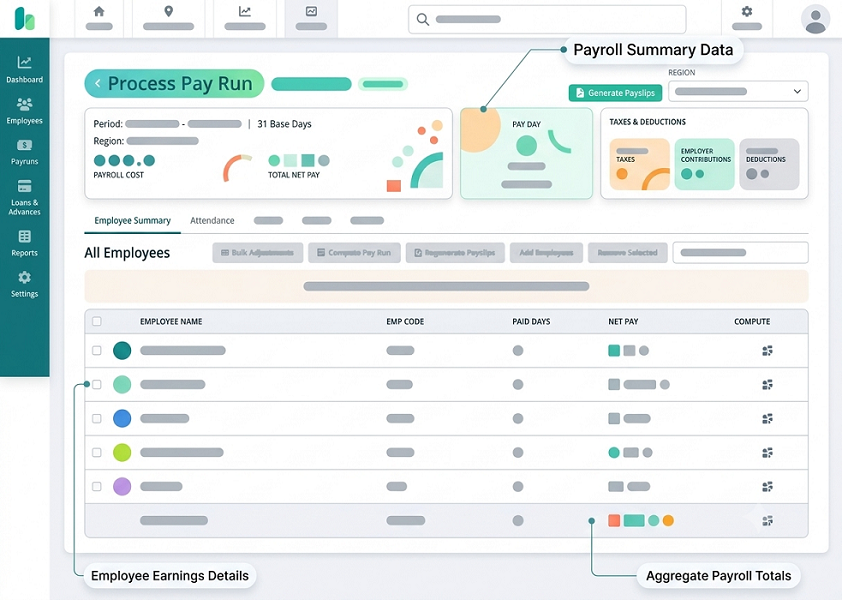
What Are Part-Time and Flexible Workers?
Part-time employment generally involves an employee working fewer hours than a comparable full-time worker under an employment arrangement that meets applicable Saudi Arabia requirements.
Flexible work can cover different working arrangements, depending on the applicable employment framework and the nature of the relationship.
Examples can include:
- Part-time employees
- Employees working variable schedules
- Shift-based employees
- Seasonal workers
- Employees with flexible working arrangements
- Employees working different hours across different periods
Employers should not assume that every worker with a reduced or variable schedule is automatically classified in the same way. The employment relationship and applicable Saudi Arabia regulations should be reviewed before payroll processing.
Why Payroll for Flexible Workers Is Different
Traditional payroll systems often assume:
Fixed salary + fixed working days + fixed working hours
Flexible payroll may instead require:
Contract terms + scheduled hours + actual hours + attendance + applicable overtime + leave + statutory deductions
For example, a part-time employee may be paid based on agreed working hours, while another employee may receive a salary under a different contractual arrangement.
Payroll teams therefore need employee-specific rules rather than applying one calculation method to everyone.
Start With the Employment Contract
The employment contract should be the foundation of payroll processing.
HR and payroll teams should verify:
- Employee classification
- Job title
- Working hours
- Working schedule
- Wage or salary
- Payment frequency
- Contract duration
- Overtime arrangements
- Leave entitlement
- Other applicable benefits
- Applicable deductions
The payroll system should reflect the actual contractual arrangement.
If the contract states a specific number of hours or a particular payment structure, payroll should be configured accordingly.
Register Employees Correctly
Before processing payroll, employers should ensure that employee information is correctly maintained in the relevant systems.
Important information can include:
- Employee identification details
- Nationality
- Employment type
- Contract information
- Working hours
- Salary
- Bank information
- Attendance
- Leave
- Social insurance information where applicable
Accurate employee classification is particularly important for flexible workers because payroll calculations can depend on the agreed working arrangement.
Calculate Pay Based on the Applicable Arrangement
Payroll teams should determine how the employee's wage is calculated according to the contract and applicable Saudi Arabia requirements.
Possible structures can include:
Hour-Based Pay
The employee receives pay based on eligible hours worked.
Example: Agreed hourly rate × eligible hours worked
Daily-Based Pay
Where permitted and contractually applicable, pay may be calculated based on eligible working days.
Fixed Part-Time Salary
An employee may receive an agreed salary for a defined part-time schedule.
Variable Pay
Some flexible workers may have commissions, incentives, or other variable compensation.
The payroll system should support the relevant calculation rather than automatically converting every worker to a standard monthly salary.
Track Actual Working Hours
Attendance is particularly important for part-time and flexible workers.
Payroll teams should capture:
- Clock-in
- Clock-out
- Scheduled hours
- Actual hours
- Breaks
- Approved overtime
- Absences
- Leave
- Holidays
- Shift changes
An attendance-management system integrated with payroll can automatically transfer approved attendance data into the payroll calculation.
Use a Flexible Schedule
Flexible workers may not follow a traditional Monday-to-Friday schedule.
A payroll and attendance system should support:
- Different shift patterns
- Variable weekly schedules
- Split shifts
- Weekend work
- Rotating shifts
- Different start times
- Different end times
- Multiple work locations
This reduces the need for manual spreadsheet calculations.
Overtime Management
Overtime should not simply be calculated as any hours exceeding an employee's scheduled time.
Payroll teams should first determine whether the additional hours qualify as overtime under the applicable Saudi Arabia employment rules and whether the work was properly authorized.
The system should record:
Scheduled hours → Actual hours → Approved additional hours → Applicable overtime calculation
This creates a clearer audit trail.
Example of Hour Tracking
Suppose a part-time employee is scheduled for: 20 hours per week
During one payroll period, the employee records:
- Scheduled hours: 80
- Actual hours: 86
- Approved additional hours: 6
Payroll should not automatically classify all six additional hours as overtime without checking the employee's contract and applicable legal rules.
The payroll administrator should review the applicable treatment before processing the payment.
Attendance and Payroll Integration
Manual data entry creates a risk of payroll errors.
An integrated system can move information through the following workflow:
Employee schedule → Attendance capture → Manager approval → Payroll calculation → Payroll review → Salary payment
This can reduce duplicate data entry.
Managing Shift-Based Flexible Workers
Retail, hospitality, restaurants, logistics, and other industries frequently use shift-based staffing.
A flexible workforce may include:
- Morning shift
- Evening shift
- Weekend shift
- Rotational shift
- Seasonal shift
- Holiday coverage
Payroll software should connect each employee's approved shift schedule with actual attendance.
This helps payroll teams distinguish between:
- Scheduled work
- Late arrival
- Early departure
- Absence
- Approved additional hours
- Leave
Leave Management
Part-time employees should not simply be assigned the same leave calculation as every full-time employee without reviewing the applicable employment arrangement and Saudi Arabia requirements.
HR should maintain:
- Leave type
- Leave entitlement
- Leave taken
- Leave balance
- Approved dates
- Payroll impact
Leave rules should be configured according to the applicable legal and contractual requirements.
Public Holidays and Rest Days
Flexible workers may have schedules that differ from standard office employees.
Payroll teams should identify:
- Employee's normal work schedule
- Scheduled rest days
- Public-holiday work
- Approved additional work
- Applicable compensation
The payroll system should use the employee's actual schedule rather than assuming that every employee works the same days.
Social Insurance Considerations
Saudi Arabia payroll teams should also consider applicable social insurance requirements.
The treatment of an employee can depend on factors such as:
- Nationality
- Employment status
- Wage
- Registration
- Applicable GOSI rules
- Type of employment arrangement
Employers should ensure that employee records and payroll calculations are aligned with the current requirements of the General Organization for Social Insurance (GOSI).
Payroll software should allow statutory deductions and employer contributions to be configured according to the applicable rules rather than using one universal percentage for every worker.
Payroll Deductions
Payroll deductions should be handled carefully.
Before applying a deduction, payroll teams should determine:
- Reason for deduction
- Contractual or legal basis
- Employee records
- Applicable limits
- Required approvals
- Payroll-period impact
Examples can include authorized deductions or other deductions permitted under applicable Saudi Arabia employment rules.
Flexible workers should not be subjected to arbitrary deductions simply because they work fewer hours.
Salary Payment and Payroll Records
Employers should maintain accurate payroll records for every employee.
For flexible workers, payroll records should clearly show:
- Employee
- Payroll period
- Contractual arrangement
- Salary or rate
- Hours worked where relevant
- Approved overtime
- Allowances
- Deductions
- Statutory contributions
- Net pay
The payroll system should preserve sufficient records to explain how the final amount was calculated.
Wage Protection System Considerations
Employers subject to the Saudi Arabia Wage Protection Program should ensure that payroll records and salary payments are properly aligned with applicable requirements.
Payroll teams should reconcile:
Payroll register → Approved salary → Bank payment → Wage Protection reporting
Differences between payroll records and actual salary payments should be investigated promptly.
The exact reporting and submission requirements should be verified through the applicable Saudi Arabia government systems and current procedures.
Flexible Workers and Saudization
Workforce planning should also consider whether flexible or part-time employees fall within applicable Saudization calculations.
Employers should not assume that every employee automatically counts in the same way toward Saudization requirements.
The treatment can depend on factors including:
- Employment type
- Profession
- Salary
- Contract
- Establishment
- Applicable localization decision
HR should therefore review the latest Ministry of Human Resources and Social Development requirements when designing flexible staffing models.
Managing Saudi Arabia and Non-Saudi Arabia Flexible Workers
Payroll systems should maintain nationality and employment information accurately.
For Saudi Arabia employees, employers may need to consider applicable:
- GOSI treatment
- Saudization requirements
- Employment contracts
- Wage requirements
For non-Saudi Arabia employees, employers may need to consider:
- Work authorization
- Iqama
- Work permit
- Contract
- Applicable social insurance treatment
- Other immigration-related requirements
These factors should be maintained separately from the attendance calculation.
Managing Multiple Pay Rates
Some businesses may have different rates for different shifts, assignments, or roles.
| Work Type | Rate |
|---|---|
| Standard shift | Contract rate |
| Approved additional hours | Applicable overtime treatment |
| Special assignment | Contractually applicable rate |
| Commission | Applicable commission plan |
Payroll software should prevent unauthorized rate changes and maintain an audit trail.
Managing Seasonal Workers
Retail, hospitality, tourism, events, and logistics companies may experience seasonal demand.
Businesses can use temporary or flexible staffing to handle:
- Holiday demand
- Tourism seasons
- Promotional periods
- Events
- Peak shopping periods
- Temporary projects
Before onboarding seasonal workers, HR should define:
- Contract duration
- Working schedule
- Pay arrangement
- Attendance method
- Leave treatment
- Payroll cycle
- End date
This allows payroll to automatically identify employees whose contracts are approaching completion.
Flexible Workers Across Multiple Locations
Businesses with branches in Riyadh, Jeddah, Dammam, Makkah, Madinah, and other locations may need employees to work across different sites.
Payroll and attendance software can track:
- Employee
- Branch
- Location
- Shift
- Hours
- Attendance
- Payroll allocation
This is particularly useful for retail chains, restaurant groups, logistics companies, and service businesses.
Managing Remote and Hybrid Workers
Some professional and technology businesses may have employees working remotely or under hybrid arrangements.
Payroll teams should maintain clear records of:
- Work schedule
- Attendance requirements
- Approved remote work
- Leave
- Overtime
- Location where relevant
- Contract terms
Attendance technology should collect only information necessary for legitimate business and compliance purposes.
Privacy Considerations
Flexible-workforce systems can collect substantial employee data.
Depending on the technology used, information may include:
- Attendance records
- Location information
- Device information
- Employee identification
- Work schedules
- Leave records
Saudi Arabia's Personal Data Protection Law (PDPL) should be considered when processing employee personal data.
Employers should apply appropriate safeguards, including:
- Purpose limitation
- Access controls
- Data security
- Data minimization
- Retention controls
- Appropriate employee information and notices
- Secure sharing
Location tracking should be used carefully and only where justified by the organization's legitimate requirements and applicable law.
Payroll Approval Workflow
A good flexible-payroll process can follow this structure:
Step 1: Employee Schedule
HR or the manager assigns the approved schedule.
Step 2: Attendance Capture
The employee records working time.
Step 3: Attendance Review
The manager verifies attendance exceptions.
Step 4: Overtime Approval
Additional hours are reviewed and approved where applicable.
Step 5: Payroll Calculation
Payroll calculates salary, deductions, contributions, and other components.
Step 6: Payroll Review
Payroll administrators verify unusual results.
Step 7: Salary Processing
Approved payroll is processed through the applicable payment process.
Step 8: Record Keeping
Payroll records are retained securely.
Use Payroll Software for Flexible Workers
Payroll software can simplify flexible-worker management through:
Attendance Integration
Automatically import approved hours.
Shift Management
Create different schedules for different employees.
Automated Calculations
Apply configured payroll rules.
Overtime Tracking
Track approved additional working hours.
Leave Integration
Connect approved leave with payroll.
Employee Self-Service
Allow employees to view schedules, attendance, and payslips where available.
Manager Approval
Managers can approve attendance and overtime.
Payroll Reports
Generate payroll registers and variance reports.
Audit Trail
Track changes to attendance, rates, and payroll data.
Frequently Asked Questions
Can part-time employees be included in Saudi Arabia payroll?
Yes. Employers can employ part-time workers, but the employment arrangement, contract, working hours, wage, statutory treatment, and other applicable requirements should be correctly established and maintained.
How should payroll calculate part-time salaries?
The calculation depends on the employee's contract and applicable employment rules. It may be based on an agreed salary, working hours, or another permitted compensation structure.
Should part-time employees use attendance software?
Attendance software can be particularly useful for part-time workers because payroll may depend on scheduled and actual working hours.
How can companies manage flexible workers across several branches?
A centralized HR and payroll platform can maintain employee schedules, attendance, branch assignments, approved additional hours, leave, and payroll information in one system.
Does flexible work remove payroll compliance requirements?
No. Flexible working arrangements do not automatically remove applicable employment, wage-payment, social insurance, contract, or statutory obligations.
Can payroll software calculate wages based on attendance?
Yes. Where the applicable employment arrangement permits attendance-based calculations, software can import approved working hours and use them in payroll calculations.
How should overtime for part-time workers be handled?
Payroll teams should determine whether additional hours qualify as overtime under the employee's contract and applicable Saudi Arabia employment requirements before applying an overtime calculation.
Should flexible workers be included in Saudization planning?
Employers should assess each worker according to the applicable Saudization rules, profession, contract, salary, and establishment requirements. Flexible status alone should not be assumed to determine whether an employee counts.
Conclusion
Payroll management for part-time and flexible workers in Saudi Arabia requires accurate employee classification, clear contracts, reliable attendance records, appropriate wage calculations, and careful handling of statutory requirements.
The most effective approach is to connect HR, attendance, scheduling, leave, payroll, and workforce-management data rather than maintaining separate manual records.
A practical workflow is:
Contract → Schedule → Attendance → Approval → Payroll Calculation → Statutory Review → Payment → Reporting
With automated payroll and attendance software, employers can manage variable schedules more efficiently, reduce manual calculations, improve payroll accuracy, and maintain better visibility across branches and flexible workforces.
Part-time and flexible payroll becomes more reliable when InnBuilt Payroll Software converts approved hours, shifts, leave, and overtime into structured payroll inputs for Saudi Arabia employers.