How Does Live Employee Tracking Differ From Visit Check-Ins in Singapore?
How Does Live Employee Tracking Differ From Visit Check-Ins in Singapore?
Introduction
Businesses in Singapore that manage field employees often need to know where their teams are, which customer locations they have visited and whether assigned work has been completed. Companies in facilities management, construction, sales, maintenance, healthcare services and delivery operations may use digital tools to improve workforce visibility and coordinate daily activities.
Two commonly used approaches are live employee tracking and visit check-ins. Although both can use GPS technology, they serve different operational purposes.
Live employee tracking provides ongoing or periodic location information about an employee's device during an authorised monitoring period. Visit check-ins, on the other hand, record specific events when an employee arrives at or leaves a designated location.
Understanding this difference helps businesses choose the right technology, establish appropriate employee monitoring policies and avoid collecting more location information than necessary.
This article explains how live employee tracking differs from visit check-ins, their benefits, limitations and privacy considerations for Singapore businesses.
1. Understanding Live Employee Tracking
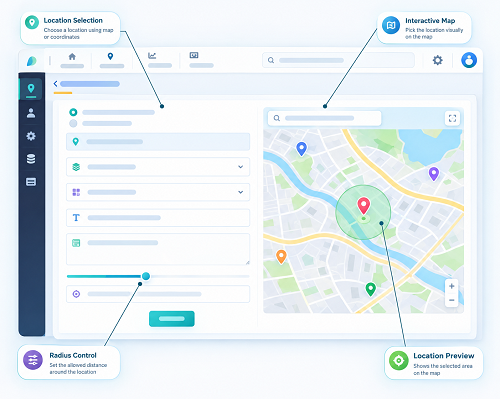
Live employee tracking uses GPS-enabled smartphones, mobile applications or dedicated tracking devices to provide information about an employee's location while tracking is active.
Depending on the software configuration, managers may see an employee's current or last-known location, movement history and travel between assigned locations.
Typical features include:
- Real-time or periodic GPS location updates.
- Employee movement and location history.
- Route and journey monitoring.
- Geofencing alerts.
- Travel distance and duration reports.
- Employee deployment visibility.
- Location-based notifications.
- Supervisor dashboards.
For example, a facilities management company may deploy technicians to several commercial buildings across Singapore. A supervisor can use live tracking to understand which technicians are travelling, which are near a customer location and which may be available for another assignment.
Live tracking is particularly useful when managers need visibility throughout the working day rather than confirmation of individual site visits.
However, the level of visibility depends on the tracking frequency, mobile network availability, GPS signal, device settings and software permissions.
2. Understanding Visit Check-Ins
Visit check-ins record an employee's arrival at or departure from a particular location.
Instead of continuously monitoring movement, the system captures specific events when an employee checks in or checks out through a mobile application, QR code, NFC tag, location-based feature or another approved method.
Common visit check-in features include:
- GPS-verified arrival records.
- Customer or site check-ins.
- Check-out timestamps.
- QR code scanning.
- NFC-based verification.
- Customer visit history.
- Visit duration calculations.
- Visit completion notes.
- Photograph or document uploads.
- Supervisor approval of visit records.
For example, a sales representative visiting customers in Orchard, Raffles Place and Tampines can record each visit through the company's mobile application.
The system stores the location, time and relevant visit details without necessarily tracking the employee continuously between appointments.
Visit check-ins are particularly useful for sales teams, field service employees, inspectors and representatives whose work involves visiting specific locations.
3. Key Differences Between Live Employee Tracking and Visit Check-Ins
Both methods provide location-related information, but their coverage, purpose and data collection requirements are different.
| Comparison area | Live employee tracking | Visit check-ins |
|---|---|---|
| Main purpose | Monitor employee location during an authorised period | Record arrival or departure at specific locations |
| Location updates | Continuous or periodic, depending on settings | Captured at defined check-in or check-out events |
| Movement visibility | Can show movement between locations | Generally does not show the complete journey |
| Data collection | May generate frequent location records | Usually generates individual visit records |
| Route monitoring | Can support route and journey history | Usually requires a separate feature |
| Site verification | May use geofencing and location alerts | Can verify a recorded site visit |
| Employee interaction | May operate automatically after authorised activation | Usually requires an employee action or scanning process |
| Reporting | Movement, distance and location history | Visit time, location, duration and completion status |
| Typical users | Dispatchers, operations managers and fleet supervisors | Sales managers, service supervisors and field team leaders |
| Privacy considerations | Requires careful control of tracking periods and access | Generally involves more limited location collection |
The most important distinction is that live tracking focuses on an employee's location over time, while visit check-ins focus on specific attendance or visit events.
4. Compare How Each Method Collects Location Data
The method of collecting location information is one of the biggest differences between these approaches.
Live employee tracking
Live tracking applications may collect GPS coordinates at regular intervals while tracking is enabled. The system can display the employee's current or last-known location and store permitted movement history.
For example, a maintenance technician may travel from the company's office to three customer locations. The tracking platform may record the journey between these destinations, depending on its configuration.
Visit check-ins
Visit check-in systems generally collect location information when an employee performs a check-in or check-out action.
For example, a technician may arrive at a customer's premises, open the mobile application and check in. The application records the visit time and location. The employee checks out after completing the assignment.
The system may not collect information about the employee's route between customer locations.
What Singapore businesses should consider: If the main requirement is to verify customer visits, event-based check-ins may provide sufficient information. If managers need to coordinate employees throughout the working day, live tracking may be more suitable.
5. Compare Their Use Cases Across Singapore Industries
Different industries have different workforce visibility requirements. The appropriate method depends on how employees perform their daily duties.
| Industry | Live employee tracking use case | Visit check-in use case |
|---|---|---|
| Sales and marketing | Monitor travelling representatives during authorised work periods | Record customer meetings |
| Facilities management | Coordinate mobile maintenance and cleaning supervisors | Confirm attendance at assigned buildings |
| Construction | Monitor authorised movement of mobile teams between project sites | Record arrival at specific project locations |
| Healthcare services | Coordinate mobile care or service personnel where appropriate | Record visits to approved patient or customer locations |
| Field maintenance | Identify available technicians and coordinate urgent jobs | Record service arrival and completion |
| Inspection services | Monitor inspectors travelling between locations | Record inspection visits and supporting evidence |
| Delivery operations | Monitor vehicles and delivery personnel | Record delivery arrival and completion |
| Security services | Coordinate mobile patrol teams | Record checkpoint visits and patrol events |
For example, a sales organisation may not need continuous location monitoring if its primary requirement is to confirm that representatives attended scheduled customer meetings.
A maintenance company handling urgent service requests may benefit more from live location visibility because dispatchers need to identify available technicians and allocate new assignments.
6. Compare Attendance Verification and Work Records
Live tracking and visit check-ins can support attendance management, but neither should automatically be treated as a complete record of working hours.
A location record may show where an employee's device was at a particular time. It does not necessarily prove when the employee started work, completed work or performed all assigned duties.
Similarly, a visit check-in confirms that an event was recorded at a particular location. It does not independently establish the full duration or quality of the work performed.
Businesses should evaluate whether their system can record:
- Employee identity.
- Work date.
- Start and end times.
- Approved working hours.
- Location of check-in.
- Visit or job reference.
- Break periods, where relevant.
- Supervisor approvals.
- Corrections and exceptions.
For Singapore employers covered by the Employment Act's recordkeeping requirements, MOM specifies employee records that include working hours and details of public holidays and leave taken. Salary records include relevant payment and deduction information. Location histories alone do not replace these records.
MOM's guidance also explains that employers must retain the latest two years of records for current employees and the last two years of records for former employees for one year after they leave.
What businesses should consider: If the main objective is attendance and payroll preparation, use a suitable attendance management system with verified working-hour records. Tracking and visit records can provide supporting operational information.
7. Compare Route Visibility and Travel Management
Live tracking can provide information about employee movement between work locations, making it useful for route monitoring and field deployment.
Visit check-ins generally record arrival and departure events but may not show the complete journey between locations.
Live tracking capabilities
- Current or last-known employee location.
- Journey history.
- Travel distance and duration.
- Route deviation alerts, where supported.
- Location-based deployment.
- Estimated arrival information, where supported.
Visit check-in capabilities
- Customer visit timestamps.
- Site arrival and departure records.
- Visit sequence.
- Visit duration.
- Customer location verification.
- Visit completion history.
For example, a company with technicians travelling between several customer premises may use live tracking to identify the nearest available employee for an urgent repair.
A sales company may only need visit check-ins to confirm that its representatives completed scheduled appointments.
What businesses should consider: Choose live tracking when travel visibility is important. Choose visit check-ins when the priority is confirming individual site visits.
8. Compare Employee Experience and Mobile Application Requirements
The employee experience can influence whether a tracking system is adopted successfully.
Live tracking may operate automatically during authorised monitoring periods after employees grant the required device permissions and tracking is activated. Employees may not need to perform a separate action for every location update.
Visit check-ins usually require employees to interact with the application or another verification method when arriving at a site.
Check the following:
| Employee experience factor | Live tracking | Visit check-ins |
|---|---|---|
| Employee action | May require initial activation or permission | Usually requires check-in or scanning |
| Battery consumption | Can be higher depending on update frequency | Usually lower due to event-based capture |
| Mobile data usage | Depends on tracking frequency | Usually limited to check-in events and related uploads |
| GPS permissions | Required for location-based tracking | Required when GPS verification is used |
| Employee training | Focus on tracking settings and policies | Focus on check-in and check-out procedures |
| Offline handling | Depends on device and platform capabilities | May allow records to be stored and synchronised later |
For example, a field technician may prefer an application that automatically records authorised location updates while allowing the employee to check in manually at each customer location.
Businesses should test both approaches on the actual mobile devices used by their employees.
9. Compare Reporting and Management Dashboards
The reporting requirements for live tracking and visit check-ins are also different.
Live tracking reports generally focus on employee movement, location history and deployment efficiency.
Visit check-in reports focus on customer visits, site attendance and task completion.
Live tracking reports
- Employee location history.
- Travel distance and duration.
- Movement between locations.
- Time spent at different sites, where configured.
- Route deviation records.
- Employee deployment reports.
- Location-based alerts.
Visit check-in reports
- Number of visits completed.
- Customer visit history.
- Arrival and departure timestamps.
- Visit duration.
- Missed or incomplete visits.
- Customer-wise visit summaries.
- Visit completion evidence.
For example, an operations manager may use live tracking reports to review how employees are deployed across different parts of Singapore.
A sales manager may use visit check-in reports to compare scheduled customer appointments with completed visits.
What businesses should consider: Review whether the platform provides separate dashboards for location monitoring, attendance and visit management. Check whether reports can be filtered by employee, team, customer, location and date.
10. Understand Privacy and PDPA Considerations
Privacy is an important consideration when implementing employee location technology in Singapore.
Live employee tracking may collect more detailed location information than visit check-ins because it can record movement over an extended period.
Visit check-ins generally collect more limited information tied to specific work events. However, they still involve personal data when the location and visit record can be linked to an identifiable employee.
Businesses should consider their obligations under Singapore's Personal Data Protection Act (PDPA).
The PDPC's advisory guidelines explain that organisations may collect, use or disclose employee personal data without consent where it is reasonable for the purpose of managing or terminating the employment relationship. However, employers must notify employees of the purposes for which their personal data is collected, used or disclosed.
Important safeguards include:
- Explain the purpose of employee location monitoring.
- Inform employees about the data being collected.
- Define when tracking will operate.
- Restrict access to authorised personnel.
- Protect location records against unauthorised access.
- Establish appropriate data retention periods.
- Provide secure data deletion procedures.
- Review third-party vendor arrangements.
- Avoid collecting unnecessary location information.
- Establish procedures for employee questions and complaints.
For example, a business may need location information to coordinate field assignments during working hours. It should consider whether continuous tracking outside those hours is necessary for that purpose.
MOM has also highlighted that workplace monitoring devices should be deployed for clear purposes, with workers informed about their use and appropriate safeguards applied to the personal data collected.
What businesses should consider: Event-based visit check-ins may be more proportionate when the business only needs confirmation of customer visits. Continuous tracking should be considered where ongoing location visibility is genuinely necessary and can be appropriately controlled.
11. Compare Software Costs and Implementation Requirements
Live tracking and visit check-in systems may have different pricing structures.
Live tracking software may involve additional costs for continuous location updates, GPS devices, mobile connectivity, advanced analytics and geofencing.
Visit check-in software may be priced according to the number of employees, mobile users, sites or check-in transactions.
Businesses should compare the complete cost rather than relying only on the advertised subscription price.
| Cost factor | Live employee tracking | Visit check-ins |
|---|---|---|
| Software subscription | May be priced per employee, device or vehicle | May be priced per employee or mobile user |
| GPS hardware | May require dedicated tracking devices | Often uses employee smartphones |
| Mobile data | Depends on tracking frequency | Usually depends on check-in activity and uploads |
| Advanced features | Route monitoring, live alerts and movement analytics | QR/NFC verification, visit reports and customer forms |
| Installation | May require device installation and configuration | Usually requires application setup and location configuration |
| Training | Tracking permissions and monitoring procedures | Check-in procedures and site verification |
| Integration | Fleet, dispatch and workforce systems | CRM, attendance and field service systems |
Businesses should also ask whether the software supports both functions in one platform or requires separate modules.
A combined solution may be useful when managers need continuous visibility for some employees and event-based visit verification for others.
12. Can Singapore Businesses Use Both Methods Together?
Yes. Live employee tracking and visit check-ins can complement each other.
A business does not necessarily need to choose only one approach. It can use continuous tracking for specific operational requirements and visit check-ins for individual customer or site activities.
For example, a field maintenance company may use:
- Live tracking during authorised working periods to coordinate technicians.
- Visit check-ins to record arrival at customer premises.
- Job management to record the work assigned.
- Completion records to confirm that the service request has been handled.
- Attendance integration to prepare working-hour information for payroll.
This creates a more complete view of field operations without relying on location tracking as the only source of information.
The business should define which employees require each feature and why. Access and monitoring settings should reflect the relevant operational purpose.
Practical Checklist for Choosing the Right Approach
Use the following checklist when evaluating employee tracking and visit check-in software.
| Business requirement | Recommended approach |
|---|---|
| Need to see employee locations during authorised working periods | Live employee tracking |
| Need to confirm customer appointments | Visit check-ins |
| Need to monitor travel between work locations | Live employee tracking |
| Need to record site arrival and departure | Visit check-ins |
| Need to allocate urgent jobs based on employee location | Live employee tracking |
| Need to maintain customer visit histories | Visit check-ins |
| Need to review employee movement patterns | Live employee tracking |
| Need to capture photographs or customer signatures during visits | Visit check-ins |
| Need both travel visibility and site verification | Combined solution |
| Need payroll-ready working-hour records | Dedicated attendance and timekeeping functionality |
Conclusion
Live employee tracking and visit check-ins serve different purposes for Singapore businesses.
Live tracking provides ongoing or periodic visibility into employee locations and movement during authorised monitoring periods. Visit check-ins record specific arrival and departure events at customer premises, project sites or other designated locations.
Businesses that need to coordinate mobile employees, allocate urgent assignments and monitor travel may benefit from live tracking. Organisations that primarily need to verify customer visits or record site attendance may find visit check-ins sufficient.
Some businesses may benefit from combining both approaches with job management and attendance software.
Before selecting a platform, evaluate the actual information required, the employee experience, reporting capabilities, integration options and PDPA considerations. The best solution is one that provides the necessary operational visibility while collecting only the location information needed for legitimate business purposes.
Compare continuous location visibility with event-based visit verification. Discuss which InnBuilt approach fits Singapore teams' operational and privacy needs.