What Employee Location Data Controls Should Thailand Businesses Consider?
What Employee Location Data Controls Should Thailand Businesses Consider?
Introduction
Businesses in Thailand increasingly use GPS-enabled attendance systems, mobile workforce applications, geo-fencing and field service management software to coordinate employees working outside traditional offices. These tools help employers verify attendance, manage customer visits, dispatch technicians, monitor operational coverage and maintain accurate working-time records.
However, employee location information can reveal more than whether someone arrived at a workplace. Depending on how a system is configured, it may record movement patterns, customer visits, travel routes, work schedules and, in some cases, locations outside working hours. If this information is collected or accessed without appropriate controls, it can create privacy, security and employee-trust concerns.
Thailand's Personal Data Protection Act B.E. 2562 (2019), commonly known as the PDPA, is therefore an important consideration when implementing employee location monitoring. Businesses should establish clear rules covering what information is collected, why it is needed, who can access it, how long it is retained and how it is protected.
This article explains the key employee location data controls Thailand businesses should consider when implementing GPS attendance, geo-fencing and workforce tracking systems.
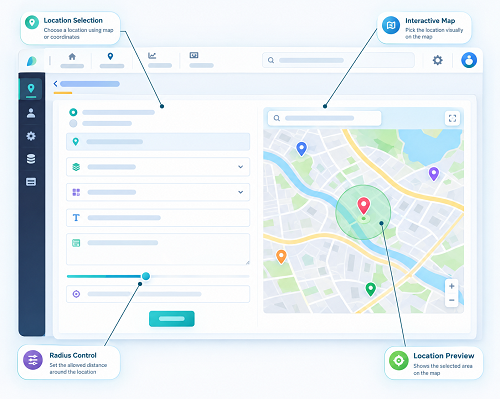
1. Identify the Purpose of Employee Location Collection
The first control is to define why the business needs employee location information.
Location data should be collected for specific and legitimate business purposes rather than simply because the software makes continuous tracking possible.
Common business purposes include:
- Verifying employee attendance at assigned workplaces.
- Confirming arrival at customer or project sites.
- Coordinating field service appointments.
- Managing delivery and logistics operations.
- Dispatching employees to urgent assignments.
- Reviewing work-related travel and territory coverage.
- Supporting employee safety during field operations.
- Investigating specific attendance or operational discrepancies.
Each purpose may require a different level of location information.
For example, an employer that needs to confirm whether a technician arrived at a customer site may only need a GPS check-in when the technician starts the job. A logistics company coordinating vehicles may have a stronger operational reason to collect location updates during active deliveries.
Businesses should document the purpose of each location-processing activity and ensure that the collection method is appropriate for that purpose.
Section 21 of Thailand's PDPA establishes purpose-related restrictions on the use of personal data, while Section 22 requires collection to be limited to what is necessary in relation to the lawful purpose.
2. Collect Only the Location Information That Is Necessary
Data minimisation is one of the most important controls for employee location monitoring.
Businesses should avoid collecting more detailed information than they need to manage attendance or field operations.
Depending on the system, location information may include:
- GPS coordinates recorded during check-in.
- Check-in and check-out timestamps.
- Assigned workplace or customer-site details.
- Distance between the employee's reported location and assigned site.
- Location updates during an active job.
- Travel routes or movement history.
- Device identifiers associated with attendance records.
- Location-related exception and correction records.
Not every business needs all these data points.
For example, an office-based employee may only need to use a fixed attendance terminal. A field sales representative may need event-based GPS verification at customer visits. A delivery operation may need more frequent location updates while employees are actively carrying out assigned routes.
Employers should assess whether each data field is necessary and remove unnecessary collection from the software configuration.
A practical approach is to classify location data into three groups:
| Data category | Example | Possible business purpose |
|---|---|---|
| Attendance-event data | GPS coordinates at check-in | Verify arrival at an assigned site |
| Assignment-related data | Customer location and job address | Coordinate field work |
| Movement data | Periodic location updates during a delivery | Support dispatch and operational coordination |
This classification helps businesses determine which information should be collected, how frequently it should be collected and how long it should be retained.
3. Choose Between Event-Based Check-Ins and Continuous Tracking
Employers should select a tracking method based on actual operational requirements.
Event-based location check-ins
Event-based tracking records an employee's location when a specific action occurs, such as:
- Starting a shift.
- Arriving at a customer site.
- Beginning a service assignment.
- Completing a job.
- Checking out at the end of the working day.
This approach is often suitable for attendance verification, customer visits and multi-site work.
Continuous or periodic location tracking
Continuous or periodic tracking collects location updates at regular intervals while the tracking function is active. It may be useful for certain delivery, transport, security or emergency-response operations.
However, it can reveal substantially more information about employee movement. Businesses should assess whether less intrusive alternatives would achieve the same operational purpose.
| Consideration | Event-based check-ins | Continuous or periodic tracking |
|---|---|---|
| Primary purpose | Verify attendance or site visits | Monitor active operations or movement |
| Collection frequency | At defined events | Repeated updates |
| Movement history | Limited | More detailed |
| Privacy impact | Generally more limited | Potentially greater |
| Typical application | Sales, maintenance, field attendance | Delivery, dispatch and certain logistics activities |
| Main control | Event and purpose restrictions | Strict activation, access and time restrictions |
Employers should not assume that continuous tracking is necessary simply because it is available in the software. The selected approach should be proportionate to the business requirement.
4. Establish a Clear Employee Location Privacy Notice
Employees should understand how their location information is collected and used.
Under Section 23 of Thailand's PDPA, data controllers generally need to provide information to data subjects before or at the time of collection, subject to the statutory requirements and exceptions.
An employee privacy notice should explain:
- What location information is collected.
- Why the organisation collects it.
- The applicable lawful basis for processing.
- Whether location is collected continuously or only during specific events.
- When tracking starts and stops.
- Whether location is collected outside working hours.
- Which departments or authorised personnel can access it.
- Whether information is shared with software providers or other organisations.
- Whether data is transferred or accessed outside Thailand.
- How long the information is retained.
- How employees can exercise their rights under the PDPA.
- Whom employees can contact with privacy questions.
The notice should be written in clear language and communicated before the tracking process begins.
Employers should also provide updates when the purpose or method of location collection changes. For example, introducing continuous vehicle tracking after previously using only attendance check-ins may require a review of the privacy notice and applicable lawful basis.
5. Identify the Appropriate Lawful Basis Under the PDPA
Employers should identify a valid lawful basis for each purpose of collecting, using or disclosing employee location information.
Consent is not automatically the only lawful basis available under Thailand's PDPA. Depending on the circumstances, other bases under Section 24 may be relevant, including:
- Contractual necessity: Where processing is necessary for performing a contract to which the employee is a party, or for taking steps at the employee's request before entering into a contract.
- Legal obligation: Where processing is necessary to comply with an applicable legal obligation.
- Legitimate interests: Where processing is necessary for the legitimate interests of the data controller or another person, provided those interests are not overridden by the employee's fundamental rights.
- Vital interests: Where processing is necessary to prevent or suppress danger to life, body or health in circumstances covered by the Act.
- Public task: Where processing is necessary for carrying out a task in the public interest or exercising official authority, where applicable.
The appropriate basis depends on the specific purpose and circumstances. Employers should not assume that all employee monitoring is automatically covered by legitimate interests or contractual necessity.
Consent also requires careful consideration in employment relationships because the employer and employee may not have equal bargaining power. If consent is used, it should meet the PDPA's requirements, including being informed and appropriately obtained.
Businesses should document the lawful basis for each location-processing activity rather than relying on one general justification for all employee monitoring.
6. Restrict Location Tracking to Appropriate Working Periods
One of the most important practical controls is defining when employee location tracking can operate.
Employees may use company mobile applications or devices for attendance and field operations, but this does not automatically justify collecting their location throughout the day and night.
Businesses should establish clear tracking schedules based on employee work arrangements.
For example:
- Activate attendance location verification when an employee checks in or out.
- Enable job-related tracking only during approved assignments where necessary.
- Stop routine location collection after the employee completes the working day.
- Provide an appropriate process for overnight shifts.
- Distinguish between working time, approved travel and personal time.
- Define how emergency tracking is activated and authorised.
For employees with flexible schedules, the system should use the employee's actual assigned working period rather than assuming that everyone follows the same office hours.
If a business operates a delivery or security service that requires location visibility during a specific duty period, the tracking policy should explain that requirement and its limits.
Employers should also test whether the application continues collecting location data after employees log out or disable the work session. Software settings should reflect the organisation's stated policy.
7. Apply Role-Based Access Controls
Not every manager or HR employee needs access to detailed employee location information.
Businesses should establish role-based permissions so that users can access only the information required for their responsibilities.
A practical access structure may look like this:
| User role | Appropriate access |
|---|---|
| Employee | Own check-in history and submitted location records |
| Direct supervisor | Location exceptions and assigned team check-ins |
| Operations manager | Relevant field-team and active-job location information |
| HR team | Attendance records and location exceptions required for HR administration |
| Payroll team | Approved working-time and attendance information, not unnecessary movement history |
| IT administrator | Technical system administration under controlled access |
| Privacy or compliance team | Access required for audits, investigations and compliance responsibilities |
Businesses should also consider:
- Individual user accounts rather than shared administrator credentials.
- Multi-factor authentication where appropriate.
- Permission reviews when employees change roles.
- Immediate removal of access when a person leaves the organisation.
- Logs showing who viewed, exported or changed location information.
- Additional approval for bulk exports or sensitive investigations.
Access to location information should be limited even within departments that have a legitimate operational need.
8. Secure Location Data Stored on Mobile Devices and Servers
Location records may be stored in mobile applications, cloud platforms, attendance databases and integrated HR systems.
Businesses should evaluate security controls across the entire data lifecycle.
Important controls include:
- Encryption: Protect location information during transmission and, where supported, while stored.
- Authentication: Require appropriate login controls for mobile applications and administrator accounts.
- Device security: Consider screen locks, operating-system updates, application permissions and remote access controls for company devices.
- Secure APIs: Protect data exchanged between attendance, payroll, CRM and field service applications.
- Audit logs: Record access, changes, exports and administrative actions.
- Backups: Secure backup copies and define how long they are retained.
- Incident response: Establish procedures for identifying, containing and investigating unauthorised access or disclosure.
Businesses should also review the software provider's security arrangements. A vendor's marketing statement that a platform is secure is not a substitute for understanding its actual controls.
Under Section 37 of Thailand's PDPA, data controllers have obligations relating to appropriate security measures, data retention and breach notification.
9. Establish Clear Data Retention and Deletion Rules
Location information should not be retained indefinitely.
Businesses should define retention periods based on the purpose of collection, applicable legal requirements, operational needs and potential disputes.
Different types of records may require different retention periods.
| Record type | Retention consideration |
|---|---|
| Routine GPS check-in | Retain for the documented attendance or operational purpose |
| Location exception | Retain according to the attendance review and dispute-handling policy |
| Approved attendance correction | Retain with the relevant attendance audit history |
| Customer visit location | Follow the relevant customer and operational record policy |
| Active job location history | Retain only as long as needed for the service or operational purpose |
| Security and access logs | Retain according to the security monitoring and incident investigation policy |
| Records subject to a legal hold | Preserve for the period required by the relevant legal or dispute process |
Employers should distinguish location data from statutory employment and wage records. For example, Sections 112–115 of Thailand's Labour Protection Act establish recordkeeping obligations for employers with 10 or more employees, including specified employee and wage records. These requirements should be considered when designing attendance record retention, but they do not mean every detailed GPS movement record must automatically be retained for the same period.
Under Section 37 of the PDPA, data controllers must arrange for personal data to be erased or destroyed when the retention period ends or when it is no longer necessary, subject to applicable legal requirements and exceptions.
Automated deletion schedules can help businesses apply retention policies consistently. Employers should also ensure that expired information is removed from backups and connected systems according to their documented deletion arrangements.
10. Control Location Data Sharing With Software Providers
Many Thai businesses use third-party attendance applications, GPS tracking platforms and cloud-based workforce management systems.
These providers may store, process or access employee location information on behalf of the employer.
Before selecting a vendor, businesses should establish:
- Whether the provider acts as a data processor or has a separate data-controller role for particular activities.
- What location information the provider collects.
- Where the information is stored.
- Which subcontractors or service providers can access it.
- Whether support teams outside Thailand can access employee records.
- What security measures protect the information.
- How the provider handles data deletion and backups.
- How quickly the provider reports security incidents.
- Whether the employer can export or retrieve its records when changing vendors.
Where a provider processes personal data on behalf of the employer, Section 40 of the PDPA establishes obligations for data processors, including following the data controller's instructions, maintaining appropriate security measures and notifying the controller of a personal data breach. The controller should put an appropriate data processing agreement in place.
The agreement should clearly address permitted processing purposes, access, confidentiality, security, subcontracting, retention, deletion, incident reporting and assistance with data subject requests.
11. Review Cross-Border Location Data Transfers
Some attendance platforms use cloud infrastructure outside Thailand. Others allow regional HR teams or overseas headquarters to access employee location records.
These arrangements may involve cross-border transfers of personal data under the PDPA.
Businesses should identify:
- The country where employee location information is stored.
- Whether overseas support teams can access it.
- Whether data is transferred to an overseas parent company.
- Whether subcontractors process the information in other countries.
- Which transfer mechanism applies.
- Whether appropriate contractual or organisational safeguards are in place.
Sections 28 and 29 of the PDPA address transfers of personal data to foreign countries and relevant safeguards or exceptions.
Employers should not assume that using a globally recognised cloud platform automatically satisfies Thailand's transfer requirements. They should review the actual data flow and the applicable legal mechanism.
It is also important to distinguish data localisation from cross-border transfer compliance. The PDPA does not impose a general requirement that all employee location data must be hosted in Thailand. However, applicable sector-specific laws or other obligations may impose additional requirements.
12. Give Employees a Way to Access and Correct Location Records
GPS systems can produce inaccurate or incomplete records. A device may report an incorrect position, a check-in may fail to synchronise, or an employee may select the wrong customer site.
Businesses should establish a process for employees to raise concerns about location information.
The process should allow employees to:
- View relevant attendance and check-in records.
- Report an incorrect location.
- Explain an outside-site check-in.
- Request correction of inaccurate personal data.
- Challenge an attendance record that does not reflect actual work.
- Submit supporting information where appropriate.
- Contact HR or the designated privacy contact.
Sections 30–36 of Thailand's PDPA provide data subject rights, including rights relating to access, correction, deletion, objection and restriction, subject to statutory conditions and exceptions.
Employers should distinguish between correcting inaccurate personal data and changing a business decision. For example, an employee may request correction of an incorrect GPS coordinate, but the review of an attendance exception may still require a separate managerial decision.
Any correction should preserve an appropriate audit trail showing the original record, the requested change, the supporting reason and the person who approved it.
13. Avoid Using Location Data as the Sole Basis for Employment Decisions
Location information can support attendance reviews, but it should not automatically determine whether an employee has performed their duties correctly.
For example:
- A GPS point near a customer site does not prove that a meeting took place.
- A missing location update does not necessarily mean the employee was absent.
- A check-in outside a geo-fence may result from an inaccurate site boundary.
- A delayed GPS update may be caused by poor network coverage.
- A route deviation may reflect an urgent customer request or traffic conditions.
Employers should combine location records with relevant schedules, job assignments, customer visit reports, supervisor instructions and employee explanations.
They should also review whether the organisation's monitoring policy permits the intended use of the data. Information collected for attendance verification should not automatically be repurposed for unrelated performance monitoring without assessing the applicable PDPA requirements and updating notices or other controls where necessary.
Managers should document the reasons for significant decisions and provide employees with a reasonable opportunity to explain relevant discrepancies.
14. Establish a Personal Data Breach Response Process
Employee location data can create risks if it is accessed, exported or disclosed without authorisation.
Examples include:
- A supervisor shares a team location report with unauthorised recipients.
- An employee loses a mobile device containing accessible attendance information.
- A vendor account is compromised.
- A public link exposes a location dashboard.
- An administrator downloads detailed movement records for an unauthorised purpose.
- A cyberattack exposes employee location histories.
Businesses should have a response process that includes:
- Detecting and reporting the incident.
- Restricting unauthorised access.
- Identifying the affected systems and records.
- Assessing the potential impact on employees.
- Preserving relevant investigation evidence.
- Notifying the responsible privacy or security team.
- Determining applicable notification obligations.
- Informing affected employees where required.
- Correcting the security weakness.
- Recording the incident and response actions.
Under Section 37 of Thailand's PDPA, data controllers must notify the Personal Data Protection Committee of a personal data breach without undue delay and, where feasible, within 72 hours after becoming aware of it, unless the breach is unlikely to result in a risk to the rights and freedoms of individuals. Where the breach is likely to result in a high risk, affected data subjects must also be notified as required by the Act.
Employers should therefore establish an internal process that enables HR, IT, security and privacy personnel to assess location-data incidents quickly.
15. Review Whether a Data Protection Officer Is Required
Businesses using employee location systems should consider whether their processing activities trigger a requirement to appoint a Data Protection Officer (DPO).
Section 41 of Thailand's PDPA sets out circumstances in which a DPO appointment is required. These include certain public authorities, organisations whose core activities involve regular monitoring of personal data or data subjects on a large scale, and organisations whose core activities involve processing sensitive personal data under Section 26, subject to the applicable rules.
Not every employer using GPS attendance automatically requires a DPO. The organisation should assess the scale, nature and purpose of its processing activities and any applicable regulatory requirements.
Even where a formal DPO appointment is not required, businesses should identify a responsible person or team to coordinate privacy notices, employee requests, vendor reviews, retention controls and incident response.
16. Configure Practical Location Controls in Attendance Software
Technology configuration plays a major role in making privacy policies effective.
Employers should evaluate whether attendance software supports the following controls:
| Software control | Why it matters |
|---|---|
| Event-based GPS capture | Records location only at defined attendance events |
| Tracking schedules | Limits location collection to approved periods |
| Automatic tracking stop | Prevents unnecessary collection after work sessions |
| Configurable geo-fences | Supports site verification without excessive monitoring |
| Role-based access | Limits who can view employee location information |
| Access audit logs | Shows who viewed or changed location records |
| Retention settings | Supports scheduled deletion |
| Employee data access | Allows employees to review relevant records |
| Correction workflow | Supports accurate attendance records |
| Encryption | Helps protect information during storage and transmission |
| Secure integrations | Controls information shared with HR, payroll and field service systems |
| Export restrictions | Reduces unauthorised downloading and sharing |
| Vendor administration controls | Supports secure third-party processing |
Businesses should test the actual behaviour of these features rather than relying solely on product descriptions.
For example, a pilot should confirm that location tracking stops when an employee ends the work session, that supervisors cannot view information outside their assigned teams, and that deleted records are handled according to the agreed retention policy.
17. Create an Employee Location Data Governance Policy
A written policy helps HR, operations, IT and employees understand their responsibilities.
The policy should cover:
- Purpose: Explain why the business uses location information.
- Scope: Identify which employee groups, devices and work activities are covered.
- Collection method: Explain whether the system uses GPS check-ins, geo-fencing, periodic updates or continuous tracking.
- Working-time limits: Define when tracking can operate and how off-duty periods are protected.
- Employee responsibilities: Explain how employees should use the application and report technical problems.
- Manager responsibilities: Establish when supervisors can view location information and how exceptions should be reviewed.
- Privacy safeguards: Explain access restrictions, security, retention and employee rights.
- Vendor arrangements: Identify how third-party service providers process and protect location data.
- Incident management: Describe how employees and managers report suspected data breaches.
- Policy review: Establish how often the organisation reviews the policy and updates it when business processes or laws change.
The policy should be consistent with the employee privacy notice, internal HR procedures, IT security requirements and vendor contracts.
Conclusion
Employee location data can help Thailand businesses improve attendance accuracy, coordinate field teams, manage customer visits and support operational safety. However, these benefits depend on collecting and handling location information responsibly.
Businesses should focus on clear purposes, data minimisation, appropriate lawful bases, working-time restrictions, role-based access, security, retention, vendor management and employee rights. They should also assess cross-border data flows and establish procedures for responding to personal data breaches.
The most effective approach is to configure attendance and tracking systems around genuine operational requirements rather than using every available monitoring feature. By combining appropriate technology controls with transparent employee policies and PDPA compliance, Thailand employers can manage field operations while protecting employee privacy and maintaining trust.
Employee location information should be limited to a defined operational purpose. Thailand businesses evaluating InnBuilt Employee Tracking App can review consent or notice processes, access permissions and retention with their privacy team.