How Can Thailand Businesses Manage Late Check-Ins and Missed Punches?
How Can Thailand Businesses Manage Late Check-Ins and Missed Punches?
Introduction
Late check-ins and missed attendance punches are common challenges for businesses in Thailand. Employees may arrive after their scheduled start time, forget to clock in, fail to record their departure or experience technical problems with an attendance device. These situations can create difficulties for HR teams, supervisors and payroll administrators, particularly in organisations with multiple branches, rotating shifts or large workforces.
For example, a manufacturing company may operate morning, evening and night shifts, while a retail business may have employees working different schedules across several outlets. If employees forget to record attendance or arrive late, managers need a consistent process to verify the actual working time and update attendance records correctly.
Poor attendance management can result in inaccurate payroll calculations, disputes about working hours, incorrect overtime payments and inconsistent disciplinary decisions. Automatically marking employees absent or deducting wages whenever a punch is missing can also create problems when the employee was actually present but the attendance device failed.
Thailand businesses should therefore establish clear attendance policies, provide convenient clock-in methods, create correction and approval workflows, and maintain reliable records of every change.
This guide explains how employers can manage late check-ins and missed punches, improve attendance accuracy, connect attendance information with payroll and maintain appropriate employment records under Thai labour requirements.
1. Understand the Difference Between Late Check-Ins and Missed Punches
The first step is to distinguish between an employee arriving late and an employee failing to record attendance.
These situations require different responses.
Late check-in
A late check-in occurs when an employee records attendance after the scheduled starting time.
For example, an employee assigned to a 9:00 AM shift may clock in at 9:20 AM.
Possible reasons include:
- Traffic congestion.
- Public transport delays.
- Personal emergencies.
- Incorrect understanding of the shift schedule.
- Unapproved changes to working hours.
- Deliberate late arrival.
Missed punch
A missed punch occurs when an employee fails to record an expected attendance event.
Examples include:
- Forgetting to clock in.
- Forgetting to clock out.
- Failing to record the end of a meal break where required.
- Using the wrong attendance terminal.
- Experiencing a mobile application failure.
- Having a fingerprint or access-card recognition problem.
- Losing internet connectivity while recording attendance.
A missed punch does not automatically prove that the employee was absent or late. The employer should verify the actual circumstances before changing the attendance record or making payroll adjustments.
2. Establish a Clear Attendance Policy
A written attendance policy provides employees and managers with consistent instructions about clock-in requirements, late arrivals and correction procedures.
Businesses should explain the policy during employee onboarding and make it accessible to all staff.
The policy should cover:
- Official working days.
- Normal working hours.
- Shift start and finish times.
- Approved clock-in and clock-out methods.
- Grace periods, if offered.
- Procedures for reporting lateness.
- Missed-punch correction requests.
- Manager approval responsibilities.
- Overtime recording.
- Attendance during business travel.
- Technical failure procedures.
- Disciplinary processes.
- Payroll cut-off dates.
Include branch-specific arrangements
A company may have different working schedules across its locations.
For example:
| Workplace | Example schedule | Attendance arrangement |
|---|---|---|
| Bangkok head office | 9:00 AM–6:00 PM | Biometric or mobile attendance |
| Chonburi factory | 6:00 AM–2:00 PM | Entry-terminal clock-in |
| Chiang Mai branch | 8:30 AM–5:30 PM | Mobile or access-card attendance |
| Phuket retail outlet | Roster-based shifts | Shared attendance terminal |
| Rayong warehouse | Rotating shifts | Biometric and supervisor verification |
These are illustrative arrangements. Employers should configure actual schedules according to their operations and applicable labour requirements.
A central attendance policy can establish consistent principles while allowing each branch to use a suitable attendance method.
3. Use Reliable Attendance Systems
An attendance management system can help businesses record employee arrival and departure times accurately.
Instead of depending entirely on paper registers or spreadsheets, employers can use digital attendance tools to capture clock-in events and identify missing records.
Common attendance methods include:
A. Biometric attendance devices
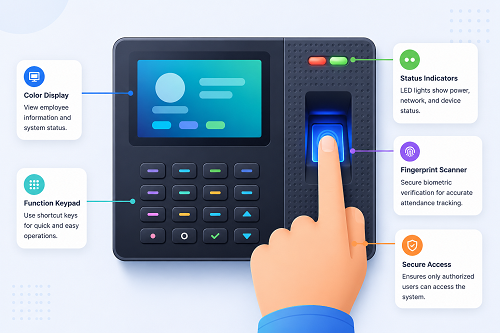
Fingerprint and facial-recognition terminals can record attendance at fixed workplaces.
They are useful for factories, warehouses, offices and retail outlets where employees report to designated entrances.
Employers should consider device reliability, queue times, hygiene, employee accessibility and privacy requirements before selecting biometric technology.
Biometric information used to uniquely identify an individual may be sensitive personal data under Thailand's Personal Data Protection Act (PDPA). Employers should assess the applicable legal conditions and consider suitable alternatives.
B. Mobile attendance applications
Mobile applications allow employees to clock in and out using company-approved smartphones or personal devices, depending on company policy.
Useful features include:
- Clock-in and clock-out recording.
- GPS-based location verification, where appropriate.
- Shift reminders.
- Missed-punch requests.
- Attendance history.
- Notifications for unusual attendance events.
C. Access cards and RFID devices
Employees can use access cards or RFID badges to record attendance at designated locations.
Employers should establish procedures for lost cards, shared-card misuse and device failures.
D. QR-code attendance
QR codes can be useful in smaller offices, temporary work locations and retail branches.
Employers should consider authentication and safeguards against employees sharing screenshots or recording attendance remotely.
The best attendance method depends on the workplace, employee roles and operational requirements. Businesses do not necessarily need to use the same device at every location, provided the records can be consolidated into a central system.
4. Configure Shift Schedules Correctly
Incorrect shift configuration is a common reason for false late-arrival alerts.
For example, an employee assigned to an evening shift beginning at 2:00 PM should not be marked late because the system is configured with a standard 9:00 AM start time.
HR should maintain accurate schedules for:
- Fixed daytime employees.
- Morning and evening shifts.
- Night shifts.
- Rotating-shift employees.
- Part-time employees.
- Flexible working arrangements.
- Employees temporarily assigned to another branch.
The attendance system should compare actual clock-in times with the employee's approved schedule.
Handle overnight shifts
Overnight shifts require special attention because the shift may begin on one calendar day and finish on the next.
For example, an employee may work from 10:00 PM on Monday until 6:00 AM on Tuesday.
The system should associate both attendance events with the correct scheduled shift. Otherwise, the employee may be incorrectly marked absent on Tuesday or recorded as having an incomplete Monday shift.
Employers should test overnight-shift settings before implementing automated late-arrival alerts.
5. Define a Reasonable Late-Arrival Reporting Process
Employees should know what to do when they expect to arrive late.
A clear reporting procedure allows supervisors to plan staffing and reduces confusion.
A practical process may include:
- The employee informs the supervisor as soon as reasonably possible.
- The employee provides an estimated arrival time.
- The supervisor records the notification where required.
- The employee clocks in upon arrival.
- The attendance system records the actual time.
- The manager reviews the reason and determines whether any exception applies.
For example, an employee scheduled to begin at 8:00 AM may experience an unexpected transport delay. The employee notifies the supervisor at 7:45 AM and arrives at 8:25 AM.
The system should preserve the actual 8:25 AM clock-in time. Any approved adjustment should be documented separately rather than silently changing the original record.
This approach supports accurate attendance reporting while giving managers sufficient information to manage staffing.
6. Decide Whether to Use a Grace Period
Some businesses allow a short grace period for clock-ins.
For example, an organisation may permit a five-minute administrative grace period before generating a late-arrival alert.
A grace period can reduce unnecessary disputes caused by minor timing differences or device delays. However, employers should distinguish an attendance alert threshold from a change to contractual working hours or statutory wage obligations.
A grace period policy should explain:
- Whether it applies to all employees or selected roles.
- Whether it applies to every shift.
- Whether repeated late arrivals are treated differently.
- How overtime and actual working time are recorded.
- Whether the grace period affects payroll calculations.
- How exceptions are approved.
A grace period should not be used to conceal actual working hours or automatically disregard time worked.
For example, if an employee clocks in at 9:04 AM for a 9:00 AM shift, the system may classify the event as within the company's administrative grace period. It should still retain the actual clock-in time.
7. Create a Formal Missed-Punch Correction Workflow
A formal correction process is one of the most important controls for managing attendance exceptions.
Employees should have a straightforward way to report missing clock-in or clock-out events.
A typical workflow is:
- The employee identifies the missing attendance record.
- The employee submits a correction request.
- The employee provides the expected time and reason.
- The supervisor checks available supporting information.
- The supervisor approves or rejects the request.
- HR reviews unusual or disputed cases.
- The approved correction is reflected in the attendance record.
- The system preserves the original record and approval history.
Example of a missed-punch request
| Field | Example information |
|---|---|
| Employee | Employee A |
| Date | 12 November |
| Scheduled shift | 9:00 AM–6:00 PM |
| Missing event | Clock-in |
| Requested time | 8:58 AM |
| Reason | Attendance terminal did not recognise access card |
| Supporting information | Supervisor confirmation |
| Approval status | Approved |
| Approver | Department manager |
The example is illustrative.
Employers should not permit employees to change their own attendance records without appropriate review. At the same time, the correction process should not be so complicated that employees delay reporting genuine errors.
8. Verify Missed Punches Before Approving Corrections
Managers should review available evidence before approving a correction.
Depending on the workplace, useful verification sources may include:
- Supervisor confirmation.
- Access-control logs.
- Security gate records.
- Workstation login records.
- Production or task records.
- Customer appointment records.
- Approved travel schedules.
- Other attendance events from the same device.
No single supporting record is necessarily conclusive. For example, entering a building does not always prove that an employee started working at that exact time.
Employers should assess the evidence consistently and avoid collecting unnecessary personal information.
Use a correction reason code
Attendance systems can use standard reason codes to make exception reporting easier.
| Reason code | Description |
|---|---|
| Forgot to clock in | Employee did not record arrival |
| Forgot to clock out | Employee did not record departure |
| Device failure | Attendance terminal was unavailable |
| Network issue | Mobile attendance could not synchronise |
| Wrong terminal | Employee used another branch device |
| Approved schedule change | Working time was changed |
| Supervisor correction | Manager verified the attendance event |
| Other | Requires an explanation |
Standard reason codes help HR identify recurring problems and determine whether additional employee training or device maintenance is required.
9. Set Approval Responsibilities for Attendance Corrections
Not every attendance correction should require the same level of approval.
A simple correction may be approved by the immediate supervisor, while a disputed or unusual request may require HR review.
An example approval structure is:
| Attendance issue | First-level reviewer | Additional review |
|---|---|---|
| Single missed punch | Immediate supervisor | HR if disputed |
| Repeated missed punches | Department manager | HR |
| Clock-in outside branch | Branch manager | HR or authorised regional manager |
| Overnight shift discrepancy | Shift supervisor | Payroll or HR |
| Attendance device failure | IT or site administrator | HR |
| Payroll-impacting correction after cut-off | Department manager | Payroll and HR |
The system should record the person who approved each correction, the date of approval and the reason for the change.
This creates accountability and helps payroll teams identify which attendance information has been verified.
10. Monitor Repeated Late Arrivals and Missed Punches
Attendance software can help employers identify employees or departments with recurring attendance problems.
Useful reports include:
- Late-arrival frequency.
- Total minutes recorded as late.
- Repeated missed clock-ins.
- Repeated missed clock-outs.
- Attendance corrections by employees.
- Attendance exceptions by branch.
- Device-related attendance failures.
- Pending correction requests.
- Unresolved payroll exceptions.
For example, an employee who forgets to clock out once may simply need a reminder. An employee who repeatedly fails to record attendance may require additional training or a formal discussion.
However, managers should investigate the reasons behind repeated exceptions.
A high number of missed punches across one branch may indicate a faulty device, poor network connectivity or an unsuitable clock-in process rather than employee misconduct.
Attendance reports should therefore be used to identify operational problems as well as individual behaviour.
11. Apply Fair and Consistent Disciplinary Procedures
Employers should establish clear procedures for addressing repeated lateness and failure to follow attendance requirements.
Possible management responses include:
- Informal reminders.
- Attendance counselling.
- Written warnings.
- Additional training.
- Formal disciplinary action under company work rules.
Before taking action, employers should consider:
- Whether the employee was informed of the attendance rules.
- Whether the scheduled working hours were communicated clearly.
- Whether the attendance device was functioning.
- Whether the employee provided a reasonable explanation.
- Whether similar cases were handled consistently.
- Whether the employee had an opportunity to explain the circumstances.
For employers with ten or more employees, Section 108 of Thailand's Labour Protection Act requires work rules in Thai covering matters including working days, normal working hours, rest periods, holidays, overtime, leave, discipline and disciplinary penalties.
The employer should ensure that attendance procedures are consistent with its work rules and applicable labour law.
A missing punch should not automatically be treated as misconduct when there is evidence that the employee was present and working.
12. Understand the Legal Risks of Deducting Wages for Lateness
Payroll treatment of late arrivals requires particular care.
Thailand's Labour Protection Act Section 76 restricts deductions from wages, overtime pay, holiday pay and holiday overtime pay. It identifies permitted categories of deductions, subject to the conditions in the Act.
Employers should not assume that they can impose a fixed monetary fine or automatically deduct an amount from earned wages simply because an employee arrives late or misses a punch.
Businesses should distinguish between:
- Recording actual time worked.
- Determining wages payable under the employment arrangement and applicable law.
- Making a deduction from wages already earned.
- Imposing a disciplinary penalty.
These are not necessarily the same legal issue.
For example, an employer may need to determine the correct payment for time not worked under the applicable employment arrangement, but this does not automatically authorise an additional punitive deduction.
Before implementing a salary-deduction formula for lateness, employers should obtain Thai employment-law advice and verify that the proposed approach complies with Sections 76 and 77 and other relevant provisions.
A safer approach is to maintain accurate attendance records, apply lawful payroll calculations and manage repeated lateness through documented workplace procedures.
13. Connect Attendance Records With Payroll
Late check-ins and missed punches can affect payroll calculations, particularly when employees receive hourly wages, shift allowances or attendance-related payments.
An integrated attendance and payroll system can reduce manual data entry and help payroll teams identify incomplete records before salary processing.
Relevant information may include:
- Actual clock-in and clock-out times.
- Scheduled working hours.
- Approved overtime.
- Unpaid absence information.
- Approved leave.
- Shift allowances.
- Attendance-related incentives, where applicable.
- Approved attendance corrections.
Example payroll workflow
| Stage | Activity | Responsible team |
|---|---|---|
| 1 | Employee records attendance | Employee |
| 2 | System identifies late or missing punches | Attendance software |
| 3 | Employee submits an explanation | Employee |
| 4 | Supervisor reviews the request | Department manager |
| 5 | HR checks unresolved exceptions | HR team |
| 6 | Approved attendance is consolidated | HR |
| 7 | Payroll processes approved information | Payroll team |
| 8 | Final payroll is reviewed | HR and finance |
Payroll teams should avoid processing incomplete attendance records without an appropriate review.
If a correction is approved after payroll cut-off, the organisation should follow a documented adjustment process and retain the approval evidence.
14. Use Automated Alerts to Reduce Attendance Exceptions
Automated notifications can help employees and managers respond to attendance problems before they affect payroll.
Useful alerts include:
Employee notifications
- Reminder before the scheduled shift.
- Notification when a clock-in is not recorded.
- Reminder to clock out.
- Confirmation of successful attendance recording.
- Notification when a correction request is approved or rejected.
Manager notifications
- The employee has not clocked in by the configured threshold.
- Missing clock-in or clock-out.
- Repeated late arrivals.
- Attendance correction awaiting approval.
- Employee clocked in at an unapproved location.
- Unusual shift-duration record.
- Payroll cut-off approaching with unresolved exceptions.
Employers should configure alerts carefully. Excessive notifications may cause managers to ignore important messages.
A useful system should allow alerts to be filtered by branch, department, shift and exception type.
15. Prepare a Backup Process for Attendance Device Failures
Attendance systems can fail because of power outages, network interruptions, hardware problems or application errors.
Businesses should establish a backup process so that employees can still record their attendance.
Possible alternatives include:
- A temporary manual attendance register.
- Supervisor-maintained attendance logs.
- A backup terminal.
- An authorised mobile attendance application.
- A temporary QR-code process.
- An IT incident report linked to the affected attendance period.
The backup process should record:
- Date and time of the failure.
- Affected branch or device.
- Employees affected.
- Alternative attendance method used.
- Person responsible for verifying the records.
- Time the normal system resumed operation.
- Date and time the records were entered into the main system.
Once the device is restored, HR should reconcile manual records with digital records and check for duplicate entries.
16. Protect Attendance Information Under Thailand's PDPA
Attendance records contain employee personal data, including names, working hours, shift assignments and attendance behaviour.
Some businesses also use GPS, photographs, fingerprints or facial recognition to verify attendance.
Thailand's Personal Data Protection Act B.E. 2562 (2019) requires organisations to handle personal data in accordance with applicable data protection principles and obligations.
Employers should consider the following measures:
A. Explain the purpose of attendance collection
Employees should receive information about why attendance data is collected and how it will be used.
B. Collect only necessary information
If the purpose is to verify a clock-in event, continuous location monitoring may be unnecessary.
C. Restrict access
Only authorised HR, payroll and management personnel should access attendance records relevant to their duties.
D. Secure employee information
Employers should assess encryption, authentication, audit trails, backups and secure data transfers.
E. Review biometric attendance carefully
Fingerprint and facial-recognition information used to uniquely identify individuals can be sensitive personal data under the PDPA. Employers should assess the applicable legal conditions for processing and consider appropriate alternatives.
F. Establish a retention policy
Attendance records should be retained according to applicable legal requirements and legitimate operational needs. They should not be kept indefinitely without a valid purpose.
17. Use Attendance Reports to Improve Workforce Management
Attendance reports can help management understand whether late check-ins and missed punches are isolated problems or signs of wider operational issues.
Useful reports include:
| Report | Management purpose |
|---|---|
| Daily late-arrival report | Identifies employees arriving after scheduled start times |
| Missed-punch report | Identifies incomplete attendance records |
| Correction history | Shows changes and approval activity |
| Branch attendance report | Compares attendance exceptions across locations |
| Shift attendance report | Identifies problems by shift |
| Device failure report | Highlights technical problems |
| Pending approvals report | Shows unresolved correction requests |
| Payroll exception report | Identifies records requiring review before payday |
For example, if a Bangkok office reports frequent missed punches at the same entrance terminal, management may need to inspect the device or introduce another clock-in point.
If missed punches occur mainly during shift changes at a factory, the company may need additional terminals or a revised clock-in process to reduce queues.
The purpose of reporting should be to improve attendance accuracy and workforce planning, not simply to increase the number of disciplinary actions.
18. Evaluate Attendance Software for Late Check-In and Missed-Punch Management
Before selecting attendance software, Thailand businesses should test how the system handles real-world attendance exceptions.
Important features include:
| Feature | What employers should check |
|---|---|
| Flexible shift configuration | Can the system manage different employee schedules? |
| Late-arrival alerts | Can alerts be configured by shift and branch? |
| Missed-punch requests | Can employees submit correction requests? |
| Manager approvals | Can supervisors review and approve corrections? |
| Audit trails | Are original and corrected records preserved? |
| Biometric integration | Can attendance devices connect reliably? |
| Mobile attendance | Can employees record attendance through an app? |
| Offline functionality | Can records synchronise after network recovery? |
| Payroll integration | Can approved attendance information be transferred? |
| Exception reports | Can HR identify repeated problems? |
| Role-based access | Can branch managers access only relevant employee records? |
| PDPA safeguards | Are appropriate privacy and security controls available? |
Employers should also confirm whether software pricing includes mobile users, attendance terminals, additional branches, integrations and technical support.
Conclusion
Managing late check-ins and missed punches requires a consistent process for recording, verifying and correcting attendance information. Thailand businesses should distinguish between genuine late arrivals and technical or administrative attendance errors before taking payroll or disciplinary action.
A clear attendance policy, reliable clock-in methods, accurate shift schedules and formal correction workflows can help HR teams maintain trustworthy records. Automated alerts and exception reports can also help supervisors identify problems early rather than waiting until payroll processing.
Employers should pay particular attention to Thailand's Labour Protection Act, especially the restrictions on wage deductions under Section 76 and the requirement for written consent in circumstances covered by Section 77. A missed punch should not automatically result in a wage deduction or disciplinary penalty without reviewing the circumstances and applicable law.
Attendance software can make this process more efficient by providing digital clock-in records, correction requests, manager approvals, audit trails and payroll integration. However, technology should support fair management practices rather than replace proper verification and employee communication.
Ultimately, the most effective approach combines accurate attendance recording, transparent correction procedures, appropriate legal review and regular monitoring. This helps businesses reduce payroll errors, improve employee accountability and maintain reliable working-time records.
A late arrival and a missing punch require different follow-up. InnBuilt Attendance Software can help Thailand supervisors identify each exception, confirm the reason and document any adjustment.