What Should Thailand Employers Review Before Processing Monthly Payroll?
What Should Thailand Employers Review Before Processing Monthly Payroll?
Introduction
Processing monthly payroll in Thailand requires more than calculating basic salaries and transferring money to employee bank accounts. Employers must review attendance, approved leave, overtime, holiday work, allowances, deductions, personal income tax withholding and Social Security contributions before finalising each payroll cycle.
These inputs are often managed by different departments. HR maintains employee information and leave records, supervisors approve attendance and overtime, finance manages payment information, and payroll teams consolidate the data. If these records are incomplete or inconsistent, employees may receive incorrect salaries, statutory contributions may be miscalculated and payroll deadlines may be missed.
A structured pre-payroll review helps employers identify discrepancies before payments are released. It also creates a reliable record of how each employee's gross salary, deductions and net pay were calculated.
For Thai employers, monthly payroll checks should also reflect current legal requirements. Important changes include the 2026 increase in the Social Security contribution wage ceiling, amendments to maternity and family-related leave rights effective from December 2025, and the revised Employee Welfare Fund contribution commencement date of 1 January 2027.
1. Verify Employee Master Data and Employment Changes
Before calculating salaries, payroll teams should confirm that employee information is accurate and up to date.
Incorrect employee records can affect salary calculations, tax withholding, Social Security contributions, leave entitlements and final settlements.
Review the following information:
- Employee ID and full legal name.
- Employment commencement date.
- Employment status.
- Department, job title and work location.
- Salary amount and payment frequency.
- Bank account details.
- Normal working schedule.
- Applicable leave entitlements.
- Social Security registration status.
- Tax identification and payroll information.
- Approved salary revisions and employment changes.
Payroll teams should pay particular attention to employees who joined, resigned, transferred departments or received salary revisions during the month.
For new employees, verify the agreed salary, employment date, payroll inclusion and relevant statutory registration information. For departing employees, confirm the last working day, outstanding wages, unused annual leave treatment where applicable, approved overtime and other final settlement components.
A central employee ID should be used across HR, attendance, leave and payroll systems to prevent duplicate records and incorrect employee matching.
2. Reconcile Attendance and Actual Working Hours
Attendance records are a major input for payroll calculations, particularly for shift workers, hourly employees and employees who regularly work overtime.
Payroll teams should compare scheduled working hours with actual attendance information before approving salary calculations.
Review:
- Scheduled shift start and finish times.
- Actual clock-in and clock-out records.
- Total working hours.
- Recorded break periods.
- Late arrivals and early departures.
- Missing attendance punches.
- Approved shift swaps.
- Work performed on holidays.
- Additional working hours.
- Approved attendance corrections.
For example, an employee may be scheduled to work from 8:00 a.m. to 5:00 p.m. but clock out at 6:30 p.m. Payroll should verify whether the additional time represents approved overtime, a schedule change or another type of recorded activity.
A missing clock-in should not automatically be treated as absence. The supervisor should check whether the employee actually worked and approve any correction with a supporting explanation.
The payroll team should preserve original attendance records and maintain an audit trail showing who approved each correction and when it was made.
3. Check Working Hours, Breaks and Overtime Eligibility
Thailand's Labour Protection Act B.E. 2541 establishes working-time and rest-period requirements that employers should consider when reviewing attendance and payroll inputs.
Under Section 23, normal working hours for general work are generally limited to eight hours per day and 48 hours per week. Certain work prescribed as hazardous is subject to lower limits of seven hours per day and 42 hours per week.
Section 27 generally requires a rest period of at least one hour after an employee has worked for no more than five consecutive hours. Where overtime following normal working hours exceeds two hours, an additional rest period of at least 20 minutes is generally required before overtime begins, subject to statutory exceptions.
Before processing payroll, employers should check:
- Whether actual working hours match the approved schedule.
- Whether required rest periods were provided.
- Whether overtime was properly recorded.
- Whether the employee was eligible for the applicable payment.
- Whether the relevant approval was obtained.
- Whether special working-time rules apply to the employee's occupation.
Payroll teams should not assume that every hour recorded after a scheduled shift automatically qualifies as approved overtime. Actual work, the employee's circumstances and applicable legal requirements must be reviewed.
4. Verify Overtime and Holiday Pay Calculations
Overtime and holiday work can significantly affect monthly payroll costs.
Employers should compare attendance records with supervisor approvals and verify the correct payment category before calculating additional wages.
An overtime register should include:
- Employee ID.
- Date of additional work.
- Normal scheduled hours.
- Actual working hours.
- Approved overtime hours.
- Whether the work occurred on a normal working day or holiday.
- Applicable payment rate.
- Approval reference.
- Calculated amount.
Under Section 24, normal working-day overtime generally requires the employee's prior consent on each occasion, subject to statutory exceptions.
Sections 61–63 establish minimum payment rates for overtime and holiday work. In general:
| Type of work | General minimum payment requirement |
|---|---|
| Normal working-day overtime | At least 1.5 times the applicable hourly wage rate |
| Holiday work for employees not otherwise entitled to holiday wages | At least 2 times the applicable hourly wage rate |
| Holiday work for employees already entitled to holiday wages | Additional payment of at least 1 times the applicable hourly wage rate |
| Holiday overtime | At least 3 times the applicable hourly wage rate |
The precise calculation depends on the employee's wage arrangement and statutory eligibility. Certain employee categories may also be subject to different overtime payment provisions.
Payroll teams should check that holiday work, holiday overtime and normal overtime are recorded separately rather than combined into one general additional-hours figure.
5. Review Approved Leave and Leave Balances
Leave records should be reconciled before monthly salaries are finalised.
HR may maintain leave applications separately from the attendance system, so payroll teams should confirm that approved leave is correctly reflected in the payroll calculation.
Review the following categories:
- Annual leave.
- Sick leave.
- Necessary business leave.
- Maternity leave.
- Leave to assist a spouse following childbirth.
- Additional childcare leave for eligible employees.
- Military service leave.
- Sterilisation leave.
- Unpaid leave.
- Other contractual or company-provided leave.
For each leave transaction, verify the employee ID, leave category, dates, number of working days, approval status and paid or unpaid treatment.
Annual leave
Under Section 30, employees who have completed one uninterrupted year of service are generally entitled to at least six working days of annual leave per year. Employers may provide more generous entitlements, and carry-forward arrangements may be made by advance agreement. Employers may also provide annual leave on a pro-rata basis before an employee completes one year of service.
Payroll teams should verify the employee's service date, annual entitlement, leave taken and remaining balance.
Sick leave
Under Section 32, employees are entitled to sick leave for as long as they are actually sick. For sick leave of three or more working days, employers may require a medical certificate from a first-class physician or an official medical establishment. If the employee cannot provide one, the employee must explain the reason.
Section 57 generally requires employers to pay wages for sick leave up to 30 working days per year. This is the statutory paid sick leave limit, not a limit on the employee's right to take genuine sick leave.
Maternity and family-related leave
The Labour Protection Act (No. 9) B.E. 2568 (2025), effective from 7 December 2025, increased maternity leave to up to 120 days per pregnancy. Employers must pay wages during maternity leave for up to 60 days.
The amendment also introduced up to 15 additional days of leave for eligible female employees to care for a newborn with qualifying medical complications, abnormalities or disabilities, subject to statutory conditions. This additional leave is paid at 50% of normal wages.
Eligible employees may also take up to 15 days of leave to assist a spouse following childbirth, with full pay, subject to the statutory conditions.
Employers should update leave management systems and payroll configurations to reflect these provisions.
6. Validate Basic Salary and Salary Revisions
Basic salary is usually the largest component of monthly payroll. Even a small error in the employee's salary rate can create recurring payment discrepancies.
Before processing payroll, compare the salary register with approved employment documents and HR change records.
Check:
- Original agreed salary.
- Approved salary increments.
- Promotion-related salary changes.
- Changes to employment status.
- Salary changes effective during the payroll period.
- Part-period salary calculations.
- Unpaid leave adjustments, where legally permitted.
- Final salary calculations for departing employees.
For employees who join or leave during a payroll period, verify the applicable calculation method against the employment terms and relevant legal requirements.
Payroll teams should not apply a software default without confirming that it matches the employee's actual arrangement.
7. Review Allowances, Bonuses and Other Variable Payments
Employers may provide additional payments beyond basic salary. These can include shift allowances, transport allowances, meal allowances, commissions, attendance incentives, performance bonuses and special assignment payments.
Each payment should be checked against its eligibility rules and supporting records.
| Payment component | What to review |
|---|---|
| Shift allowance | Eligible shifts and actual attendance |
| Transport allowance | Employee eligibility and approved amount |
| Meal allowance | Qualifying shifts or working arrangements |
| Attendance incentive | Attendance conditions and exclusions |
| Commission | Verified sales or performance records |
| Performance bonus | Approved performance results |
| Special assignment allowance | Assignment details and authorisation |
| Expense reimbursement | Supporting documents and company policy |
Payroll teams should distinguish between payments that constitute wages and genuine business expense reimbursements. Their treatment for labour law, personal income tax and Social Security purposes may differ.
For example, a fixed monthly transport allowance may be treated differently from reimbursement of an actual business expense supported by receipts.
Each payment type should have a documented policy and a consistent payroll treatment.
8. Check Deductions and Unpaid Absences
Before deducting money from salaries, employers should verify the reason, calculation and legal basis.
Possible payroll deductions include:
- Employee Social Security contributions.
- Personal income tax withholding.
- Approved employee benefit contributions.
- Lawful deductions for specified damage or loss, where statutory conditions are satisfied.
- Unpaid leave adjustments where appropriate.
- Other deductions permitted by law.
Section 76 of the Labour Protection Act restricts wage deductions to specified categories and statutory conditions. Section 77 requires written employee consent where applicable. Employers should not impose arbitrary fines or automatic salary deductions for lateness without reviewing the legal requirements.
Payroll teams should investigate missing attendance records before making any absence-related deduction. An employee may have worked but failed to record a punch, or the attendance system may have experienced a technical problem.
Every adjustment should have supporting documentation and an appropriate approval.
9. Calculate Social Security Contributions Using the Current Wage Ceiling
Social Security contributions are an important statutory payroll input for employees insured under Section 33 of Thailand's Social Security Act.
From 1 January 2026, the maximum monthly wage base for Section 33 contributions increased from THB 15,000 to THB 17,500. The standard contribution rate remains 5% for the employee and 5% for the employer.
2026 Section 33 contribution reference
| Item | 2026 amount |
|---|---|
| Minimum monthly wage base | THB 1,650 |
| Maximum monthly wage base | THB 17,500 |
| Employee contribution rate | 5% |
| Employer contribution rate | 5% |
| Maximum employee contribution | THB 875 |
| Maximum employer contribution | THB 875 |
For an employee with a monthly contribution wage base of THB 17,500, the employee contribution is THB 875 and the employer contribution is another THB 875.
Payroll teams should:
- Verify employee registration and insured status.
- Check the applicable contribution wage base.
- Apply the correct minimum and maximum limits.
- Record employee and employer contributions separately.
- Review joiners, leavers and relevant employment changes.
- Reconcile payroll totals with Social Security submission records.
- Retain payment confirmations.
The Social Security contribution wage ceiling should not be confused with the employee's actual salary. An employee earning more than THB 17,500 may still receive the full contractual salary, even though the Section 33 contribution calculation is capped at the applicable wage base.
The Social Security Office generally requires monthly contributions to be submitted by the 15th day of the following month. Employers should check the applicable filing and payment instructions for the relevant period.
10. Prepare for the Employee Welfare Fund Changes
Employers should also review whether they will be subject to Thailand's Employee Welfare Fund requirements.
The Employee Welfare Fund contribution commencement date was initially scheduled for 1 October 2026. However, a Royal Decree published in the Government Gazette on 22 October 2026 postponed the start of collection to 1 January 2027.
The scheme generally applies to employers with ten or more employees who are not covered by an applicable exemption. Employers should assess eligibility and any qualifying provident fund or other statutory exemption carefully.
Under the announced contribution schedule:
- From 1 January 2027 to 31 December 2031, the employee contribution is generally 0.25% of wages and the employer contribution is 0.25%.
- From 1 January 2032, the respective rates are scheduled to increase to 0.50%.
Employers should use the postponement period to review employee coverage, assess exemptions, determine which payments constitute wages for contribution purposes and configure payroll systems.
The EWF has not been cancelled. Employers should prepare for the revised commencement date rather than continuing to use the superseded October 2026 schedule.
11. Review Personal Income Tax Withholding
Employers must calculate and withhold personal income tax from employment income according to the applicable Revenue Code requirements.
Payroll teams should review:
- Employee tax information.
- Monthly salary and other taxable employment income.
- Bonuses and additional payments.
- Applicable allowances and benefits.
- Employee declarations and relevant supporting information.
- Cumulative year-to-date earnings.
- Tax withheld during previous payroll periods.
- Tax withholding for employees who joined or left during the year.
Employment income is generally subject to withholding tax, with the applicable calculation depending on the employee's circumstances and the Revenue Department's prescribed method. Employers should not use a flat percentage for all employees without considering the applicable calculation rules.
The payroll team should reconcile the tax amount in the payroll register with the amount reported in the monthly withholding tax return, commonly Form PND.1.
The monthly PND.1 filing and payment deadline should be checked against the Revenue Department's current calendar. Electronic filing may have an extended deadline under the applicable rules, so payroll teams should not assume that the paper and online deadlines are identical.
12. Review Employee Benefits and Other Payroll Commitments
Monthly payroll checks should also cover benefits and deductions arising from company policies or employment agreements.
Examples include:
- Provident fund contributions.
- Health and accident insurance.
- Employee loan repayments.
- Approved welfare contributions.
- Meal or transport benefits.
- Other contractual deductions or benefits.
For provident fund arrangements, payroll teams should confirm employee membership, contribution percentages, salary basis and effective dates.
Employer and employee contributions should be recorded separately. Changes to membership or contribution rates should be supported by the relevant fund rules and employee authorisations.
Employers should also distinguish between statutory obligations and voluntary benefits. A benefit offered under company policy should not be treated as a statutory deduction without a proper basis.
13. Check Payroll Calculations and Net Salary
Once all earnings and deductions have been validated, payroll teams should review the gross-to-net calculation.
A typical payroll calculation may include:
Gross earnings
- Basic salary.
- Overtime pay.
- Holiday pay.
- Allowances.
- Bonuses and commissions.
- Other applicable earnings.
Less applicable deductions
- Employee Social Security contribution.
- Personal income tax withholding.
- Lawful employee deductions.
- Approved unpaid leave adjustments.
- Other authorised deductions.
Result: Net salary payable
Payroll teams should review employee-level calculations and compare the current month with the previous payroll period.
Large differences should be investigated. For example, a significant decrease in net salary may result from unpaid leave, a salary change, a correction to an allowance or an incorrect deduction.
The payroll register should clearly separate employee deductions from employer contributions and other employer costs.
14. Verify Payslips and Salary Payment Information
Before releasing salary payments, employers should check that each employee's payroll information is accurate and understandable.
A payslip or wage statement should clearly identify relevant earnings and deductions, including:
- Employee name and identification details.
- Payroll period.
- Basic salary.
- Overtime and holiday payments.
- Allowances and bonuses.
- Social Security deductions.
- Tax withholding.
- Other applicable deductions.
- Net salary payable.
For employers with ten or more employees, Section 114 requires wage-related payment records containing working days and working time, wage rates and amounts, overtime pay, holiday pay and holiday overtime pay. Where wages are paid through a bank transfer, the transfer evidence can serve as evidence of payment under the statutory provision.
Employers should also check employee bank details and the total payment file before submission to the bank.
A final comparison should be made between:
- The approved payroll register.
- The salary payment file.
- The total amount released by the bank.
- The accounting entries for payroll expenses and liabilities.
Any difference should be explained and documented.
15. Confirm Payroll Payment and Filing Deadlines
Payroll teams should maintain a compliance calendar covering salary payments, tax withholding, Social Security contributions and other relevant obligations.
Under Section 70 of the Labour Protection Act, wages calculated monthly, daily or hourly, or on another basis not exceeding one month, must generally be paid at least once a month unless a more favourable arrangement is agreed. Overtime pay, holiday pay and holiday overtime pay must also be paid at least once a month. Where employment is terminated, outstanding wages and relevant payments are generally due within three days of termination.
A monthly compliance calendar may include:
| Obligation | General timing |
|---|---|
| Monthly salary payment | At least once a month under the applicable arrangement |
| Overtime and holiday pay | At least once a month |
| PND.1 withholding tax | Generally within seven days after the end of the month of payment; verify the current online filing extension |
| Section 33 Social Security contributions | Generally by the 15th of the following month |
| Employee Welfare Fund | Prepare for the revised commencement date of 1 January 2027, where applicable |
Employers should check current filing instructions, holidays and electronic submission extensions before each payroll closes. A calendar reminder alone is not sufficient; the organisation should retain proof that each filing and payment was completed.
16. Review Payroll Reports and Investigate Unusual Differences
Payroll reports help employers identify errors before approving payments.
Useful reports include:
| Payroll report | What employers should review |
|---|---|
| Payroll summary | Total gross pay, deductions and net salary |
| Employee earnings report | Salary and additional payments by employee |
| Attendance exception report | Missing punches, late arrivals and unusual working hours |
| Overtime report | Approved overtime and holiday work |
| Leave report | Approved leave and unpaid absence adjustments |
| Deduction report | Social Security, tax and other deductions |
| Contribution report | Employee and employer statutory contributions |
| Joiner and leaver report | Employees included or excluded from payroll |
| Salary variance report | Differences compared with previous months |
| Bank payment report | Employee payment amounts and total payroll transfer |
Payroll teams should pay particular attention to unusual salary increases or decreases, duplicate payments, negative net pay and unexpected changes in statutory deductions.
A discrepancy should be traced to its original source rather than corrected through an unexplained manual adjustment.
17. Protect Payroll Information Under Thailand's PDPA
Payroll records contain personal data, including employee identities, salaries, bank details, tax information and absence records. Some supporting documents may also contain sensitive health information.
Employers should apply appropriate controls under Thailand's Personal Data Protection Act B.E. 2562.
Important safeguards include:
- Provide appropriate employee privacy notices.
- Collect only information needed for legitimate payroll and employment purposes.
- Restrict payroll access according to job responsibilities.
- Use secure authentication for payroll applications.
- Protect bank account and salary information.
- Limit access to medical and sensitive leave documentation.
- Review payroll software vendor and data-processing arrangements.
- Maintain appropriate retention and deletion procedures.
- Securely transfer payroll information between HR, finance and external providers.
- Establish a process for responding to personal data breaches.
Section 37 of the PDPA requires appropriate security measures and controls over unauthorised use or disclosure. It also establishes notification requirements for qualifying personal data breaches, including notification to the PDPC without delay and, where feasible, within 72 hours after becoming aware of the breach, subject to the statutory risk exception. High-risk breaches may also require notification to affected individuals.
Payroll teams should ensure that supervisors receive only the employee information necessary for their responsibilities, rather than unrestricted access to salary and bank records.
18. Maintain Payroll and Employment Records
Employers should retain sufficient documentation to demonstrate how wages and statutory payments were calculated.
Under Sections 112–115 of the Labour Protection Act, employers with ten or more employees must maintain specified employee and wage-payment records.
Relevant records include:
- Employee information and employment details.
- Working days and working time.
- Wage rates and amounts.
- Overtime and holiday payments.
- Evidence of wage payment.
- Relevant changes to employee information.
Section 115 generally requires employee records to be retained for at least two years from the date of termination and wage-payment records for at least two years from the date of payment. Where a relevant complaint, labour dispute or lawsuit is pending, the records must be retained until the matter reaches a final order or judgment.
Employers should also consider separate tax, Social Security, accounting and data protection retention requirements. These may have different periods and should not automatically be treated as identical to the Labour Protection Act's record-retention rules.
Conclusion
Monthly payroll processing in Thailand requires a coordinated review of employee information, attendance, leave, overtime, salary changes, allowances, deductions, tax withholding and Social Security contributions.
Employers should verify every important payroll input before approving salary payments. They should also keep statutory requirements up to date, particularly the 2026 Social Security contribution ceiling, the revised maternity and family-related leave entitlements, and the Employee Welfare Fund commencement date of 1 January 2027.
Integrated HR, attendance, leave and payroll software can reduce manual reconciliation and make discrepancies easier to identify. However, employers still need clear approval responsibilities, accurate source records and regular reviews of statutory calculations.
A consistent monthly payroll checklist helps businesses reduce salary errors, meet payment and filing deadlines, protect employee information and maintain reliable employment records.
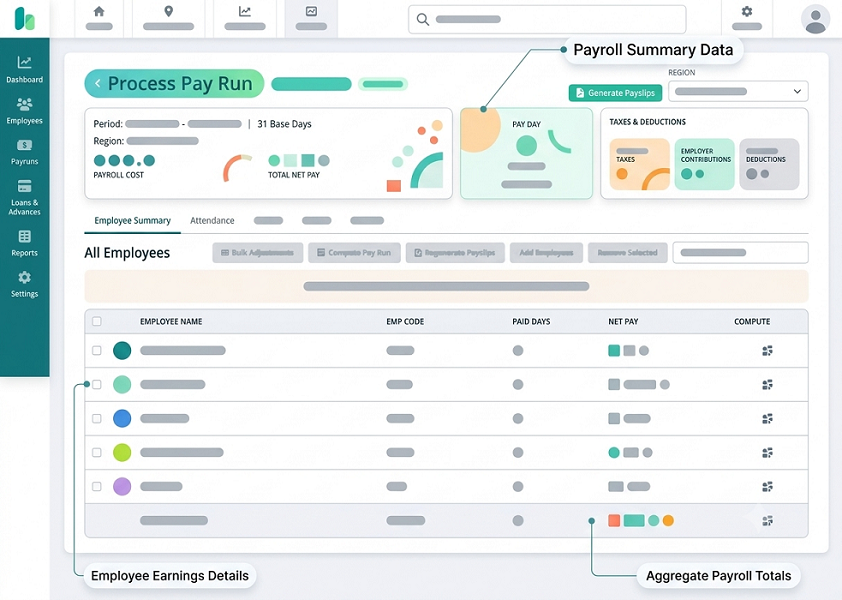
Monthly payroll review should include changed employee details, variable pay and unresolved exceptions. InnBuilt Payroll Software can help Thailand teams organise those inputs for approval before processing.