How Can Thailand Hospitals Fill Nursing Shifts When Staff Call in Sick?
How Can
When Staff Call in Sick?
Introduction
Hospitals in Thailand must maintain reliable nursing coverage throughout the day, including nights, weekends, and public holidays. However, unexpected staff absences can make shift planning difficult. A nurse may call in sick shortly before a shift begins, leaving a ward, emergency department, intensive care unit, or operating theatre with fewer available staff than planned.
The challenge is not simply finding another employee to cover the vacant position. Hospital managers must ensure that replacement nurses have the right qualifications, clinical experience, and familiarity with the department. They must also consider patient acuity, workload, rest periods, overtime requirements, and employee wellbeing.
A structured absence-response process helps hospitals respond quickly without relying excessively on double shifts or placing additional pressure on already busy nursing teams. Workforce management software can support this process by providing real-time attendance information, replacement lists, shift availability, and approval workflows.
1. Establish a Clear Procedure for Reporting Sick Leave
Hospitals should have a standard procedure for nurses to report illness-related absences. The process should make it easy for employees to notify the appropriate person while giving nursing managers enough time to arrange replacement coverage.
A sick-leave reporting procedure should specify:
- Whom the nurse must contact, such as the ward supervisor or nursing coordinator.
- How the absence should be reported, such as by phone or an approved HR application.
- When the employee should notify the hospital, where reasonably possible.
- What information is required to plan shift coverage.
- How the absence should be recorded in the attendance system.
- How the employee should provide updates if the expected return date changes.
For example, if a nurse scheduled for a 7:00 AM shift reports illness early in the morning, the ward supervisor should immediately notify the nursing coordinator and begin checking replacement availability.
Hospitals should avoid relying only on informal messaging groups. An official reporting channel helps ensure that absences are recorded and that the appropriate manager receives the notification.
The procedure should also protect employee privacy. Managers generally need sufficient information to manage the absence, not unnecessary details about an employee's medical condition.
2. Identify Which Nursing Shifts Need Immediate Coverage
Not every nursing absence creates the same operational risk. A hospital should assess the affected department, patient workload, and required clinical competencies before selecting a replacement.
For example, the absence of one nurse in a general outpatient department may have a different operational impact from the absence of an experienced intensive care nurse.
Hospitals should identify critical coverage requirements for:
- Emergency departments
- Intensive care units
- Operating theatres
- Recovery rooms
- Maternity and neonatal units
- Medical and surgical wards
- Paediatric departments
- Dialysis units
- Outpatient departments
The nursing coordinator should review the actual staffing position rather than simply counting how many employees are present.
Important factors include patient numbers, patient acuity, admissions and discharges, observation requirements, medication rounds, planned procedures, and the experience of the remaining team.
3. Maintain a Backup List of Available Nurses
Hospitals can respond more quickly to unexpected absences by maintaining an updated list of nurses who may be available for additional shifts.
The list can include:
- Nurses willing to accept additional shifts.
- Part-time nurses with available working hours.
- Nurses trained in more than one department.
- Approved relief or float-pool nurses.
- Qualified temporary or agency nursing personnel, where permitted.
- Nurses returning from planned leave who have confirmed availability.
The list should be updated regularly. A nurse who was available last month may now have a different schedule or may already be approaching the hospital's working-hour limits.
A backup list should also distinguish between availability and clinical suitability. A nurse should not be assigned to a specialist department merely because they are free to work.
For example, a general ward nurse may not have the competencies required to independently cover a specialist intensive care assignment.
4. Create a Nursing Float Pool
A nursing float pool consists of qualified nurses who are trained to provide temporary coverage across selected hospital departments.
Instead of relying entirely on employees from the affected ward, hospitals can use float-pool nurses to respond to short-notice absences.
A float-pool arrangement may support:
- General medical and surgical wards.
- Departments with similar patient-care requirements.
- Admission and discharge support.
- Periods of predictable high patient demand.
- Short-term gaps caused by sick leave or unexpected absences.
However, float-pool assignments should follow competency requirements. Hospitals should maintain records of each nurse's training, clinical experience, and approved departments.
A float-pool nurse should receive a proper handover before assuming responsibility for patients. The receiving department should also explain its procedures, equipment, escalation arrangements, and patient-care priorities.
5. Use Cross-Training to Improve Staffing Flexibility
Cross-training helps hospitals develop a larger pool of employees who can safely support more than one department.
For example, a nurse may be trained to work in two related general wards. When one ward experiences an unexpected absence, a qualified nurse from the other ward may be available to help.
Hospitals should maintain a skills matrix containing:
| Information | Purpose |
|---|---|
| Nursing qualification | Confirms professional eligibility |
| Primary department | Identifies the nurse's usual assignment |
| Secondary departments | Shows approved alternative assignments |
| Clinical competencies | Identifies relevant patient-care skills |
| Equipment training | Confirms familiarity with specialised equipment |
| Training completion dates | Supports competency reviews |
| Supervisor approval | Confirms assignment suitability |
Cross-training should not be treated as permission to assign nurses to every department. Specialist services may require additional training, clinical experience, or specific authorisation.
The objective is to improve staffing flexibility while maintaining patient safety and professional standards.
6. Prioritise Replacement Assignments Based on Patient Acuity
When multiple nurses call in sick, hospitals may not be able to fill every vacancy immediately. Managers therefore need a consistent method for prioritising replacement coverage.
The decision should consider patient-care requirements rather than relying solely on department size or the number of vacant positions.
A practical assessment can consider:
- The number of patients requiring nursing care.
- The severity and complexity of patient conditions.
- The level of continuous monitoring required.
- Medication administration and treatment schedules.
- Planned procedures and emergency responsibilities.
- The experience and competencies of the remaining nursing team.
- Available support from other clinical professionals.
For example, an intensive care unit with several patients requiring continuous monitoring may need immediate specialist coverage. A department with fewer urgent clinical requirements may be able to reorganise certain non-urgent activities under appropriate clinical supervision.
Hospitals should use established clinical escalation procedures when safe coverage cannot be achieved.
7. Establish a Short-Notice Replacement Workflow
A defined workflow helps nursing managers respond consistently when a nurse reports sick shortly before a shift.
A practical process may include the following steps:
Step 1: Receive the absence notification
The nurse contacts the designated supervisor or nursing coordinator through the approved reporting channel.
Step 2: Verify the affected shift
The supervisor checks the employee's department, scheduled hours, role, and shift start time.
Step 3: Assess the staffing gap
The department reviews the number of nurses available, patient workload, clinical competencies, and minimum internal coverage requirements.
Step 4: Check the replacement pool
The coordinator reviews available float-pool nurses, cross-trained employees, part-time staff, and other approved replacement resources.
Step 5: Contact suitable replacements
Available nurses are contacted through the approved communication process. Their willingness and ability to work the proposed shift are confirmed.
Step 6: Review working hours and rest
Before approving additional work, the manager checks previous shifts, actual hours, rest periods, weekly rest, and applicable overtime requirements.
Step 7: Confirm the assignment
The replacement receives the department, shift time, reporting location, supervisor details, and relevant handover information.
Step 8: Update attendance and staffing records
The system records the original absence and the approved replacement assignment separately.
This process creates a clear record of how the hospital responded to the staffing shortage.
8. Use Voluntary Shift Swaps and Additional Shifts Carefully
Voluntary shift swaps can help hospitals cover vacancies without immediately recruiting temporary staff.
For example, a nurse scheduled for an evening shift may agree to exchange shifts with another nurse who is available to work that evening. A suitable replacement may also volunteer for an additional shift, provided the assignment is safe and compliant.
Hospitals should establish a formal approval process for these arrangements.
Before approving a swap or additional shift, managers should verify:
- Both employees agree to the change.
- The replacement has the required clinical competencies.
- The proposed schedule does not create an unsafe sequence of shifts.
- Applicable rest and working-hour requirements are met.
- Overtime and holiday-work requirements are reviewed.
- The updated roster is communicated to both employees.
- Attendance and payroll records reflect the approved arrangement.
A shift swap should not be treated as automatically eliminating overtime or rest-period obligations.
Hospitals should also avoid making additional shifts the default response to every absence. Repeated reliance on overtime can increase fatigue, affect employee retention, and create risks for patient care.
9. Avoid Excessive Double Shifts and Nurse Fatigue
Asking an employee to work a second consecutive shift may appear to be a quick solution, but repeated extended working hours can create significant operational and patient-safety concerns.
Nurses working long or consecutive shifts may experience fatigue, reduced concentration, slower responses, and difficulty maintaining consistent patient-care standards.
Hospital managers should therefore:
- Review actual hours worked before assigning extra shifts.
- Avoid repeated double-shift arrangements.
- Monitor consecutive working days and recovery time.
- Provide appropriate rest periods.
- Distribute additional shifts fairly.
- Consider temporary staffing or approved float-pool coverage.
- Monitor overtime patterns by department.
- Escalate persistent staffing shortages to hospital management.
A replacement plan should balance immediate coverage with longer-term employee wellbeing.
If a hospital repeatedly experiences shortages in the same department, management should investigate whether the problem is caused by insufficient headcount, high turnover, workload imbalance, poor shift design, or inadequate leave planning.
10. Build a Reserve Staffing Plan for Weekends and Night Shifts
Unexpected sick leave can be particularly difficult to manage during nights, weekends, and public holidays because fewer administrative and staffing resources may be available.
Hospitals should prepare specific coverage arrangements for these periods.
A reserve plan may include:
- An on-call nursing coordinator.
- A designated after-hours replacement contact.
- A list of qualified nurses who have confirmed availability.
- Department-specific float-pool arrangements.
- Approved temporary staffing providers.
- Escalation contacts for nursing administration.
- Procedures for managing simultaneous absences.
The hospital should also define who has authority to approve replacement shifts and additional working hours outside normal administrative hours.
For example, a night-shift supervisor should know whom to contact if two nurses report sick before the start of the shift and the available float-pool nurse is already assigned elsewhere.
11. Work With Approved Temporary and Agency Nursing Staff
Temporary or agency nurses may provide additional coverage when internal resources are insufficient.
However, hospitals should not assume that every available nurse is suitable for immediate deployment.
Before assigning temporary nursing personnel, the hospital should verify:
- Professional registration and applicable credentials.
- Relevant clinical experience.
- Department-specific competencies.
- Employment or agency documentation.
- Required training and orientation.
- Familiarity with hospital procedures.
- Access permissions and identification.
- Shift availability and working-hour arrangements.
Temporary nurses should receive an appropriate clinical handover and be informed of the hospital's reporting and escalation procedures.
Hospitals should also clarify contractual responsibilities with staffing agencies, including scheduling, remuneration, professional requirements, and relevant employment obligations.
Agency staffing should be part of a planned contingency strategy rather than an informal last-minute arrangement.
12. Coordinate Replacement Nurses With Patient Handover
Filling a vacant shift is only one part of the process. The replacement nurse must receive enough information to perform the assigned responsibilities safely.
A clinical handover should follow the hospital's approved patient-care procedures and communication standards.
Depending on the department, the handover may cover:
- Patient identity and current condition.
- Relevant clinical history.
- Current treatment and medication requirements.
- Pending tests and investigations.
- Monitoring and observation needs.
- Planned procedures.
- Known risks and precautions.
- Outstanding clinical tasks.
- Escalation instructions.
The incoming nurse should have access to the necessary clinical records and know which clinician or supervisor is responsible for escalation.
Hospitals should not assume that a nurse can safely take over a full patient assignment simply because the replacement has arrived on time. The department must assess whether the nurse has the appropriate skills and receives an adequate handover.
13. Use Attendance and Workforce Management Software
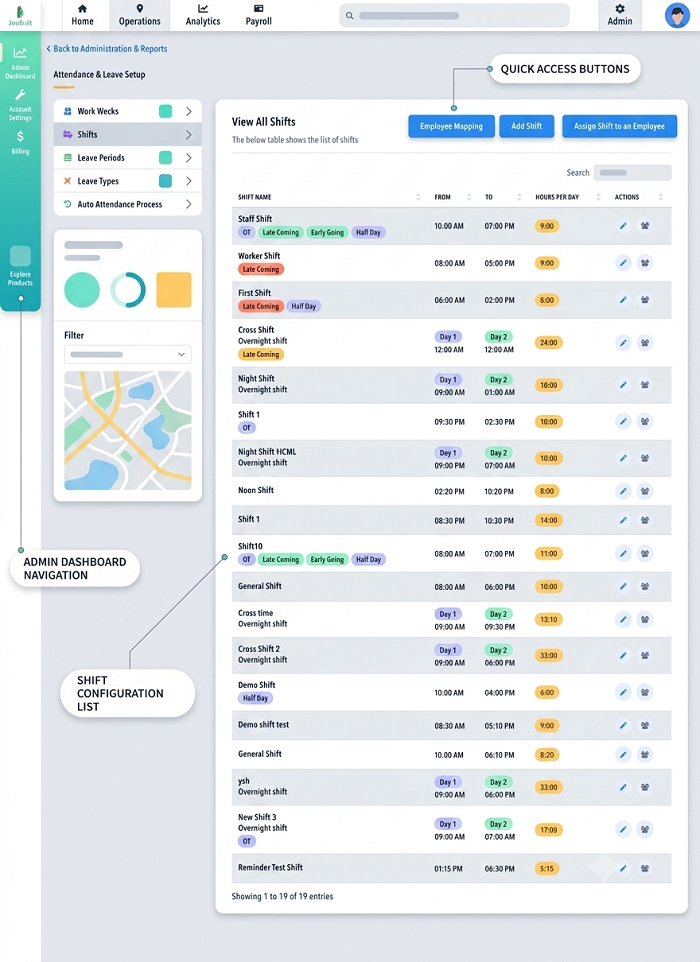
Workforce management software can help hospitals manage sudden absences and replacement assignments more efficiently.
Useful features include:
Real-time attendance monitoring
Managers can see which employees have clocked in, which are absent, and where staffing shortages may exist.
Automated absence notifications
The system can notify the appropriate supervisor when an employee submits a sick-leave request or fails to report for a scheduled shift.
Replacement availability lists
Managers can review qualified employees who have indicated their availability for additional shifts.
Skills-based assignment records
The system can display an employee's approved departments, competencies, and relevant training information.
Shift scheduling and swaps
Employees can request shift changes through a controlled approval workflow.
Overtime monitoring
Managers can review additional working hours before approving a replacement assignment.
Payroll integration
Approved attendance, leave, and overtime information can be transferred to payroll for verification.
Reporting dashboards
Hospital administrators can identify recurring absence patterns, staffing gaps, and departments that regularly depend on additional shifts.
Software should support clinical decision-making rather than automatically assign nurses without reviewing professional competence and patient-care requirements.
14. Plan Ahead for Predictable Absence Patterns
Although individual illnesses are unpredictable, hospitals can use historical information to identify periods when staffing pressure is more likely.
For example, managers may review:
- Historical sick-leave levels by month.
- Absence patterns by department and shift.
- Seasonal workload changes.
- Planned annual leave.
- Training and professional development schedules.
- Retirement and employee turnover.
- Recruitment lead times.
- Periods of high patient admissions.
This information can help hospitals prepare reserve coverage before staffing becomes critical.
If a hospital consistently experiences higher absence levels during certain periods, it may need to maintain additional float-pool capacity or adjust its planned staffing levels.
Managers should use absence information responsibly. Historical patterns should support workforce planning, not lead to assumptions that individual employees are likely to take sick leave.
15. Understand Thailand's Sick Leave and Working-Time Requirements
Hospitals operating in Thailand should consider the applicable employment framework when managing sick leave and replacement shifts.
For private-sector hospital employees covered by the Labour Protection Act B.E. 2541 (1998), the following provisions are particularly relevant.
Sick leave – Section 32
Employees are entitled to sick leave for as long as they are actually sick. For sick leave of three or more days, an employer may require a medical certificate from a first-class physician or an official medical establishment. If the employee cannot provide the certificate, the employee must explain the reason.
Paid sick leave – Section 57
Employers must pay wages for sick leave under Section 32 up to 30 working days per year. This is the statutory paid sick-leave limit; it is not a limit on an employee's right to take sick leave when actually ill.
Normal working hours – Section 23
For general work, normal working hours are generally limited to eight hours per day and 48 hours per week. Certain prescribed hazardous work is subject to a lower limit of seven hours per day and 42 hours per week. Hospitals should assess the actual job and applicable legal provisions rather than assuming that every nursing assignment falls into the same category.
Overtime – Section 24
Overtime on a normal working day generally requires the employee's prior consent on each occasion, subject to statutory exceptions. A nurse's absence does not automatically authorise the hospital to require another employee to work overtime.
Rest periods – Section 27
Employees are generally entitled to at least one hour of rest during a working day after no more than five consecutive hours of work. The Act also contains requirements concerning rest before overtime that continues for more than two hours, subject to applicable exceptions.
Weekly rest – Section 28
Employees are generally entitled to at least one weekly holiday, with no more than six days between weekly holidays, subject to specific statutory arrangements for certain types of work. Hospitals should review the applicable provisions before designing continuous shift coverage.
Employment records – Sections 112–115
Employers covered by the employee and wage-record requirements must maintain the prescribed employment and wage-related records. Relevant working-time, overtime, and payment information should be recorded accurately and retained in accordance with the Act.
Important distinction for public hospitals: The Labour Protection Act does not apply in the same way to every category of public-sector employment. Government officials, state-enterprise employees, and other public hospital personnel may be subject to separate employment laws, civil-service rules, or institutional regulations. Hospitals should confirm the employment status of their nursing staff before applying private-sector Labour Protection Act provisions.
Hospitals should also check applicable professional nursing requirements and their own clinical staffing policies. Employment-law compliance alone does not establish that a particular nurse-to-patient assignment is clinically appropriate.
16. Protect Employee Health and Attendance Information
Sick-leave records may contain sensitive information about employees. Hospitals should establish appropriate controls when collecting, storing, and using this data.
Under Thailand's Personal Data Protection Act (PDPA), health information is sensitive personal data. Hospitals should therefore pay particular attention to the legal basis for processing, access restrictions, security, retention, and appropriate handling of employee medical records.
Practical safeguards include:
- Restrict detailed medical information to authorised personnel.
- Allow nursing supervisors to see the absence status and expected availability where necessary.
- Avoid sharing diagnoses in general shift-planning groups.
- Store medical certificates securely.
- Establish clear retention and deletion procedures.
- Limit access to HR and occupational-health personnel according to their responsibilities.
- Review third-party HR and workforce software providers.
- Provide appropriate employee privacy notices.
The replacement coordinator generally needs to know that a nurse is unavailable and which shift requires coverage. Detailed medical information should not be circulated unnecessarily.
17. Monitor Staffing and Absence Management KPIs
Hospitals should review staffing indicators to determine whether their absence-response process is effective.
| KPI | What it measures |
|---|---|
| Short-notice absence rate | Frequency of absences reported close to shift start |
| Replacement coverage rate | Percentage of vacant shifts successfully covered |
| Time to fill a vacant shift | Time between absence notification and confirmed replacement |
| Unfilled shift count | Number of shifts without the planned coverage |
| Overtime hours | Additional working hours by department |
| Double-shift frequency | How often employees work consecutive or extended shifts |
| Float-pool utilisation | How frequently reserve nurses are deployed |
| Agency staffing usage | Dependence on temporary nursing personnel |
| Absence trends by department | Areas experiencing recurring staffing pressure |
| Staff turnover rate | Employee retention and workforce stability |
These indicators should be interpreted together. A hospital may achieve a high replacement coverage rate but rely heavily on overtime. That result may indicate that the immediate staffing process is effective while the underlying workforce plan needs improvement.
Patient safety, nursing workload, employee wellbeing, and service continuity should remain central to performance reviews.
18. Common Mistakes Hospitals Should Avoid
- Waiting until the shift begins to search for a replacement: Establish an early reporting procedure and an updated backup list.
- Assigning nurses based only on availability: Verify professional qualifications, clinical competencies, and department suitability.
- Relying on repeated double shifts: Monitor working hours and fatigue, and use additional staffing resources where necessary.
- Ignoring patient acuity: Assess the actual care requirements of the department before deciding how to distribute available nurses.
- Using informal shift swaps: Record employee agreement and obtain the required approval.
- Failing to update the official roster: Ensure that the replacement assignment is reflected in attendance and payroll records.
- Sharing medical details unnecessarily: Keep sick-leave information confidential and restrict access.
- Using temporary nurses without proper orientation: Verify credentials, training, and department-specific procedures before deployment.
- Ignoring recurring staffing shortages: Review recruitment, retention, scheduling, and workload instead of repeatedly treating the symptoms.
Conclusion
Hospitals in Thailand can manage unexpected nursing absences more effectively by combining a clear sick-leave reporting process, a qualified replacement pool, cross-trained staff, and structured shift approval procedures. However, filling a vacant position should never be treated as a simple headcount exercise. Replacement nurses must have the right clinical competencies, receive an appropriate handover, and be assigned according to patient-care requirements.
Workforce management software can improve visibility into attendance, shift availability, overtime, and staffing gaps. When supported by sensible reserve staffing arrangements and regular workforce reviews, these systems help hospitals maintain continuity of care while reducing excessive pressure on existing nursing teams.
A sustainable approach combines rapid absence response with long-term recruitment, retention, employee wellbeing, and safe staffing planning.
When a nurse reports sick, the roster needs an accountable replacement. InnBuilt Shift Management can help Thailand hospitals identify uncovered shifts, arrange cover and document the updated assignment.