How Can Thailand Teams Record Overnight Shifts That Cross Midnight?
How Can Thailand Teams Record Overnight Shifts That Cross Midnight?
Introduction
Many businesses in Thailand operate beyond standard daytime working hours. Manufacturing plants, hospitals, hotels, security companies, logistics providers, warehouses, retail operations and customer support centres often schedule employees to work overnight shifts.
A common example is a shift that begins at 10:00 p.m. on Monday and ends at 6:00 a.m. on Tuesday. Although the employee works one continuous shift, the attendance record covers two calendar dates. If the attendance system treats midnight as the end of the working day, it may incorrectly divide the shift, calculate working hours inaccurately or send incomplete information to payroll.
Recording overnight shifts correctly requires more than capturing clock-in and clock-out times. Employers need to configure shift schedules, identify the correct shift date, record breaks, distinguish normal hours from overtime, handle weekly rest days and public holidays, and maintain reliable attendance records.
Thailand employers should also ensure that their attendance procedures reflect the Labour Protection Act B.E. 2541 (1998), including its provisions on normal working hours, rest periods, overtime and employment records.
This article explains how Thailand businesses can accurately record overnight shifts that cross midnight and how attendance software can help HR teams, supervisors and payroll departments manage them.
1. Understand Why Overnight Shifts Need Special Attendance Rules
A shift that crosses midnight creates a difference between the calendar date and the employee's scheduled working period.
For example:
| Attendance detail | Example |
|---|---|
| Shift start | Monday, 10:00 p.m. |
| Shift end | Tuesday, 6:00 a.m. |
| Scheduled duration | 8 hours |
| Calendar dates covered | Monday and Tuesday |
| Shift reference date | Monday |
| Shift type | Overnight |
If the attendance system uses midnight as an automatic cut-off, it may record two separate attendance entries:
- Monday: 10:00 p.m. to 11:59 p.m.
- Tuesday: 12:00 a.m. to 6:00 a.m.
This can create problems when the system calculates daily hours, lateness, overtime, rest periods or payroll.
For example, the system might incorrectly identify the second part of the shift as a new attendance day or flag the employee as absent on Tuesday because there is no separate clock-in event.
Employers should therefore configure overnight shifts as continuous scheduled shifts rather than treating midnight as an automatic shift boundary.
2. Assign a Shift Date to Each Overnight Shift
One of the most important configuration decisions is determining which date identifies an overnight shift.
A practical approach is to use the shift start date as the shift reference date.
For example, an employee scheduled from 10:00 p.m. on 19 November to 6:00 a.m. on 20 November should have one attendance record linked to the shift beginning on 19 November.
The attendance system should preserve both actual timestamps while maintaining the original shift reference date.
A useful record structure includes:
- Employee ID and name.
- Shift reference date.
- Scheduled start date and time.
- Scheduled end date and time.
- Actual clock-in date and time.
- Actual clock-out date and time.
- Break start and end times.
- Total hours worked.
- Approved overtime, if applicable.
- Supervisor approval status.
This approach helps HR teams review attendance without losing the actual calendar dates and times of the employee's work.
Practical example: If a factory employee starts work at 9:45 p.m. on Monday and finishes at 6:15 a.m. on Tuesday, the system can associate the attendance record with Monday's scheduled shift while retaining Tuesday's actual clock-out timestamp.
3. Configure Overnight Shifts in Attendance Software
Attendance software should support shifts that begin on one calendar day and end on the next.
HR teams should not have to create artificial midnight clock-outs or ask employees to clock in again after midnight.
When configuring an overnight shift, employers should enter:
- Shift name, such as Night Shift A.
- Scheduled start time, such as 10:00 p.m.
- Scheduled end time, such as 6:00 a.m.
- Applicable shift reference date.
- Scheduled break periods.
- Grace period for late arrivals, if company policy allows one.
- Overtime approval requirements.
- Applicable weekly rest days and holiday rules.
The system should recognise that the end time belongs to the following calendar day.
For example, a shift configured from 22:00 to 06:00 should be interpreted as an eight-hour overnight schedule, not as a negative sixteen-hour period or two unrelated shifts.
Employers should also test schedules that cross month-end and year-end boundaries. A shift beginning on 31 December and ending on 1 January should remain one correctly linked attendance record.
4. Record Actual Clock-In and Clock-Out Times
A scheduled shift and an employee's actual attendance are not always identical.
An employee may arrive early, arrive late, leave early or remain at work beyond the scheduled end time. The attendance system should record actual events separately from scheduled times.
For an overnight shift, the system should capture the complete date and time for each event.
| Event | Scheduled time | Actual example |
|---|---|---|
| Clock-in | 10:00 p.m. Monday | 9:55 p.m. Monday |
| Break start | 2:00 a.m. Tuesday | 2:05 a.m. Tuesday |
| Break end | 2:30 a.m. Tuesday | 2:35 a.m. Tuesday |
| Clock-out | 6:00 a.m. Tuesday | 6:10 a.m. Tuesday |
The system should preserve the original punch data rather than replacing it with scheduled times.
This allows supervisors to determine whether an employee arrived early, worked beyond the scheduled shift or took a break at a different time.
Attendance records should also distinguish between an actual clock-in and a manually corrected entry. This helps HR teams identify adjustments and maintain an audit trail.
5. Record Breaks That Occur After Midnight
Breaks are particularly important for overnight shifts because they may occur on a different calendar date from the shift start.
For example, an employee working from 10:00 p.m. to 6:00 a.m. may take a break from 2:00 a.m. to 2:30 a.m.
The system should associate the break with the same overnight shift while preserving the actual Tuesday timestamps.
Thailand's Labour Protection Act Section 27 generally requires an employer to provide at least one hour of rest per working day after an employee has worked for no more than five consecutive hours. The rest period may be divided into shorter periods by agreement, subject to the statutory total and minimum interval requirements. Specific exceptions apply to certain continuous or emergency work arrangements.
Where overtime continues after normal working hours for at least two hours, the Act generally requires a rest period of at least 20 minutes before the overtime begins, subject to statutory exceptions.
The Ministry of Labour's guidance explains these rest-period requirements.
Employers should configure break rules based on the applicable legal requirements and their work arrangements. They should not assume that a break taken after midnight belongs to a separate attendance day for scheduling purposes.
A good attendance system should capture:
- Scheduled break start and end times.
- Actual break start and end times, where required.
- Total break duration.
- Missed or shortened breaks.
- Supervisor-approved break adjustments.
- Whether the break is treated as working time under the applicable arrangement.
6. Calculate Working Hours Across Two Calendar Dates
The attendance system must calculate the complete shift duration using actual timestamps.
For example:
- Monday clock-in: 10:00 p.m.
- Tuesday clock-out: 6:00 a.m.
- Total elapsed time: 8 hours.
- Unpaid break: 30 minutes.
- Net working time: 7 hours and 30 minutes.
The calculation should use the actual start and end timestamps rather than subtracting clock times without considering the date change.
A basic calculation is:
Net working time = Actual clock-out time − Actual clock-in time − Deductible break time
The employer must determine whether a break is deductible based on the applicable employment arrangement and labour-law requirements. Not every period labelled as a break can automatically be excluded from working time.
For example, if an employee is required to remain available and cannot freely use the break period, HR should review whether it qualifies as a genuine rest period.
The system should also distinguish:
- Scheduled working hours.
- Actual elapsed time.
- Net working time.
- Overtime.
- Holiday work.
- Approved adjustments.
This prevents payroll from relying on a single total-hours figure that may conceal important differences.
7. Apply Thailand's Working-Hour Rules Correctly
Recording an overnight shift does not remove the employer's obligation to comply with working-hour limits.
Under Section 23 of Thailand's Labour Protection Act, normal working hours for general work generally must not exceed eight hours per day and 48 hours per week. For work prescribed as potentially harmful to health and safety, the general limits are seven hours per day and 42 hours per week.
Section 23 also permits certain agreed arrangements for distributing hours across working days, subject to statutory conditions. Some types of work may have specific rules under ministerial regulations.
HR teams should therefore avoid treating an overnight shift as automatically compliant simply because it is configured as one continuous attendance record.
They should review:
- The employee's applicable normal working hours.
- Total working hours in the relevant week.
- Whether the work falls into a category with a lower limit.
- Whether additional hours are overtime.
- Whether a special regulation applies to the industry or work type.
For example, an employee scheduled for an eight-hour night shift may also have worked additional hours earlier in the same week. The weekly total must be considered rather than reviewing the overnight shift in isolation.
8. Distinguish Overtime From the Scheduled Overnight Shift
An overnight shift does not automatically mean that all hours after midnight are overtime.
The scheduled start and end times, applicable normal working-hour arrangement, actual hours worked and legal requirements determine how the hours should be classified.
Consider this example:
| Detail | Time |
|---|---|
| Scheduled start | 10:00 p.m. Monday |
| Scheduled end | 6:00 a.m. Tuesday |
| Actual clock-in | 10:00 p.m. Monday |
| Actual clock-out | 7:00 a.m. Tuesday |
| Additional time | 1 hour |
The additional hour should be reviewed to determine whether it qualifies as overtime and whether the required approval and payment rules apply.
Under Section 24, employers generally need an employee's prior consent on each occasion before requiring overtime on a normal working day, subject to specified exceptions, such as certain continuous or emergency work.
Sections 61–63 establish minimum overtime and holiday-work payment rates, depending on the type of work and day involved.
Attendance software should therefore support:
- Scheduled shift hours.
- Actual hours worked.
- Overtime start and end times.
- Overtime reason.
- Employee consent or applicable exception.
- Supervisor approval.
- Payroll classification.
HR should not classify every hour after midnight as overtime or assume that the date change creates a new overtime calculation automatically.
9. Handle Weekly Rest Days That Intersect With Overnight Shifts
An overnight shift can begin before a weekly rest day and finish during it.
For example, an employee may be scheduled from 10:00 p.m. Saturday to 6:00 a.m. Sunday, while Sunday is shown as the employee's weekly rest day.
The attendance and payroll system should not automatically assume that all hours worked on Sunday are either normal hours or holiday work without reviewing the applicable legal arrangement.
Thailand's Labour Protection Act Section 28 generally requires at least one weekly holiday, with the interval between weekly holidays not exceeding six days. Special arrangements apply to certain types of work and must meet the relevant statutory conditions.
Employers should define how overnight shifts are assessed when they overlap a weekly rest day. HR and payroll teams should review the applicable work schedule, statutory holiday entitlement and payment requirements before configuring the calculation.
The system should preserve the exact time intervals so that payroll can identify which hours fall on the relevant rest day and apply the correct rules.
10. Manage Public Holidays That Begin or End During an Overnight Shift
Public holidays create another important challenge for overnight attendance.
Suppose an employee starts a shift at 10:00 p.m. on the day before a company-announced traditional holiday and finishes at 6:00 a.m. on the holiday itself.
The shift spans two calendar dates, but the attendance system should not automatically classify the entire shift as holiday work or ignore the hours that fall on the holiday.
Thailand's Labour Protection Act Sections 29, 56 and 62 address traditional holidays, holiday pay and payment for work on holidays. The correct treatment depends on the employee's schedule, holiday entitlement and applicable legal provisions.
Employers should configure their systems to:
- Maintain the company's approved holiday calendar.
- Record the exact hours falling before and during the holiday.
- Identify the relevant holiday work periods.
- Apply the appropriate payment rules.
- Support payroll review and approval.
- Preserve the original shift and punch timestamps.
HR teams should test shifts that begin before a public or traditional holiday and finish during it, as well as shifts that begin on the holiday and finish the following day.
11. Handle Missed Punches and Attendance Corrections
Employees working overnight may forget to clock out before leaving in the morning or may encounter device problems during the night.
A missed clock-out should not automatically be treated as an absence or an incomplete shift without investigation.
A suitable correction process should include:
- Employee submits a missed-punch request.
- The employee provides the correct date and approximate time.
- The employee explains the reason for the missing punch.
- Supervisor checks the shift roster and available evidence.
- HR reviews the correction where required.
- The authorised person approves or rejects the request.
- The system records the adjustment and approval history.
For example, an employee who clocks in at 10:00 p.m. on Monday but forgets to clock out at 6:00 a.m. on Tuesday should submit a correction linked to the Monday overnight shift.
The system should retain the original incomplete record and the approved correction rather than silently replacing the original entry.
Useful supporting evidence may include access-control records, supervisor confirmation, work logs or other appropriate operational records.
12. Prevent Duplicate Attendance Records After Midnight
Some attendance systems create a new record automatically when the calendar date changes. This can produce duplicate or fragmented entries.
For example, an employee may have:
- One attendance entry for Monday from 10:00 p.m. to 11:59 p.m.
- Another attendance entry for Tuesday from 12:00 a.m. to 6:00 a.m.
If the software does not recognise the connection between these entries, it may incorrectly calculate attendance days, overtime or payroll.
Employers should check whether the system supports:
- Cross-midnight shift configuration.
- Shift reference dates.
- Automatic matching of clock-out events to the correct shift.
- Overnight punch pairing.
- Duplicate-punch detection.
- Multiple shifts within one calendar day.
- Month-end and year-end shift handling.
The system should also prevent an employee's next scheduled shift from being incorrectly matched with the previous night's clock-out.
13. Connect Overnight Attendance With Payroll
Payroll teams need accurate overnight attendance information to calculate wages and additional payments.
A reliable attendance-to-payroll integration should transfer the complete shift record rather than sending only a daily total.
Important information includes:
| Payroll data | Why it matters |
|---|---|
| Employee ID | Links attendance to the correct employee |
| Shift reference date | Identifies the scheduled shift |
| Actual clock-in and clock-out | Establishes the time worked |
| Break duration | Supports working-time calculation |
| Normal hours | Separates scheduled work from additional hours |
| Overtime hours | Supports overtime payment calculations |
| Holiday work hours | Supports applicable holiday payments |
| Weekly rest-day work | Supports rest-day payment review |
| Approved adjustments | Explains changes to original punches |
Payroll teams should reconcile overnight attendance before finalising salary calculations.
They should pay particular attention to shifts near payroll cut-off dates. A shift that begins on the last day of a month and ends on the first day of the next month should be transferred consistently according to the employer's approved payroll-period policy and applicable wage-payment obligations.
14. Maintain Complete Attendance Records
Accurate attendance records are important for internal reviews, payroll verification and labour inspections.
Thailand's Labour Protection Act Sections 112–115 establish employee-register and wage-related record requirements for employers with ten or more employees.
Section 114 addresses wage-related records, including working days and time, wage rates, wages paid and applicable overtime and holiday payments. Section 115 generally requires relevant records to be retained for at least two years, with additional retention where a complaint or legal proceeding is involved.
Employers should review the exact statutory requirements for the records they maintain rather than assuming that every attendance-system log has an identical retention period.
For overnight shifts, records should include:
- Original clock-in and clock-out timestamps.
- Scheduled shift details.
- Break records.
- Overtime approvals.
- Holiday and weekly rest-day classifications.
- Missed-punch corrections.
- Supervisor approvals.
- Payroll export history.
These records make it easier to explain how working hours and payments were calculated.
15. Protect Employee Attendance Data
Attendance systems may collect personal information through employee IDs, access cards, mobile applications, location verification or biometric devices.
Thailand's Personal Data Protection Act (PDPA) applies to personal data processed for attendance management.
Employers should establish appropriate controls, including:
- Informing employees about the purposes of attendance data collection.
- Identifying an appropriate legal basis for processing.
- Restricting access to authorised HR, payroll and management personnel.
- Protecting attendance records against unauthorised access.
- Defining retention and deletion procedures.
- Reviewing vendor access and data-processing arrangements.
- Applying additional safeguards where sensitive personal data, such as biometric information used for unique identification, is processed.
Employers should avoid collecting more information than is necessary to record working time. For example, a business using mobile attendance should assess whether location verification at check-in is sufficient instead of continuously tracking employees throughout the night.
16. Use Attendance Reports to Monitor Overnight Shifts
Attendance reports help managers identify recurring problems and improve shift planning.
Useful reports include:
- Overnight shift attendance summary.
- Late check-in report.
- Early departure report.
- Missing clock-out report.
- Break compliance report.
- Overtime hours report.
- Holiday work report.
- Weekly rest-day work report.
- Cross-midnight attendance exceptions.
- Attendance correction and approval report.
- Payroll reconciliation report.
For example, an HR manager may notice that employees in one warehouse frequently forget to clock out at the end of the night shift. This could indicate a device-placement issue, an unclear clock-out procedure or a rushed shift handover.
Reports should help managers identify operational problems rather than simply generate lists of employee exceptions.
17. Choose Attendance Software With Cross-Midnight Capabilities
Businesses evaluating attendance software should test actual overnight scenarios before purchasing or implementing a system.
Important capabilities include:
| Software feature | Business benefit |
|---|---|
| Overnight shift configuration | Supports shifts spanning two calendar dates |
| Shift reference date | Keeps the full shift linked to its start date |
| Actual timestamp capture | Preserves accurate punch information |
| Break management | Records rest periods across midnight |
| Overtime workflow | Supports approvals and payroll classification |
| Holiday calendar | Identifies holiday periods correctly |
| Weekly rest-day rules | Supports appropriate scheduling and payment reviews |
| Missed-punch correction | Provides a controlled adjustment process |
| Payroll integration | Transfers approved attendance information |
| Audit trail | Records changes and approvals |
| Mobile and device support | Enables different workplace check-in methods |
| Reporting | Helps HR review exceptions and working hours |
Businesses should also test the software's handling of overnight shifts across weekends, public holidays, month-end dates and year-end dates.
18. Test Overnight Attendance Scenarios Before Implementation
A practical pilot helps identify configuration problems before the software is used for payroll.
HR and IT teams can test the following situations:
| Test scenario | Expected system behaviour |
|---|---|
| Shift starts at 10:00 p.m. and ends at 6:00 a.m. | Records one linked overnight shift |
| Employee arrives late | Flags the late arrival according to policy |
| Employee clocks out after scheduled time | Records the actual time and flags the exception |
| Break occurs after midnight | Links the break to the original shift |
| Employee forgets to clock out | Creates a correction workflow |
| Shift overlaps a weekly rest day | Preserves exact time intervals for review |
| Shift overlaps a traditional holiday | Identifies relevant holiday work periods |
| Shift crosses month-end | Preserves both calendar dates |
| Two overnight shifts are scheduled close together | Matches punches to the correct shift |
| Device goes offline | Preserves or queues attendance data for synchronisation |
The pilot should include employees, supervisors, HR, payroll and IT representatives.
Before go-live, the team should compare attendance reports with manually verified sample calculations and confirm that payroll receives the correct information.
Conclusion
Recording overnight shifts that cross midnight requires a consistent approach to shift scheduling, timestamp capture, break management, working-hour calculations and payroll integration.
Thailand businesses should configure attendance systems to recognise an overnight shift as one scheduled working period while retaining the actual dates and times of every attendance event. This helps prevent duplicate records, incorrect overtime calculations, missed punches and payroll discrepancies.
Employers should also ensure that their procedures reflect the Labour Protection Act's requirements on working hours, rest periods, overtime, weekly holidays and employment records. A well-configured attendance system, supported by clear company policies and trained supervisors, can make overnight workforce management more accurate and easier to audit.
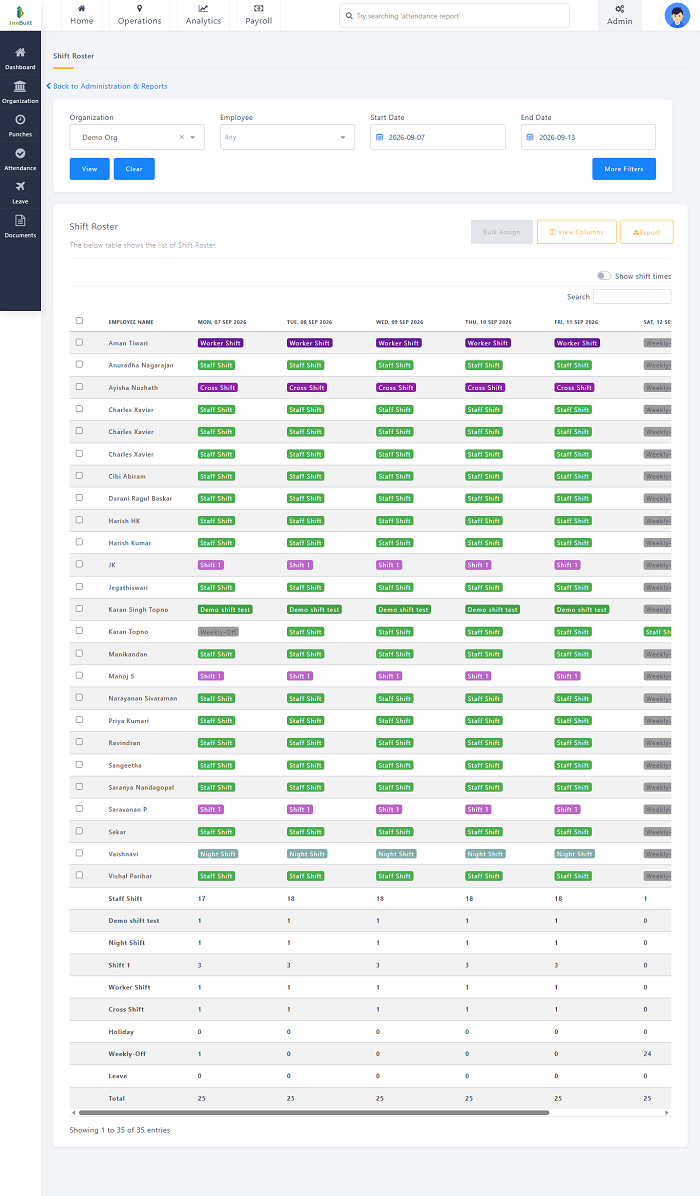
An overnight shift should be reviewed as one assignment even when its punches fall on two calendar dates. InnBuilt Shift Management can help Thailand teams reconcile the roster with start and end times.