How Can Thailand Businesses Reduce Proxy Attendance at Multi-Shift Sites?
How Can Thailand Businesses Reduce Proxy Attendance at Multi-Shift Sites?
Introduction
Managing attendance at worksites with multiple shifts can be challenging for Thailand businesses. Factories, warehouses, logistics centres, hospitals and other continuous-operation facilities often have employees reporting for duty at different times throughout the day and night. When large groups arrive together, supervisors may struggle to verify that every employee is recording their own attendance.
One common problem is proxy attendance, also known as buddy punching. It occurs when one employee records a check-in or check-out on behalf of another employee. This can happen when employees share access cards, exchange PINs, scan another person's QR code or ask colleagues to sign attendance registers for them.
Proxy attendance can create inaccurate working-hour records, payroll errors, disputes over lateness and difficulties monitoring staffing levels. It can also affect production planning when managers believe an employee has arrived even though that person is absent.
Thailand businesses can reduce these problems by combining reliable attendance technology, clear procedures, supervisor verification and regular record reviews. The following practices can help employers improve attendance accuracy across multi-shift worksites.
1. Understand Why Proxy Attendance Happens
Before introducing new controls, employers should identify how proxy attendance occurs at their worksites.
Common causes include:
- Employees sharing RFID or access cards.
- Colleagues entering another employee's PIN.
- Employees exchanging QR codes or check-in links.
- Supervisors recording attendance without verifying identity.
- Paper attendance registers being signed by someone else.
- Employees asking colleagues to clock out on their behalf.
- Poorly supervised attendance terminals.
- Inadequate controls during shift changes.
Multi-shift workplaces can be particularly vulnerable because supervisors may not be present at every entrance during early-morning, evening or overnight reporting periods.
For example, a factory operating three shifts may have hundreds of employees arriving within a short time. If employees use shared cards or PINs, a colleague may be able to record attendance for an absent worker.
Employers should investigate the process rather than immediately assuming that every attendance discrepancy is intentional. Device errors, network interruptions, incorrect shift assignments and missed punches can also produce inaccurate records.
2. Establish a Clear Attendance and Identity Verification Policy
A written attendance policy should explain how employees must record their own working time.
The policy should cover:
- Approved check-in and check-out methods.
- Rules against recording attendance for another person.
- Restrictions on sharing cards, PINs and login credentials.
- Procedures for missed punches.
- Rules for shift changes and shift swaps.
- Supervisor responsibilities.
- Attendance correction and approval procedures.
- Consequences of deliberate attendance fraud.
- Employee channels for reporting technical problems.
The policy should distinguish intentional proxy attendance from genuine attendance-recording errors.
For example, an employee who forgets to check out should be able to submit a correction request with supporting information. This should not automatically be treated as an attempt to falsify attendance.
For employers with 10 or more employees, Section 108 of Thailand's Labour Protection Act B.E. 2541 (1998) requires work rules in Thai covering specified matters, including working days, normal working hours, rest periods, holidays, overtime, leave, discipline and disciplinary penalties.
Employers should ensure that attendance-related procedures are consistent with their work rules and applicable labour requirements.
3. Use Individual Employee Identification
Each employee should have a unique identity within the attendance system.
A shared attendance account makes it difficult to establish who actually recorded an attendance event. Individual identification helps employers connect each check-in and check-out to the correct employee record.
Possible identification methods include:
- Individual RFID or access cards.
- Employee-specific PINs.
- QR-code authentication.
- Mobile employee accounts.
- Biometric verification.
- Supervisor-assisted identity checks.
Employers should avoid generic department accounts or shared credentials for normal employee attendance.
The system should also prevent duplicate or conflicting attendance events where possible. For example, it should flag a second check-in when an employee already has an active attendance session, rather than silently accepting both records.
Unique identification is the foundation of reliable attendance management, but it should be supported by controls that make credential sharing more difficult.
4. Introduce Face Recognition Where Appropriate
Face recognition attendance can reduce proxy attendance because the system verifies the person presenting themselves against registered facial information.
Instead of relying only on a card or PIN, the system checks whether the person using the terminal matches the enrolled employee.
Potential benefits include:
- Reducing attendance entries made with another employee's card.
- Improving identity verification at busy entrances.
- Reducing dependence on paper registers.
- Supporting automated check-in and check-out records.
- Providing more consistent identity checks across shifts.
Face recognition can be useful at large factories, warehouses and industrial sites where many employees report at the same time.
However, it should not be treated as completely foolproof. Poor lighting, camera positioning, protective equipment, appearance changes and spoofing attempts can affect recognition.
Employers should also consider Thailand's PDPA. Biometric data used to uniquely identify an individual is sensitive personal data under Section 26. Businesses must establish an appropriate legal basis, provide required privacy information and apply suitable safeguards. Explicit consent may be required unless a specific statutory exception applies.
Employers should assess whether face recognition is necessary and proportionate, and provide an appropriate alternative attendance method where needed.
5. Choose Attendance Devices That Suit the Worksite
The effectiveness of attendance controls depends partly on the physical environment.
A system that works well in an office may not perform reliably at a dusty factory entrance or a warehouse with heavy employee traffic.
Before installation, employers should consider:
- Number of employees arriving per shift.
- Number of entry and exit points.
- Expected check-in volume during peak periods.
- Lighting conditions.
- Dust, heat and humidity.
- Network availability.
- Power supply.
- Protective equipment worn by employees.
- Device durability.
- Maintenance requirements.
For example, a manufacturing facility may need multiple attendance terminals near employee entrances to avoid long queues during shift changes.
Employers should test devices during actual peak periods rather than relying only on vendor demonstrations.
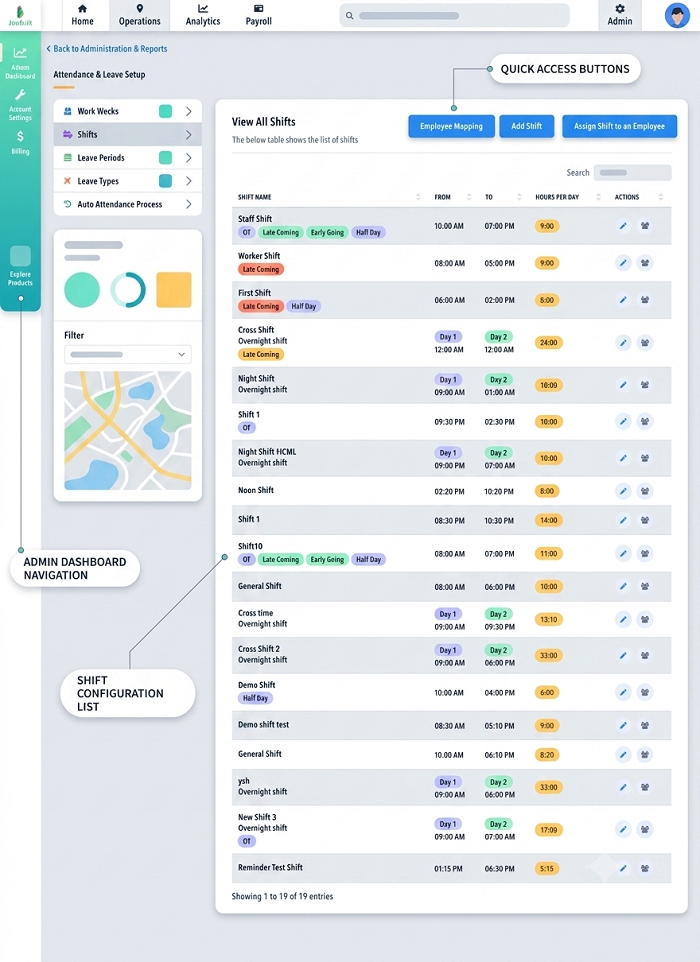
6. Match Attendance Records With Assigned Shift Schedules
Multi-shift sites need accurate shift configuration.
An attendance event should be checked against the employee's assigned schedule so that managers can identify unusual or conflicting records.
Common shift arrangements include:
- Morning shifts.
- Afternoon shifts.
- Night shifts.
- Rotating shifts.
- Weekend shifts.
- Split shifts.
- Extended operational shifts.
Attendance software should allow employers to assign employees to specific shifts and record schedule changes with an approval history.
For example, an employee assigned to a 7:00 AM–3:00 PM shift should not automatically be treated as present for a 3:00 PM–11:00 PM shift simply because a check-in appears during that period.
The system should flag unexpected attendance events for review.
Employers should also configure reasonable check-in windows based on their operational arrangements. These windows should help identify unusual entries without incorrectly rejecting legitimate early arrivals, approved overtime or authorised shift changes.
7. Use Shift-Based Check-In and Check-Out Controls
Attendance rules should account for the start and end of each shift.
A practical system can identify:
- Check-ins before the scheduled shift.
- Check-ins within the permitted reporting window.
- Late check-ins.
- Missing check-ins.
- Check-outs before the scheduled end.
- Missing check-outs.
- Duplicate check-in events.
- Attendance events outside the assigned shift.
These controls can help supervisors identify unusual attendance activity.
For example, if an employee is scheduled for a night shift but the system records a check-in several hours before the shift begins, the event can be flagged for verification.
However, an unusual timestamp does not automatically prove proxy attendance. HR should consider approved schedule changes, overtime, shift swaps and operational assignments before making a decision.
8. Position Attendance Terminals at Controlled Entry Points
The location of attendance devices can influence how effectively a business verifies employee identity.
Terminals should be installed at designated employee check-in locations where the verification process can be supervised appropriately.
Employers may consider placing devices at:
- Main employee entrances.
- Production-area entry points.
- Warehouse staff entrances.
- Restricted worksite access points.
- Designated shift reporting locations.
The objective is to make it difficult for one employee to record attendance for several colleagues without creating unnecessary congestion.
Where feasible, businesses can position terminals so that supervisors can observe the process during peak reporting periods.
However, attendance terminals should not be used to impose unnecessary surveillance. Employers should define the purpose of each device and avoid collecting more personal information than necessary.
9. Combine Attendance Verification With Access Control Carefully
Some businesses use attendance systems alongside building access-control systems.
For example, an employee may use an access card to enter a facility and then complete a separate attendance check-in.
Connecting these systems can help employers compare entry events with attendance records.
Possible checks include:
- Whether an employee entered the facility before recording attendance.
- Whether an attendance event occurred at an authorised location.
- Whether a card was used at multiple terminals within an impossible time interval.
- Whether a person attempted to use a restricted entrance.
- Whether attendance was recorded without a corresponding expected access event.
However, access records and attendance records serve different purposes. Entering a building does not necessarily mean that an employee has started work, and an employee may have legitimate reasons to enter or leave without recording a normal shift event.
Employers should use these records as supporting evidence rather than automatically treating them as proof of working time.
10. Monitor Duplicate and Unusual Attendance Events
Attendance software should identify patterns that may indicate proxy attendance or credential misuse.
Useful alerts include:
- Multiple check-ins for the same employee.
- One credential being used at different terminals within an unusually short period.
- Check-ins outside assigned shifts.
- Repeated attendance corrections.
- Unusual numbers of manual attendance entries.
- Missing check-outs.
- Repeated use of the same device or account in suspicious circumstances.
- Attendance events that conflict with approved leave or absence records.
For example, if an employee's access card appears at two distant entrances within a few minutes, the system can flag the event for investigation.
These alerts should be treated as indicators, not automatic proof of misconduct. Technical errors, shared device configurations and incorrect employee assignments can also cause unusual patterns.
11. Assign Supervisors to Verify Attendance During Shift Changes
Technology should be supported by appropriate supervision.
At large worksites, supervisors can help verify attendance during periods when large numbers of employees report for duty.
Their responsibilities may include:
- Checking that employees use their own credentials.
- Assisting with unsuccessful attendance verification.
- Reviewing missing punches.
- Confirming approved shift changes.
- Reporting suspected credential sharing.
- Checking staffing levels at the start of each shift.
- Approving attendance corrections where authorised.
A business with several production areas may assign a responsible supervisor to each shift or worksite zone.
Supervisors should follow consistent procedures so that employees receive fair treatment regardless of which shift they work.
12. Create a Fair Process for Missed Punches
Not every missing attendance record indicates proxy attendance.
Employees may forget to check in, fail to complete a check-out or encounter a technical problem with the terminal.
Employers should create a correction process that allows employees to report these situations.
A suitable workflow includes:
- Employee submits a missed-punch request.
- The employee identifies the date and affected shift.
- The employee provides the actual reporting or departure time.
- Supporting information is reviewed where appropriate.
- The supervisor checks the request.
- HR or an authorised manager approves the correction.
- The system preserves the original record and correction history.
The process should record who made the change, who approved it and why it was necessary.
This helps distinguish genuine attendance problems from deliberate attempts to manipulate records.
13. Configure Overnight Shifts Correctly
Night shifts create additional attendance challenges because the shift may cross midnight.
For example, an employee may start work at 10:00 PM and finish at 6:00 AM the next day.
The attendance system should link both events to the correct scheduled shift while retaining their actual calendar dates and timestamps.
Employers should test whether the system can:
- Recognise shifts that cross midnight.
- Match check-out events to the correct shift.
- Prevent duplicate attendance sessions.
- Handle early and late check-ins.
- Record breaks accurately.
- Identify missing check-outs.
- Transfer working-hour information correctly to payroll.
A system that treats every calendar date as a separate attendance session may incorrectly classify overnight employees as absent or create duplicate records.
Correct configuration helps prevent false alerts and payroll errors.
14. Protect Attendance Records and Employee Personal Data
Attendance systems process employee information such as names, employee IDs, working hours, locations and sometimes biometric information.
Employers should follow Thailand's Personal Data Protection Act when collecting, using and storing this information.
Important safeguards include:
- Collecting only information needed for attendance management.
- Informing employees about the purpose of collection.
- Restricting access to authorised users.
- Securing attendance records and system accounts.
- Establishing suitable retention periods.
- Reviewing vendor access and data-processing arrangements.
- Providing appropriate procedures for employee data requests.
If face recognition or fingerprint verification is used, biometric information used to uniquely identify an individual is sensitive personal data under Section 26. Employers must assess the applicable legal basis and safeguards before collecting it.
Businesses should not introduce biometric attendance simply because it is available. They should consider whether it is necessary and proportionate compared with less intrusive alternatives.
15. Connect Attendance With Payroll Carefully
Proxy attendance can create payroll inaccuracies because payroll calculations may depend on recorded working time, approved overtime and absence information.
Integrating attendance with payroll can reduce manual data transfer and help HR identify inconsistencies before salary processing.
A suitable workflow should:
- Capture employee attendance events.
- Match events with assigned shifts.
- Identify missing or unusual records.
- Review and approve corrections.
- Separate normal hours from approved overtime.
- Identify holiday work and applicable payment categories.
- Transfer verified data to payroll.
- Reconcile payroll results with attendance reports.
Thailand's Labour Protection Act establishes requirements concerning normal working hours, overtime and rest periods.
Under Section 23, normal working hours are generally limited to eight hours per day and 48 hours per week, with lower limits for prescribed hazardous work. Section 24 generally requires prior employee consent for overtime on a normal working day on each occasion, subject to statutory exceptions.
Section 27 addresses daily rest periods, while Section 28 generally requires at least one weekly holiday with no more than six days between weekly holidays.
Employers should ensure that attendance corrections do not automatically create or remove overtime entitlements without reviewing the actual work performed and applicable legal requirements.
16. Maintain Reliable Attendance and Wage Records
Accurate records help employers investigate proxy attendance complaints, respond to employee disputes and demonstrate compliance.
For employers with 10 or more employees, Sections 112–115 of the Labour Protection Act establish requirements concerning employee registers and wage-related records.
Relevant wage and payment documents must include information such as working days and working time, along with wage rates and amounts paid for wages, overtime, holiday work and holiday overtime.
Section 115 generally requires employee records to be retained for at least two years from the employee's termination date and relevant wage-payment documents for at least two years from the payment date. Where specified complaints, labour disputes or legal proceedings are involved, retention must continue until the relevant order or judgment is final.
Businesses should maintain:
- Employee master records.
- Shift rosters.
- Attendance timestamps.
- Missed-punch requests.
- Approved corrections.
- Overtime approvals.
- Supervisor verification records.
- Payroll calculations.
- Relevant payment evidence.
Records should be searchable by employee, worksite, shift and payroll period.
17. Train Employees on Attendance Responsibilities
Employees should understand that attendance credentials are personal and must not be shared.
Training should explain:
- How to record attendance correctly.
- Why employees must use their own credentials.
- Why cards and PINs should not be shared.
- How to report a lost or damaged card.
- What to do when a terminal fails.
- How to submit missed-punch corrections.
- How to request a shift change.
- How attendance information is used.
- How to report suspected proxy attendance.
Supervisors should receive additional training on handling exceptions, reviewing suspicious events and maintaining accurate records.
Training should be repeated when new attendance devices or procedures are introduced.
18. Review Attendance Reports Regularly
Regular reporting helps employers identify repeated problems and assess whether attendance controls are working.
Useful reports include:
| Report | What it helps identify |
|---|---|
| Shift-wise attendance | Employees who have reported for each shift |
| Late-arrival report | Repeated late check-ins |
| Missing-punch report | Incomplete attendance sessions |
| Duplicate-event report | Multiple or conflicting attendance entries |
| Manual-correction report | Frequent attendance adjustments |
| Credential-use report | Unusual card or account activity |
| Department attendance report | Staffing shortages across teams |
| Overtime report | Additional working hours requiring review |
| Device exception report | Failed scans and terminal problems |
| Payroll reconciliation report | Differences between attendance and payroll inputs |
HR should investigate recurring patterns rather than relying on a single unusual event.
Reports can also help management decide whether additional terminals, better supervision or revised shift procedures are needed.
19. Test Attendance Controls Before Full Deployment
Before introducing a new attendance system across all shifts, businesses should conduct a pilot.
A useful pilot should test:
- Individual employee registration.
- Card or PIN-sharing controls.
- Face recognition accuracy, if used.
- Attendance recording during peak periods.
- Multiple shifts and overnight shifts.
- Duplicate attendance alerts.
- Missing-punch correction workflows.
- Network and power interruptions.
- Supervisor approval processes.
- Payroll integration.
- Employee privacy safeguards.
The pilot should include employees from different departments and shifts. Testing only during normal office hours may not reveal problems that occur during overnight operations or busy shift changes.
Employers should measure failed check-ins, manual corrections, queue times and attendance discrepancies before deciding whether to expand the system.
Conclusion
Reducing proxy attendance at multi-shift sites requires a structured approach that combines individual employee identification, reliable attendance devices, shift-based controls, supervisor verification and regular reporting.
Thailand businesses should also establish fair missed-punch procedures, configure overnight shifts correctly and connect verified attendance information with payroll.
Biometric attendance can provide an additional identity-verification layer where it is appropriate and legally justified, but it is not the only solution. Employers should consider less intrusive alternatives and comply with Thailand's PDPA when processing employee biometric information.
By implementing clear policies and testing attendance controls across every shift, businesses can improve workforce visibility, reduce attendance manipulation and maintain more reliable working-time records.
Proxy punching is difficult to spot when many shifts overlap. InnBuilt Face Attendance Software can help Thailand worksites review identity-linked entries alongside the expected shift roster.