How Can Thailand Restaurants Record Split Shifts and Actual Hours Worked?
How Can Thailand Restaurants Record Split Shifts and Actual Hours Worked?
Introduction
Restaurants in Thailand often experience different levels of customer demand throughout the day. Breakfast, lunch and dinner services may require separate staffing arrangements, while quieter periods between meal services can make continuous shifts inefficient.
To manage these patterns, many restaurants use split shifts. An employee may work during the lunch service, take a break during the afternoon and return for the evening service. For example, a waiter might work from 10:00 a.m. to 2:00 p.m. and then from 5:00 p.m. to 9:00 p.m.
Although split shifts help restaurants match staffing with customer demand, they create additional challenges for attendance management and payroll. Managers must record each work period accurately, distinguish working time from genuine rest periods, calculate total hours and identify overtime or holiday work where applicable.
A single daily clock-in and clock-out record may not provide enough information to calculate actual working hours for employees who leave and return during the same day.
Restaurants therefore need a clear attendance policy, reliable time-recording procedures and a consistent method of calculating working hours. This article explains how Thailand restaurants can record split shifts and actual hours worked while supporting accurate payroll and compliance with labour requirements.
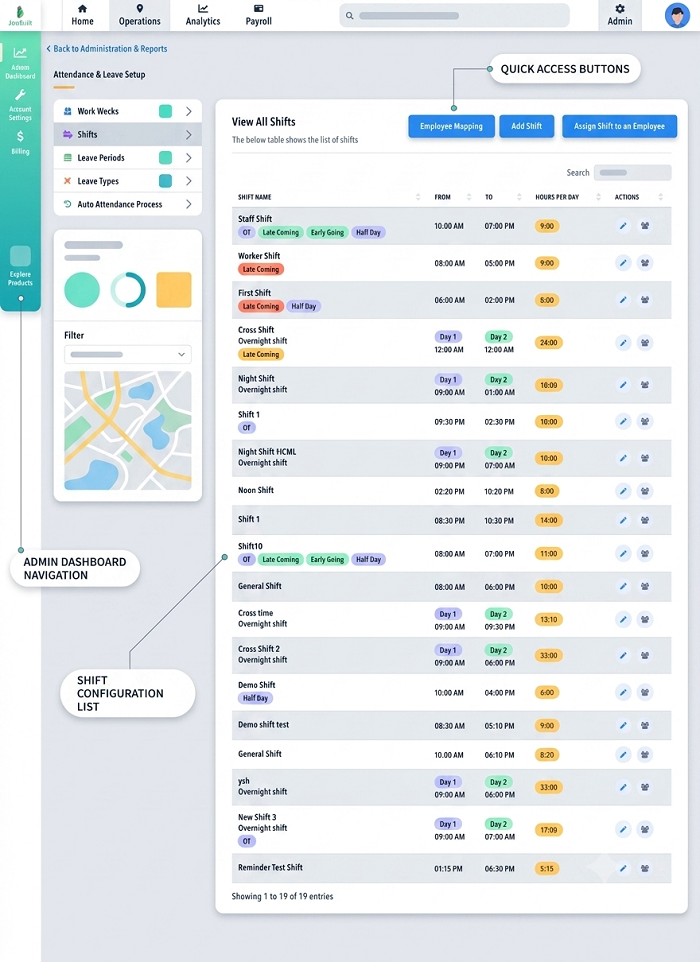
1. Understand How Split Shifts Work in Restaurants
A split shift divides an employee's scheduled work into two or more separate working periods within the same day, with a substantial break between them.
Restaurants commonly use this arrangement because customer demand is concentrated around meal periods.
For example:
| Work period | Example schedule | Main responsibilities |
|---|---|---|
| First shift | 10:00 a.m.–2:00 p.m. | Lunch preparation and service |
| Break between shifts | 2:00 p.m.–5:00 p.m. | Scheduled break or non-working interval, depending on the arrangement |
| Second shift | 5:00 p.m.–9:00 p.m. | Dinner preparation and service |
In this example, the employee works for four hours in the first period and four hours in the second period.
Restaurants may use split shifts for several roles:
- Waiters and service staff.
- Kitchen assistants.
- Chefs and cooks.
- Cashiers.
- Restaurant supervisors.
- Baristas and beverage preparation staff.
- Cleaning and dishwashing employees.
- Delivery and takeaway support staff.
The schedule should identify the start and end of every work period. Recording only the first arrival and final departure would incorrectly show a continuous 11-hour attendance span, even though the employee worked in two separate periods.
A split-shift arrangement should therefore be represented as multiple attendance intervals linked to one employee and one workday.
2. Create a Separate Attendance Record for Each Work Period
The most important step is to record every time an employee starts and finishes work.
A restaurant should not rely on one clock-in and one clock-out event when an employee has multiple work periods during the day.
For a split-shift employee, the attendance record should capture:
- First shift clock-in.
- First shift clock-out.
- Second shift clock-in.
- Second shift clock-out.
- Any additional work periods, if applicable.
- Approved corrections or adjustments.
For example:
| Attendance event | Recorded time |
|---|---|
| First shift clock-in | 10:00 a.m. |
| First shift clock-out | 2:00 p.m. |
| Second shift clock-in | 5:00 p.m. |
| Second shift clock-out | 9:00 p.m. |
| Total recorded work intervals | 8 hours |
This creates a clear record of when the employee actually attended work.
Restaurants should also record the employee's scheduled shift separately from actual attendance. This allows managers to identify late arrivals, early departures, additional working time and unapproved schedule changes.
3. Distinguish Working Time From the Break Between Shifts
A long interval between two work periods should not automatically be treated as working time or automatically excluded from working time without examining the arrangement.
Managers should establish whether the employee is genuinely released from work during the interval.
For example, an employee who finishes lunch service at 2:00 p.m. and returns at 5:00 p.m. may have a genuine non-working interval if they are free to use that time as they wish.
The situation may be different if the employee must remain at the restaurant, perform preparation tasks, respond to customer requests or remain available for work during the supposed break.
Restaurants should document:
- When the break begins.
- When the employee is expected to return.
- Whether the employee is free from work duties.
- Whether the employee is required to remain available.
- Whether any work is performed during the interval.
- Whether the interval is treated as working time under the applicable legal rules.
Thailand's Labour Protection Act B.E. 2541 (1998), Section 27, establishes general requirements for rest periods. It generally requires at least one hour of rest per working day after no more than five consecutive hours of work. Rest periods may be divided by prior agreement, provided the total meets the statutory minimum.
The Act also contains rules about the treatment of rest periods exceeding two hours. In addition, the Ministry of Labour's guidance recognises a specific arrangement for food and beverage shops that open or provide services at non-continuous times, under which rest periods may exceed two hours. Restaurants should assess their actual operating pattern and the applicable legal treatment rather than assume that every long interval is automatically unpaid or excluded from working time.
4. Calculate Actual Working Hours Across All Shifts
After recording the attendance intervals, restaurants should calculate the employee's actual working time for the day.
A basic calculation is:
Actual hours worked = Total of all recorded working intervals
For example:
| Work period | Start | End | Hours worked |
|---|---|---|---|
| Lunch shift | 10:00 a.m. | 2:00 p.m. | 4 hours |
| Dinner shift | 5:00 p.m. | 9:00 p.m. | 4 hours |
| Total | 8 hours |
The three-hour interval between the shifts is not included in this simple calculation because the example assumes it is a genuine non-working period and is treated accordingly under the applicable rules.
A second example may involve an employee who works from 9:30 a.m. to 1:30 p.m. and returns from 4:30 p.m. to 9:30 p.m.
- First work period: 4 hours.
- Second work period: 5 hours.
- Total recorded work intervals: 9 hours.
The payroll team must then review the employee's agreed normal working hours and the applicable rules for daily and weekly working time. It should not assume that splitting the schedule automatically removes overtime implications.
For accurate calculations, attendance software should add the separate work intervals while preserving the original timestamps.
5. Maintain Both Scheduled and Actual Working Hours
A restaurant should maintain two separate sets of information:
Scheduled working hours: The hours assigned to the employee before the workday begins.
Actual working hours: The hours recorded when the employee starts and finishes each work period.
Comparing these records helps managers understand whether employees are following their assigned schedules.
For example:
| Work period | Scheduled time | Actual time | Variance |
|---|---|---|---|
| Lunch | 10:00 a.m.–2:00 p.m. | 10:10 a.m.–2:05 p.m. | Late arrival and late finish |
| Dinner | 5:00 p.m.–9:00 p.m. | 4:55 p.m.–9:20 p.m. | Early arrival and late finish |
The attendance system should preserve the actual events instead of replacing them with scheduled times.
Managers can then determine whether the additional time was authorised, whether it was work-related and how it should be treated for payroll.
This distinction is particularly useful during busy weekends, public holidays and special restaurant events when employees may be asked to begin early or remain after the scheduled closing time.
6. Use a Clear Clock-In and Clock-Out Procedure
Employees should understand exactly when and how to record attendance for each shift.
A practical restaurant procedure may include:
- Clock in immediately before beginning the first assigned work period.
- Clock out when the first work period ends.
- Record the beginning and end of the break as required by the system.
- Clock in again before starting the second work period.
- Clock out after completing the final assigned duties.
- Report missed or incorrect punches to the supervisor.
- Obtain approval for any attendance correction.
Restaurants can use different methods to capture these events.
Biometric attendance terminals: Employees use a fingerprint or facial recognition terminal to record attendance. Biometric processing requires particular care because biometric data is sensitive personal data under Thailand's Personal Data Protection Act (PDPA).
PIN or employee ID terminals: Employees enter an individual identification number or scan a staff card.
Mobile attendance applications: Employees record attendance through a mobile application, subject to appropriate location and privacy controls.
Supervisor-approved attendance: A manager records or verifies attendance when an employee cannot use the normal system, such as during a terminal outage.
Whichever method is selected, each employee should have an individual attendance record. Shared credentials and informal group clock-ins make it difficult to establish who actually worked.
7. Record Early Starts, Late Finishes and Additional Work
Restaurant workloads can change quickly. A large group booking, delayed delivery, unexpected customer demand or kitchen equipment problem may require employees to work beyond their scheduled hours.
The attendance system should capture the actual time even when it differs from the roster.
For example:
- A chef starts 20 minutes early to prepare for a large booking.
- A waiter remains 30 minutes after closing to complete service and cleaning duties.
- A kitchen assistant returns earlier than planned because a delivery arrives.
- A supervisor requests additional staff during an unexpected evening rush.
These events should be recorded and reviewed.
Managers should not automatically classify every early arrival or late departure as overtime without examining whether the employee actually performed work and whether the time was authorised. Equally, they should not ignore time spent performing required duties merely because the employee did not receive a formal overtime instruction.
A useful approval workflow should record:
- Employee name and department.
- Scheduled working period.
- Actual additional working time.
- Reason for the additional work.
- Supervisor approval or review.
- Payroll treatment.
This creates an auditable record for payroll and management review.
8. Review Overtime Across Split Shifts
Split shifts do not eliminate the need to monitor overtime.
Restaurants should calculate actual working hours across all work periods and compare them with the employee's normal working hours under the applicable agreement and legal requirements.
Under Section 23 of Thailand's Labour Protection Act, normal working time for general work is generally limited to eight hours per day and 48 hours per week. Certain prescribed hazardous work has lower limits.
Section 24 generally requires prior employee consent for overtime on a normal working day on each occasion, subject to statutory exceptions. The definition of overtime includes work beyond normal working time or beyond the daily working hours agreed under Section 23.
For example, an employee scheduled for two four-hour periods may work eight hours in total. If the employee then remains for an additional hour after dinner service, the restaurant should record the extra time and review its treatment under the employee's agreed schedule and applicable overtime rules. Restaurants should also distinguish between:
- Normal working time.
- Overtime on a normal working day.
- Work on a weekly holiday.
- Work on a traditional holiday.
- Overtime performed on a holiday.
These categories may have different consent, eligibility and payment requirements.
Section 25 specifically addresses holiday work in food shops and beverage shops. Restaurants should still apply the relevant statutory rules on holiday work and payment rather than treating all holiday shifts as ordinary working days.
9. Check Rest Periods and Weekly Rest Days
Split-shift scheduling should not be used to avoid statutory rest requirements.
Managers need to review both the time between work periods and the employee's rest arrangements across the working week.
Important checks include:
- Whether the employee receives the required daily rest period.
- Whether the employee works for too many consecutive hours without the required rest.
- Whether the break arrangement meets applicable legal conditions.
- Whether overtime creates an additional rest requirement.
- Whether the employee receives the required weekly holiday.
- Whether late closing followed by an early opening creates an unreasonable or non-compliant schedule.
Section 27 generally requires a rest period of at least one hour after no more than five consecutive hours of work. If overtime following normal working hours exceeds two hours, the employer generally must provide at least 20 minutes of rest before the overtime begins, subject to statutory exceptions.
Section 28 generally requires at least one weekly holiday, with no more than six days between weekly holidays.
Restaurants should review the complete schedule rather than assessing each shift independently. An employee may appear to have reasonable hours in each individual work period but still have an unsuitable overall weekly schedule.
10. Handle Missed Punches and Attendance Corrections
Employees may occasionally forget to clock in or out, particularly when they are moving quickly between lunch and dinner service.
A missed punch should be corrected through a controlled process rather than handled informally.
For example, an employee may clock out at 2:00 p.m. but forget to record the second clock-in at 5:00 p.m.
The correction process should capture:
- Employee name and ID.
- Date of the missing event.
- Expected attendance time.
- Reason for the missed punch.
- Employee explanation.
- Supporting information, where appropriate.
- Supervisor approval.
- Date and time of the correction.
The system should retain the original attendance record and the corrected information. It should not silently overwrite the original data.
Supervisors can verify corrections using shift rosters, work assignments, POS activity where relevant, kitchen preparation records or other reliable operational information.
However, sales or POS transactions alone should not be treated as conclusive proof of an employee's entire working period.
11. Connect Attendance Records With Payroll
Attendance data becomes especially useful when it is connected to payroll.
At the end of each pay period, the payroll team should receive a consolidated record of:
- Total normal working hours.
- Actual work periods.
- Approved overtime hours.
- Holiday work.
- Holiday overtime.
- Late arrivals and early departures.
- Approved unpaid absences.
- Attendance corrections.
- Applicable rest-period treatment.
The payroll team should verify that the time records match the employee's pay arrangement.
For example, hourly employees may require a different calculation process from monthly salaried employees. Daily, hourly and monthly wage arrangements should not be treated as interchangeable.
The payroll system should also preserve the underlying attendance details so that a manager can trace a calculated payment back to the actual work intervals.
A reliable integration reduces manual calculations and helps identify discrepancies before salary processing.
12. Maintain Legally Relevant Working-Time and Wage Records
Thailand's Labour Protection Act contains specific recordkeeping obligations for employers with 10 or more employees.
Section 114 requires employers within its scope to maintain documents relating to the payment of wages, overtime pay, holiday pay and holiday overtime pay. These documents must include working days and working time, along with applicable wage and payment details.
Section 115 establishes retention requirements for employee records and wage-related payment documents. In general, employee records must be retained for at least two years from the termination of employment, and payment documents for at least two years from the payment date. Where a relevant complaint, labour dispute or legal proceeding exists, the records must be retained until the matter is finally resolved.
Restaurants should maintain records in a format that allows them to retrieve information by employee, date, shift and pay period.
Useful records include:
- Employee details and employment information.
- Published work schedules.
- Actual clock-in and clock-out events.
- Split-shift intervals.
- Rest-period information.
- Approved overtime.
- Holiday work.
- Wage and payment records.
- Attendance corrections and approvals.
Restaurants with 10 or more employees must also consider the work-rule requirements under Section 108. These include rules concerning working days, normal working hours, rest periods, holidays, overtime, holiday work, leave and wage payment arrangements.
13. Protect Employee Attendance and Location Data
Digital attendance systems may collect personal information such as employee names, identification numbers, timestamps, device details and, in some cases, location or biometric information.
Restaurants should manage this information in line with Thailand's PDPA.
Practical safeguards include:
Explain the purpose: Tell employees why attendance information is collected and how it will be used for workforce management and payroll.
Collect only necessary information: Avoid collecting continuous location data if attendance-event verification is sufficient.
Restrict access: Allow only authorised HR, payroll and management personnel to view detailed employee records.
Protect biometric information: Fingerprint and facial recognition data require special attention because biometric data used for uniquely identifying a person falls within the PDPA's sensitive personal data category.
Set retention rules: Keep attendance information for appropriate legal, payroll and operational purposes and securely dispose of it when no longer required.
Control vendor access: Review the security, processing arrangements and data-handling practices of attendance software providers.
Restaurants should not assume that employee consent is automatically the correct legal basis for every type of attendance processing. The appropriate lawful basis and safeguards should be assessed for the specific data and purpose.
14. Use Attendance Software to Manage Split Shifts
A suitable attendance management system can make split-shift recording more accurate and easier to review.
When evaluating software, restaurants should look for the following capabilities:
| Software feature | Benefit for restaurant operations |
|---|---|
| Multiple clock-in and clock-out events | Records every work period separately |
| Split-shift scheduling | Assigns different working periods within one day |
| Scheduled versus actual comparison | Identifies late arrivals and extra working time |
| Automatic hour calculation | Adds actual work intervals accurately |
| Break management | Records rest periods and break arrangements |
| Overtime approval | Routes additional work for supervisor review |
| Holiday calendars | Helps distinguish holiday work from normal work |
| Missed-punch correction | Provides a controlled attendance adjustment process |
| Payroll integration | Transfers approved hours for salary processing |
| Audit trail | Preserves original events and approved corrections |
| Employee self-service | Allows employees to view schedules and attendance records |
| Reports and dashboards | Helps managers identify attendance patterns |
A good system should support different schedules for kitchen, service, cleaning and management teams.
It should also allow employees to view their own attendance records and report discrepancies before payroll cut-off.
15. Review Split-Shift Performance With Useful Reports
Attendance reports can help restaurant managers understand whether split shifts are working effectively.
Useful reports include:
| Report | What managers can review |
|---|---|
| Daily attendance report | All work periods recorded for each employee |
| Split-shift report | Employees working multiple periods in one day |
| Scheduled versus actual hours | Differences between rosters and attendance |
| Overtime report | Additional hours requiring review |
| Missed-punch report | Missing or incomplete attendance events |
| Department attendance report | Coverage across kitchen, service and support teams |
| Weekly working-hours report | Total hours across the working week |
| Payroll exception report | Attendance data requiring correction before payment |
| Holiday work report | Employees assigned to work on holidays |
Managers should use these reports to identify recurring problems.
For example, if employees regularly clock out late after dinner service, the restaurant may need to review closing procedures, cleaning responsibilities or the number of employees assigned to the shift.
If staff frequently return early from breaks, supervisors should determine whether the break schedule is realistic or whether operational demands are interfering with rest periods.
16. Common Mistakes Restaurants Should Avoid
Even when restaurants use attendance software, incorrect policies can create unreliable records.
Common mistakes include:
Recording only one daily clock-in and clock-out: This makes it difficult to identify separate work periods and actual hours.
Treating every long interval as unpaid automatically: The actual arrangement and applicable rest-period rules must be considered.
Ignoring work performed during breaks: If employees perform duties during a supposed break, the restaurant should record and assess that time correctly.
Replacing actual time with scheduled time: Attendance corrections should preserve the original clock events and approval history.
Calculating overtime only by looking at the final shift: The full day's and week's working hours must be reviewed.
Failing to record additional duties: Preparation, closing, cleaning and other required work should be considered when determining actual working time.
Using informal messaging as the only attendance record: Supervisor messages can support an investigation but should not replace a reliable attendance record.
Ignoring employee access to records: Employees should have a clear way to review their attendance and report errors.
Avoiding these mistakes improves payroll accuracy and reduces disputes about working time.
17. Practical Implementation Checklist for Thailand Restaurants
Restaurants can use the following checklist to improve split-shift attendance management.
Shift planning
- Define each work period separately.
- Publish schedules before the workday.
- Identify break periods and expected return times.
- Review coverage for lunch, dinner and closing duties.
- Check daily and weekly working-hour arrangements.
Attendance recording
- Capture every clock-in and clock-out.
- Link all work periods to the correct employee and workday.
- Record actual rather than scheduled times.
- Provide a procedure for missed punches.
- Preserve corrections and approval history.
Working-time review
- Calculate total hours across all work periods.
- Review the treatment of long breaks.
- Identify additional work and potential overtime.
- Check weekly rest days and holiday work.
- Confirm applicable rest-period requirements.
Payroll and compliance
- Transfer verified attendance data to payroll.
- Review overtime and holiday payments.
- Maintain required working-time and wage records.
- Check applicable work-rule requirements.
- Apply appropriate retention and privacy safeguards.
Continuous improvement
- Review attendance exceptions each pay period.
- Collect employee feedback.
- Monitor recurring late finishes and early starts.
- Adjust shift patterns when demand changes.
- Train supervisors to manage attendance corrections consistently.
Conclusion
Recording split shifts and actual hours worked is essential for Thailand restaurants that operate around lunch and dinner service periods. When employees work multiple periods in one day, a single daily clock-in and clock-out record cannot provide a sufficiently detailed picture of their attendance.
Restaurants should record each work interval separately, distinguish genuine non-working periods from time spent performing duties, calculate total hours and review overtime and holiday work appropriately.
A clear attendance policy, reliable clock-in procedures and integration with payroll can help managers reduce errors and maintain accurate employee records. Attendance management software can further simplify the process through split-shift scheduling, automatic hour calculations, correction workflows and detailed reports.
Most importantly, restaurants should ensure that operational flexibility does not undermine employee rest periods, working-hour limits or statutory payment entitlements. Accurate records support better scheduling, fairer payroll and more transparent workforce management.
A split shift should not hide the hours worked in each service period. InnBuilt Attendance Software can help Thailand restaurants compare separate punches with planned lunch and dinner coverage.