How Can Thailand Retail Chains Plan Staffing Across Bangkok and Provincial Stores?
How Can Thailand Retail Chains Plan Staffing Across Bangkok and Provincial Stores?
Introduction
Retail chains in Thailand often operate stores across different locations, from busy shopping districts and department stores in Bangkok to shopping centres, high-street outlets and smaller communities in provincial areas. Although these stores may follow the same brand standards, their staffing requirements can differ significantly.
A Bangkok store may experience heavy customer traffic during weekday evenings, weekends and public holidays. A provincial store may have different peak periods influenced by local shopping habits, tourism, festivals, school holidays and market days. Some stores may require additional cashiers and sales assistants, while others need more stockroom employees, supervisors or customer service staff.
Planning staffing across these locations requires more than assigning the same number of employees to every branch. Retail managers must forecast demand, understand store-level workloads, manage employee availability, coordinate transfers and ensure that every location has sufficient coverage.
The challenge becomes more complex when employees work different shifts, stores have different operating hours and managers need to control labour costs across multiple provinces.
A structured workforce planning process helps retail chains balance staffing levels, improve customer service and maintain consistent operations. This article explains how Thailand retail chains can plan staffing across Bangkok and provincial stores using demand forecasting, workforce scheduling, attendance management and HR software.
1. Understand the Different Staffing Needs of Bangkok and Provincial Stores
The first step is to recognise that staffing requirements are not identical across all locations.
Bangkok stores may experience high customer traffic because of office workers, commuters, tourists, shopping malls and residential communities. Provincial stores may have different demand patterns depending on population, local industries, tourism activity and shopping habits.
For example:
| Store location | Potential staffing considerations |
|---|---|
| Bangkok shopping malls | High evening and weekend traffic, promotional events and extended operating hours |
| Bangkok neighbourhood stores | Residential shopping patterns, after-work demand and local delivery orders |
| Chiang Mai stores | Tourism-related demand, weekends and seasonal visitor activity |
| Phuket stores | Tourist arrivals, holiday periods and fluctuations in visitor numbers |
| Pattaya stores | Tourism, hospitality-related demand and weekend traffic |
| Khon Kaen stores | Regional shopping demand, local events and university-related activity |
| Nakhon Ratchasima stores | Shopping-centre traffic, local customer demand and regional events |
| Smaller provincial outlets | Smaller teams, broader employee responsibilities and limited backup coverage |
These are planning considerations rather than fixed demand patterns. Each store should be assessed using its actual sales, transaction volumes, customer visits and operating history.
Retail chains should avoid assuming that a Bangkok store always needs more employees than a provincial store. A smaller tourist-area outlet may experience a temporary surge that requires more staffing than a larger store in a quieter period.
2. Collect Store-Level Data Before Preparing Staff Schedules
Accurate scheduling depends on reliable information.
The head office should collect operational data from every branch before deciding how many employees are required. Store managers should provide consistent information so that staffing decisions can be compared across locations.
Useful data includes:
- Daily and hourly customer traffic.
- Sales transactions by hour.
- Average transaction value.
- Number of customers served per employee.
- Product category demand.
- Promotional and discount periods.
- Stock replenishment requirements.
- Delivery and receiving schedules.
- Store opening and closing times.
- Employee attendance and leave patterns.
- Current staffing levels by department.
- Customer complaints and service delays.
For example, a Bangkok shopping mall outlet may experience its busiest period between 5 p.m. and 9 p.m. A provincial store may receive more customers in the morning or during weekends.
These differences should be reflected in the shift roster.
Retail chains should also distinguish between customer-facing work and operational work. A store may need additional employees during quiet customer periods to receive stock, organise shelves, conduct inventory checks or prepare promotional displays.
A staffing plan based only on customer traffic may therefore underestimate the actual workload.
3. Forecast Staffing Demand by Store and Time Period
After collecting store-level data, retail managers should forecast the number of employees required for each location.
Rather than using one monthly staffing target, chains should prepare forecasts by store, department, day and time period.
A practical forecasting process includes:
Review historical demand: Examine customer traffic, transactions and sales from previous weeks and comparable seasonal periods.
Identify upcoming events: Consider public holidays, promotional campaigns, local festivals, tourism seasons and shopping-centre events.
Estimate operational workload: Include customer service, cash handling, stock replenishment, delivery receiving, merchandising and cleaning.
Calculate required labour hours: Estimate how many employee hours are needed to complete the expected workload.
Compare demand with available staffing: Identify shortages, excess capacity and opportunities to adjust shifts.
A simple planning formula is:
Required staffing hours = Estimated customer-service hours + Stock and operational hours + Supervisory and support hours
The estimated hours can then be compared with the productive hours available from employees assigned to that store.
For example, if a store expects higher customer traffic during a weekend promotion, management may schedule additional cashiers and sales assistants during peak hours while retaining sufficient stockroom coverage.
Forecasts should be updated when actual demand differs from expectations. A schedule prepared several weeks in advance should not remain unchanged if a major promotion, group event or unexpected increase in customer traffic occurs.
4. Create Different Staffing Models for Different Store Formats
Retail chains may operate several store formats, including large supermarkets, department stores, convenience stores, fashion outlets, electronics shops and smaller neighbourhood branches.
Each format requires a different staffing model.
For example:
| Store format | Typical staffing requirements |
|---|---|
| Large retail store | Department supervisors, sales assistants, cashiers, stockroom employees and customer service staff |
| Supermarket | Cashiers, shelf replenishment teams, fresh-food employees, stock handlers and department supervisors |
| Convenience store | Cashiers, customer service employees, replenishment staff and shift supervisors |
| Fashion outlet | Sales associates, fitting-room support, cashiers and inventory employees |
| Electronics store | Product specialists, sales consultants, cashiers and technical support |
| Small provincial outlet | Multi-skilled sales employees, cashier support and a store supervisor |
Head office should define minimum staffing requirements for each format while allowing store managers to adjust schedules based on actual demand.
For example, a convenience store may require at least one employee responsible for customer transactions during all operating periods, while a large department store may need separate teams for different departments.
Minimum staffing levels should also consider security, cash-handling controls, health and safety and the need for employees to take statutory breaks.
5. Plan Shifts Around Customer Traffic and Store Operating Hours
Retail stores often experience different customer volumes throughout the day. A fixed shift arrangement may not provide sufficient coverage during peak periods.
Managers should prepare shift schedules based on the store's operating hours and expected customer traffic.
Possible shift arrangements include:
- Opening shifts for store preparation and early customers.
- Day shifts for regular customer service and stock activities.
- Evening shifts for after-work shopping.
- Closing shifts for final transactions, cash reconciliation and store security.
- Weekend shifts for higher customer traffic.
- Special event shifts for promotional campaigns.
For example, a shopping-centre store in Bangkok may need more employees during evening hours, while a provincial store may require additional staffing on market days or during local events.
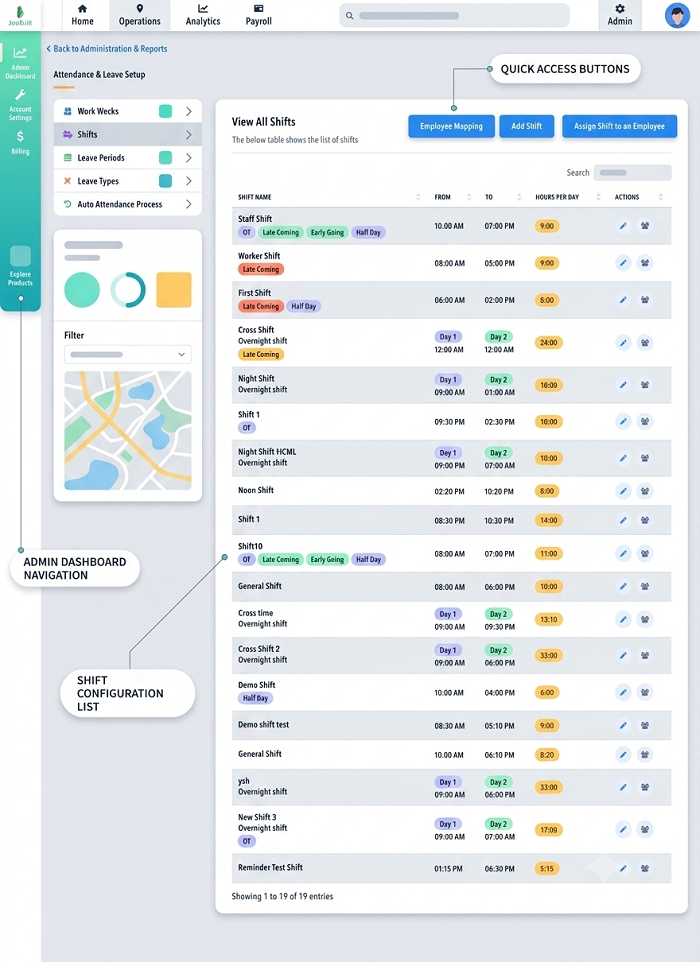
A practical shift plan should show:
| Planning information | Purpose |
|---|---|
| Employee name and ID | Identifies the assigned employee |
| Store and department | Shows the work location and responsibility |
| Shift start and end | Defines scheduled working time |
| Break period | Helps plan employee rest |
| Job role | Identifies the required skills |
| Supervisor | Establishes accountability |
| Weekly rest day | Supports rest-day planning |
| Shift status | Shows whether the schedule is confirmed or changed |
Managers should publish schedules early enough for employees to plan their personal commitments. Last-minute changes should be handled through an approval process.
6. Use Flexible Staffing to Handle Promotions and Seasonal Demand
Retail chains often experience temporary increases in customer demand during:
- Songkran.
- New Year.
- Long weekends.
- School holidays.
- End-of-season sales.
- Store anniversary promotions.
- Major shopping campaigns.
- Local festivals.
- Tourist high seasons.
During these periods, additional employees may be needed for customer service, checkout counters, inventory handling and product replenishment.
Retail chains can prepare flexible staffing arrangements through:
Temporary recruitment: Hire additional employees for a defined business period, with appropriate employment arrangements and training.
Part-time staffing: Use part-time employees for specific periods when additional coverage is needed.
Cross-training: Train suitable employees to perform more than one role, allowing managers to adjust assignments when demand changes.
Approved employee transfers: Temporarily assign employees from stores with available capacity to branches experiencing higher demand.
Reserve staffing pools: Maintain a list of trained employees who may be available for approved additional shifts.
Flexible staffing should not be used as a substitute for proper workforce planning. Temporary employees need clear instructions, appropriate supervision and training before handling customer transactions, cash, inventory or sensitive information.
7. Coordinate Employee Transfers Between Bangkok and Provincial Stores
One advantage of operating a retail chain is the ability to coordinate workforce resources across locations. However, transferring employees between stores requires careful planning.
A store manager may request additional employees when customer traffic increases or when several employees are absent. Head office can review staffing across nearby branches and identify whether temporary support is practical.
Before approving a transfer, managers should consider:
- Whether the employee has the necessary skills.
- Whether the original store can operate without that employee.
- Travel time and transport arrangements.
- Accommodation requirements for longer assignments.
- Employee availability and agreement where required.
- Working hours and rest-day implications.
- Reporting and supervision arrangements.
- Payroll and expense treatment.
- The expected duration of the assignment.
Transfers between nearby Bangkok branches may be relatively straightforward. Assignments between Bangkok and provincial stores can involve longer travel times, accommodation and additional expenses.
For example, a retail chain may temporarily assign trained employees from a quieter branch to support a new store opening in another province. The company should document the assignment dates, work location, reporting manager and applicable expense arrangements.
Employee transfers should also be reviewed against employment contracts, company policies and applicable labour requirements. A workforce planning system should retain both the employee's home-store information and the actual location where work was performed.
8. Manage Employee Skills and Department Coverage
A retail chain may have enough employees in total but still experience shortages because the available employees do not have the skills required for particular roles.
For example, a store may have sufficient sales assistants but not enough trained cashiers during a promotional period. Another branch may have adequate customer service coverage but insufficient employees authorised to receive deliveries or supervise stock handling.
Head office should maintain a skills inventory for each employee.
Useful information includes:
- Current job role.
- Department assignment.
- Cash-handling training.
- Product knowledge.
- Customer service skills.
- Inventory and stockroom experience.
- Supervisory responsibilities.
- Health and safety training.
- Language skills where relevant.
- Training completion and expiry dates, where applicable.
A skills matrix helps managers identify employees who can be assigned to different tasks without compromising operational standards.
Cross-training can improve flexibility, but employees should only perform tasks for which they have received appropriate training and authorisation.
9. Maintain Minimum Staffing During Employee Leave and Absences
Annual leave, sick leave, personal leave and unexpected absences can create staffing shortages, particularly in stores with small teams.
Retail chains should incorporate employee leave information into workforce planning rather than treating leave as a separate HR activity.
A practical process includes:
- Collect leave requests through a central system.
- Review staffing levels for the requested dates.
- Identify minimum coverage requirements.
- Check whether another trained employee can provide support.
- Approve or manage overlapping requests according to company policy and applicable law.
- Update the store roster.
- Communicate confirmed changes to employees and supervisors.
Thailand's Labour Protection Act provides statutory leave entitlements, including annual holidays and sick leave. Section 30 provides at least six working days of annual holiday after one uninterrupted year of service, while Section 32 provides sick leave as long as the employee is actually sick. Section 57 generally requires payment of wages for sick leave up to 30 working days per year.
Retail chains should account for statutory entitlements when preparing staffing forecasts. Managers should not routinely reject legitimate leave requests simply because the store has not maintained an adequate staffing reserve.
10. Monitor Attendance Across All Store Locations
A central staffing plan is only effective when head office can compare scheduled working hours with actual attendance.
Retail chains should maintain consistent attendance procedures across Bangkok and provincial stores.
Attendance information should include:
- Employee identity.
- Assigned store.
- Department or job role.
- Scheduled shift.
- Actual clock-in time.
- Actual clock-out time.
- Break records where required.
- Overtime and holiday work.
- Approved shift changes.
- Missed punches and corrections.
- Employee transfers and temporary assignments.
A central attendance system can help HR identify patterns such as repeated late arrivals, frequent overtime, absenteeism and staffing shortages.
For multi-store operations, it is particularly important to record the actual work location. An employee who temporarily supports another branch should not have their attendance attributed incorrectly to the home store.
Store managers should also have a process for reporting terminal failures, missed punches and emergency schedule changes. Corrections should be approved and retain an audit trail.
11. Use Store-Level and Regional Management Structures
Retail chains need clear responsibilities for staffing decisions.
If every staffing change requires approval from head office, store managers may struggle to respond quickly to customer demand. On the other hand, giving every store unrestricted control can create inconsistent staffing costs and scheduling practices.
A practical structure can divide responsibilities between head office, regional managers and store managers.
| Management level | Main staffing responsibilities |
|---|---|
| Head office HR | Workforce policies, employee records, payroll coordination and labour compliance |
| Workforce planning team | Demand forecasts, staffing budgets and workforce allocation |
| Regional manager | Review staffing across stores in a region and approve transfers |
| Store manager | Prepare local rosters, manage attendance and respond to daily demand |
| Department supervisor | Assign tasks, monitor breaks and report coverage issues |
For example, a regional manager responsible for several provincial stores can compare staffing levels across branches and identify where additional support may be available.
Head office should establish approval limits for overtime, temporary recruitment and inter-store transfers. This creates accountability without slowing down routine operational decisions.
12. Control Overtime and Working-Hour Compliance
Retail stores may need additional staffing during promotions, inventory counts, stock deliveries, public holidays and store openings.
However, overtime should not become the normal solution to poor staffing forecasts.
Under Thailand's Labour Protection Act B.E. 2541 (1998), Section 23 generally limits normal working time to eight hours per day and 48 hours per week. Certain work prescribed as potentially hazardous to health and safety has lower limits.
Section 24 generally requires an employee's prior consent for overtime on a normal working day on each occasion, subject to statutory exceptions. Section 25 governs holiday work, including conditions applicable to retail sale and service activities. Section 26 provides for a combined limit on specified overtime and holiday work hours under Ministerial Regulations.
Retail managers should therefore:
- Check actual working hours before assigning additional shifts.
- Obtain consent where required for overtime.
- Review weekly working hours.
- Plan weekly rest days.
- Check holiday work requirements and payment.
- Record overtime approvals.
- Monitor repeated overtime at individual stores.
- Review staffing shortages that create recurring additional hours.
Section 27 generally requires a rest period of at least one hour per working day after no more than five consecutive hours of work, subject to the statutory arrangements and exceptions. Section 28 generally requires at least one weekly holiday, with no more than six days between weekly holidays.
These requirements should be incorporated into scheduling software so that managers can identify potential problems before confirming a roster.
13. Use Workforce Management Software for Multi-Store Scheduling
Managing schedules through separate spreadsheets can become difficult when a retail chain operates many branches.
Different spreadsheet formats, delayed updates and inconsistent employee records can prevent head office from understanding the company's actual staffing position.
A central workforce management system can provide a consistent view across all stores.
Important software capabilities include:
Centralised employee records: Maintain employee profiles, job roles, home stores, departments and employment information.
Multi-location scheduling: Create and manage rosters for Bangkok and provincial stores from one system.
Demand-based scheduling: Use historical sales, customer traffic and operational requirements to estimate staffing needs.
Employee availability: Record approved leave, unavailable dates and shift preferences.
Skills-based assignment: Allocate employees according to training, experience and job requirements.
Inter-store transfers: Record temporary assignments, work locations and approval status.
Attendance integration: Compare scheduled shifts with actual clock-in and clock-out records.
Overtime controls: Identify additional working hours and route them for approval.
Employee self-service: Allow employees to view schedules, submit availability and request shift changes.
Payroll integration: Transfer verified attendance, overtime and holiday work information to payroll.
Regional dashboards: Compare staffing coverage, attendance exceptions and labour costs across stores.
A suitable system should allow head office to view company-wide workforce information while restricting access to authorised managers according to their responsibilities.
14. Monitor Labour Costs Without Compromising Customer Service
Labour cost management is an important part of multi-store workforce planning.
However, reducing employee numbers without considering customer demand can result in longer queues, missed sales opportunities and poor customer experiences.
Retail chains should evaluate labour costs alongside operational performance.
Useful indicators include:
| KPI | What it measures |
|---|---|
| Labour cost as a percentage of sales | Workforce cost compared with store revenue |
| Sales per labour hour | Sales generated for each hour worked |
| Transactions per employee | Customer transactions handled by employees |
| Customer waiting time | Time customers spend waiting for assistance or checkout |
| Overtime hours per store | Reliance on additional working time |
| Absenteeism rate | Employee absence patterns |
| Schedule adherence | Difference between scheduled and actual attendance |
| Staff turnover | Employee retention and replacement requirements |
| Vacancy rate | Unfilled positions across stores |
| Training completion rate | Availability of trained employees |
| Customer service complaints | Potential impact of staffing shortages |
Managers should compare stores with similar formats and operating conditions. A supermarket, convenience store and fashion outlet should not necessarily be assessed against the same productivity targets.
For example, a store with a higher labour cost percentage may still be performing well if it handles more complex customer service requirements or operates in a high-cost location.
The objective should be to achieve appropriate staffing levels, not simply to minimise headcount.
15. Establish Consistent Staffing Policies Across the Retail Chain
A multi-location retailer should have standard workforce policies so that employees receive consistent treatment regardless of their store.
Policies should explain:
- How store rosters are prepared.
- When schedules are published.
- How shift changes are requested and approved.
- How attendance is recorded.
- How missed punches are corrected.
- How overtime is authorised.
- How weekly rest days are scheduled.
- How holiday work is managed.
- How employee transfers are approved.
- How travel and accommodation expenses are handled.
- How staffing shortages are escalated.
For employers with 10 or more employees, Section 108 of the Labour Protection Act requires work rules in Thai covering matters including working days, normal working hours, rest periods, holidays, overtime, holiday work, leave and related employment procedures.
Standard policies should be supported by local operational guidance. A store in a tourist destination may need different shift coverage from a small neighbourhood outlet, even though both follow the same company-wide rules.
16. Protect Employee Information Across Multiple Stores
Centralised workforce systems may contain employee information that is accessible to head office, regional managers and store supervisors.
Retail chains should establish appropriate privacy and access controls.
Practical measures include:
Role-based access: Store managers should normally access information needed to manage their own employees, while regional managers may need broader visibility across assigned branches.
Secure attendance data: Protect employee identification details, clock-in records and other personal information.
Limited location collection: If mobile attendance uses GPS, collect location information only when necessary for the stated attendance purpose.
Retention controls: Establish appropriate retention periods for employee and attendance records.
Vendor review: Check how workforce software providers store, process and protect employee information.
Audit trails: Record who views or changes sensitive employee and attendance information.
For retail chains using mobile attendance or biometric systems, Thailand's Personal Data Protection Act (PDPA) should be considered. Employee location information linked to an identifiable person is personal data. Biometric data used for unique identification is sensitive personal data under Section 26 and requires additional safeguards.
The company should assess the appropriate lawful basis for processing, provide relevant privacy information and avoid collecting more information than necessary.
17. Review Staffing Performance Across Bangkok and Provincial Regions
A central dashboard helps head office understand which stores are operating with adequate staffing and which locations need attention.
Retail chains should review staffing performance at three levels.
Store level: Review daily coverage, attendance, overtime, leave and customer service requirements.
Regional level: Compare staffing across branches and identify opportunities for temporary support or recruitment.
Company level: Review labour budgets, vacancies, turnover, productivity and workforce planning accuracy.
For example, a regional dashboard may show that several provincial stores consistently use overtime during weekends while nearby branches have available employees. Management can investigate whether schedules can be adjusted or temporary support can be arranged.
Reports should also identify stores where staffing shortages are affecting customer waiting times, stock replenishment or store opening procedures.
Regular reviews help the company adjust workforce plans before operational problems become recurring.
Conclusion
Planning staffing across Bangkok and provincial stores requires retail chains to understand local demand rather than apply one fixed staffing model to every branch. Customer traffic, store format, operating hours, promotional activity, tourism and employee availability all influence the number and type of employees required.
By collecting reliable store-level information, forecasting staffing demand, building flexible shift arrangements and coordinating employees across regions, retailers can improve coverage without relying excessively on overtime or last-minute recruitment.
A central workforce management system can further simplify operations by connecting employee records, multi-store schedules, attendance, transfers, overtime and payroll information.
The most effective staffing strategy balances three priorities: sufficient employees to serve customers, appropriate labour costs for the business and fair working arrangements for employees. With consistent policies and accurate workforce data, Thailand retail chains can manage both Bangkok and provincial operations more efficiently while maintaining a reliable customer experience.
Retail staffing across many stores needs local flexibility and central visibility. InnBuilt Shift Management can help Thailand chains review store rosters and attendance in Bangkok and the provinces.