How Can Thailand Businesses Manage Rotating Shifts and Weekly Rest Days?
How Can Thailand Businesses Manage Rotating Shifts and Weekly Rest Days?
Introduction
Businesses in Thailand that operate beyond standard office hours often rely on rotating shifts to maintain continuous operations. Manufacturing plants, hospitals, hotels, transport companies, warehouses, retail outlets and customer support centres may need employees to work different shifts throughout the week, including weekends and public holidays.
Rotating shifts help businesses distribute work across different time periods, but they also create scheduling challenges. Managers must coordinate shift changes, maintain adequate staffing, prevent excessive working hours and ensure that employees receive their statutory weekly rest days.
Thailand's Labour Protection Act B.E. 2541 (1998) establishes important requirements for working hours, rest periods and weekly holidays. Under Section 28, employers must generally provide employees with at least one weekly holiday, with no more than six days between weekly holidays. The employer and employee may agree in advance on which day will be the weekly holiday. Certain specified types of work have a limited arrangement for accumulating and postponing weekly holidays, subject to statutory conditions.
A well-designed shift management process helps employers maintain business continuity while protecting employee rest entitlements. This article explains how Thailand businesses can organise rotating shifts, assign weekly rest days, manage shift changes and use workforce management software to improve scheduling accuracy.
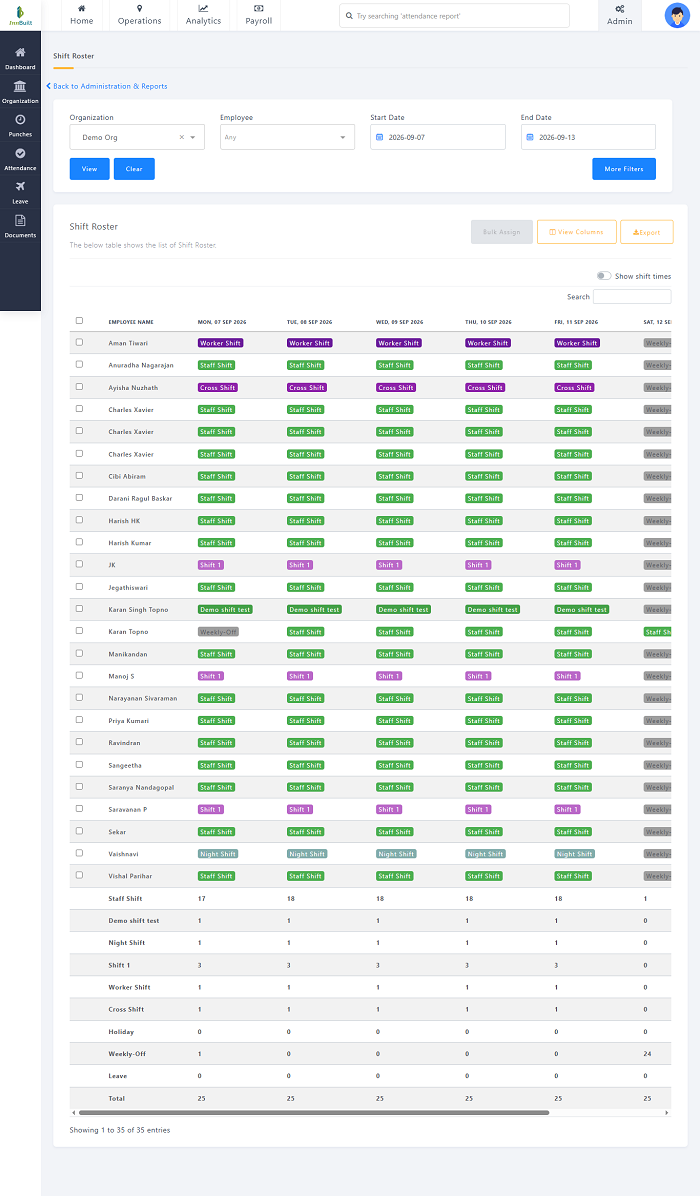
1. Understand the Different Types of Work Schedules
Before designing a rotating shift system, employers should identify the type of schedule required by each department.
Not every business needs the same shift arrangement. A factory operating continuously may require three shifts, while a retail business may use two shifts with additional weekend coverage.
Common work schedule arrangements include:
- Fixed shifts: Employees work the same shift on a regular basis, such as a morning or evening shift.
- Rotating shifts: Employees move between different shifts according to a planned rotation.
- Split shifts: Employees work separate periods during the same day, with a break between them.
- Night shifts: Employees work during overnight hours.
- Weekend shifts: Employees are scheduled to work on Saturdays, Sundays or other designated rest days, subject to applicable holiday and rest-day rules.
- Continuous-operation shifts: Teams cover different time periods so that business operations can continue throughout the day and night.
For example, a manufacturing business may operate three shifts:
| Shift | Illustrative working time |
|---|---|
| Morning | 6:00 a.m. – 2:00 p.m. |
| Evening | 2:00 p.m. – 10:00 p.m. |
| Night | 10:00 p.m. – 6:00 a.m. |
These are illustrative shift times, not statutory working-hour limits. Employers must configure the actual schedule to comply with applicable normal working hours, rest periods and overtime requirements.
2. Review Thailand's Normal Working-Hour Limits
Working-hour compliance is the foundation of a lawful rotating shift schedule.
Under Section 23 of the Labour Protection Act, normal working hours generally cannot exceed eight hours per day or 48 hours per week. For work prescribed as hazardous to health and safety, normal working hours are generally limited to seven hours per day and 42 hours per week.
Where normal working hours on one day are shorter than eight hours, the employer and employee may agree to add the remaining hours to another normal working day, subject to the statutory conditions. The daily limit in such an arrangement is generally nine hours, while the weekly limit remains 48 hours. Special compensation may apply to excess hours for certain wage categories.
Employers should check:
- The employee's normal daily working hours.
- The total normal working hours for the week.
- Whether the job is classified as hazardous work.
- Whether any agreed adjustment to daily hours is permitted.
- Whether additional hours qualify as overtime.
- Whether the shift arrangement creates a conflict with rest-period requirements.
For example, a company should not assume that an employee can work twelve normal hours simply because the business operates around the clock. A shift system must be designed around the applicable legal limits and any specific rules governing the relevant type of work.
3. Plan Weekly Rest Days in Advance
Weekly rest days should be built into the shift schedule before employees are assigned to work.
Section 28 generally requires employers to provide at least one weekly holiday for each employee. The interval between weekly holidays must not exceed six days.
The employer and employee may agree in advance on which day will be the weekly holiday. This means that a weekly rest day does not always have to fall on Sunday. Businesses operating seven days a week can assign different rest days to different employees, provided the statutory requirements are met.
For example:
| Employee | Working days | Weekly rest day |
|---|---|---|
| Employee A | Monday–Saturday | Sunday |
| Employee B | Tuesday–Sunday | Monday |
| Employee C | Wednesday–Monday | Tuesday |
| Employee D | Thursday–Tuesday | Wednesday |
This arrangement allows the business to maintain coverage throughout the week while giving each employee a planned weekly rest day.
Managers should record weekly rest days clearly in the employee's work schedule. They should also review changes whenever employees transfer between departments, move to another shift or cover colleagues.
4. Design a Fair Rotating Shift Pattern
A rotating shift system should provide predictable schedules and distribute less desirable shifts fairly.
Employers should decide how frequently employees will move between shifts. Some businesses rotate weekly, while others use longer cycles to provide employees with more predictable working patterns.
A rotation plan should consider:
- The number of shifts required each day.
- Minimum staffing for each shift.
- Employee skills and qualifications.
- Weekly rest-day assignments.
- Night-shift coverage.
- Shift handover requirements.
- Working-hour limits.
- Employee availability.
- Health and safety risks.
For example, a company may rotate employees between morning, evening and night shifts over a three-week cycle. Managers should review the transition between shifts carefully, ensuring employees have sufficient time away from work and receive their required weekly rest.
A rotation plan should be published in advance so employees can understand their upcoming work schedules and make personal arrangements.
5. Avoid Scheduling Employees for Excessive Consecutive Working Days
One of the most important checks in rotating shift management is the interval between weekly rest days.
Under Section 28, the general rule is that an employee must receive at least one weekly holiday, with no more than six days between weekly holidays.
For example, if an employee receives Sunday as a weekly rest day, the employer should not schedule the employee to work continuously for seven or more days before providing the next weekly rest day.
Managers should monitor consecutive working days when:
- Employees change shifts.
- Employees cover another person's absence.
- Public holidays affect normal rosters.
- Supervisors make last-minute schedule changes.
- Employees work additional hours.
- Employees transfer between departments.
A schedule that appears compliant at the team level may still create a problem for an individual employee. HR should therefore check each employee's actual sequence of working days and rest days.
Certain types of work may qualify for an agreed arrangement to accumulate and postpone weekly holidays. However, this is a limited statutory exception, not a general option available to every employer.
6. Understand When Weekly Rest Days Can Be Accumulated or Postponed
Thailand law provides a limited exception to the normal weekly rest-day arrangement for certain types of work.
Under Section 28, employees in specified categories, including hotel businesses, transport work, forest work and work in locations lacking basic facilities, may have an arrangement to accumulate and postpone weekly holidays. The employer and employee must agree in advance, and the accumulated rest days must be taken within a period of four consecutive weeks.
Employers should not assume that this exception applies simply because their business operates continuously or uses rotating shifts.
Before using an accumulation arrangement, HR should:
- Confirm that the work falls within a category permitted by the law and applicable Ministerial Regulations.
- Check the conditions governing the arrangement.
- Obtain the required advance agreement.
- Record the weekly holidays being accumulated.
- Track when each accumulated day is taken.
- Ensure the statutory four-week period is observed.
For businesses that do not qualify for this exception, the general rule of at least one weekly holiday with no more than six days between weekly holidays continues to apply.
The exception should be treated as a specific legal arrangement, not a way to postpone rest days whenever staffing becomes difficult.
7. Provide Appropriate Rest Periods Within Each Shift
Weekly rest days and daily rest periods are separate requirements. Providing an employee with a weekly holiday does not remove the employer's obligation to arrange rest periods during working days.
Under Section 27 of the Labour Protection Act, employers generally must provide at least one hour of rest per working day after an employee has worked for no more than five consecutive hours. The rest period may be divided by advance agreement, provided the total is at least one hour per day.
Where overtime after normal working hours exceeds two hours, the employer must generally arrange a rest period of at least 20 minutes before the employee begins overtime. Statutory exceptions apply to certain continuous work performed with the employee's consent and emergency work.
Managers should consider these requirements when preparing:
- Morning shifts.
- Evening shifts.
- Overnight shifts.
- Extended production shifts.
- Split shifts.
- Shifts involving overtime.
- Continuous-operation schedules.
For example, an employee working an eight-hour shift should have the required daily rest period arranged within the shift. If the employee is then asked to work more than two additional hours, the manager should also check the pre-overtime rest requirement.
Rest periods should be included in the roster rather than left to informal arrangements between employees and supervisors.
8. Manage Shift Changes and Handover Times
Shift changes are a common source of scheduling errors. When one team finishes work and another takes over, managers must ensure that handover activities do not unintentionally extend employees' working hours.
For example, a production employee scheduled to finish at 2:00 p.m. may be asked to stay until 2:30 p.m. because the incoming employee arrives late. If this happens regularly, the additional time must be reviewed for working-hour and payment purposes.
A structured handover process should cover:
- Shift start and finish times.
- Arrival expectations for incoming employees.
- Handover responsibilities.
- Outstanding work and safety issues.
- Equipment or system status.
- Supervisor confirmation.
- Recording of additional time worked.
Managers should avoid routinely asking employees to arrive early or leave late without accounting for the time under applicable working-hour and wage rules.
A digital attendance system can record actual clock-in and clock-out times and help managers identify repeated handover delays.
9. Plan Overnight Shifts Carefully
Overnight shifts require particular attention because working hours may cross midnight and overlap two calendar dates.
For example, an employee may start work at 10:00 p.m. on Monday and finish at 6:00 a.m. on Tuesday. The shift should be recorded as one continuous work period with the correct start and end times.
Managers should establish clear rules for:
- Which date is used to identify the shift.
- How attendance is recorded across midnight.
- How daily working hours are calculated.
- How overtime is identified.
- How weekly rest days are protected.
- How holiday work is classified.
- How payroll receives overnight shift data.
Employers should not assume that the midnight boundary automatically creates a new shift or resets the employee's working-hour limits.
Night work can also increase fatigue, so managers should consider employee alertness, transport arrangements, workplace security and safe handover procedures.
Pregnant employees are subject to specific restrictions under Section 39 of the Labour Protection Act, including restrictions on being required to work between 10:00 p.m. and 6:00 a.m., subject to the limited statutory exception. Employers should ensure that their scheduling process accounts for these protections.
10. Coordinate Weekly Rest Days With Public Holidays
Weekly rest days must also be coordinated with traditional holidays announced by the employer.
Under Section 29, employers must announce at least 13 traditional holidays each year in advance, including National Labour Day. If a traditional holiday falls on an employee's weekly holiday, the employee is generally entitled to a substitute holiday on the following working day.
This is especially important for businesses using rotating shifts because different employees may have different weekly rest days.
For example, a traditional holiday may fall on Sunday. An employee whose weekly rest day is Sunday will generally be entitled to a substitute holiday on the following working day. An employee whose weekly rest day is Tuesday will need to be assessed according to their own schedule.
Managers should:
- Publish the annual traditional holiday calendar.
- Record each employee's weekly rest day.
- Identify overlaps between traditional holidays and weekly rest days.
- Determine applicable substitute holidays.
- Update individual shift rosters.
- Communicate changes to employees.
- Ensure payroll uses the correct holiday classification.
Employers should not use a single company-wide calendar without checking individual weekly rest-day arrangements.
11. Establish a Clear Process for Changing Assigned Shifts
Operational requirements may sometimes require a manager to change an employee's shift. However, frequent last-minute changes can disrupt employee rest, create attendance disputes and affect personal commitments.
Employers should establish a written shift-change procedure.
A good procedure should explain:
- Who can request a shift change.
- Who has authority to approve it.
- How much advance notice should normally be provided.
- How employees are notified.
- How shift swaps are recorded.
- How working-hour limits are checked.
- How weekly rest days are protected.
- How overtime and holiday payments are reviewed.
For example, if an employee is moved from an evening shift to a morning shift, the manager should check the time between the two shifts. A schedule change should not result in an employee having insufficient time away from work or being assigned excessive consecutive working days.
Employers should also distinguish between a change to the roster and an actual additional work assignment. If the change results in work beyond normal hours, the applicable overtime rules must be considered.
12. Manage Shift Swaps Between Employees
Allowing employees to request shift swaps can provide flexibility while helping businesses maintain coverage.
However, informal swaps can create problems if managers do not know who is actually working.
A formal shift-swap process should require:
- A request from the employee proposing the swap.
- Confirmation from the colleague accepting the shift.
- Verification that the replacement employee is qualified.
- Review of both employees' working hours and rest days.
- Manager approval.
- Updating the official roster.
- Updating attendance and payroll records.
For example, an employee assigned to a Saturday evening shift may request a swap with a colleague assigned to a Sunday morning shift. The manager should check both employees' weekly schedules before approving the arrangement.
A swap should not be approved if it causes a weekly rest-day violation, creates excessive working hours or leaves a critical position uncovered.
13. Calculate Weekly Rest-Day and Holiday Payments Correctly
Rotating shifts can affect payroll because employees may work on different days of the week, including their assigned weekly rest days and traditional holidays.
Under Section 56, employers generally must pay wages for weekly holidays to employees, subject to statutory exceptions for employees paid by the day, by the hour or by output.
Where employees work on a weekly holiday, holiday work pay provisions may apply. Under Section 62, employees entitled to weekly holiday pay generally receive additional holiday work pay of at least one times their normal hourly wage rate for hours worked. Employees who are not entitled to holiday pay for that weekly holiday generally receive at least twice their normal hourly wage rate for the hours worked.
Holiday overtime is governed separately by Section 63 and generally requires payment of at least three times the normal hourly wage rate.
Payroll teams should distinguish between:
- A normal working day.
- An employee's weekly rest day.
- A traditional holiday.
- A substitute traditional holiday.
- Work performed during normal hours on a holiday.
- Overtime performed on a holiday.
For example, an employee may have Monday as the weekly rest day and work on Sunday as part of a rotating schedule. Sunday should not automatically be treated as the employee's weekly holiday merely because it is commonly a rest day for other employees.
Payroll should use the employee's actual assigned schedule and the applicable legal classification when calculating payments.
14. Monitor Attendance and Consecutive Working Days
A rotating shift plan is useful only if actual attendance is compared with the published schedule.
Employees may arrive late, leave early, miss a punch or work additional hours because of production delays. These changes can affect working-hour calculations and weekly rest-day intervals.
HR and supervisors should monitor:
- Scheduled working days.
- Actual working days.
- Weekly rest days.
- Consecutive days worked.
- Shift start and finish times.
- Overtime hours.
- Missed attendance records.
- Approved shift swaps.
- Unplanned absences.
- Substitute holidays.
A weekly review can identify employees approaching the maximum permitted interval between weekly rest days.
For example, if a supervisor asks an employee to cover an absent colleague on a scheduled rest day, HR should check whether the employee has already worked six consecutive days and how the replacement assignment affects the next rest day.
Attendance corrections should preserve the original record and document who approved the change. This creates a reliable audit trail for payroll and compliance reviews.
15. Use Workforce Management Software to Coordinate Rotating Shifts
Managing rotating shifts manually can become difficult when a business has several departments, locations and employee groups.
Workforce management software can centralise schedules, attendance, weekly rest days and payroll information.
Useful features include:
| Software feature | How it supports shift management |
|---|---|
| Shift templates | Creates reusable morning, evening and night schedules |
| Rotating shift patterns | Automates planned shift rotations |
| Weekly rest-day tracking | Helps managers monitor rest-day intervals |
| Working-hour alerts | Flags potential daily and weekly limit issues |
| Employee availability | Shows approved leave and scheduling conflicts |
| Shift-swap approvals | Records employee requests and manager decisions |
| Overnight shift support | Records shifts that cross midnight |
| Holiday calendars | Identifies traditional holidays and substitute days |
| Attendance integration | Compares scheduled and actual working hours |
| Payroll integration | Transfers normal hours, overtime and holiday work |
| Audit history | Records schedule changes and approvals |
| Management reports | Shows staffing levels, overtime and attendance trends |
Before implementing a system, employers should test different shift patterns, weekly rest-day arrangements, overnight shifts and holiday scenarios.
The system should allow HR to configure rules according to the company's actual operations and applicable Thai labour requirements. Automated scheduling should not be assumed to guarantee legal compliance without proper configuration and review.
16. Protect Employee Health and Safety When Planning Rotations
Rotating shifts can affect sleep, concentration and employee well-being, particularly when employees frequently change between day and night work.
Employers should consider health and safety when designing shift patterns.
Practical measures include:
- Avoiding unnecessary last-minute changes.
- Giving employees advance notice of shift rotations.
- Reviewing workloads during overnight shifts.
- Providing appropriate rest periods.
- Monitoring repeated overtime.
- Ensuring adequate supervision.
- Providing safe transport arrangements where necessary.
- Reviewing fatigue risks in safety-sensitive jobs.
- Allowing employees to report scheduling concerns.
For example, a transport company should consider fatigue risks when scheduling drivers for overnight work. A manufacturing company should review whether employees operating machinery have adequate rest before starting a new shift.
A schedule that meets minimum legal working-hour limits may still create operational safety concerns if employees are consistently fatigued. Managers should therefore consider both statutory compliance and practical health risks.
17. Communicate Shift Schedules and Rest Days Clearly
Employees should know when they are expected to work and when they are entitled to rest.
Employers should publish schedules through a reliable communication channel, such as an employee portal, mobile application, email or workplace noticeboard.
A shift schedule should clearly show:
- Employee name or identifier.
- Department and work location.
- Shift date.
- Shift start and finish times.
- Assigned weekly rest day.
- Break periods.
- Holiday assignments.
- Substitute holidays.
- Approved shift swaps.
- Schedule changes.
Employers should also establish a process for notifying employees about urgent changes and recording acknowledgement where appropriate.
For businesses with multilingual workforces, shift notices should be available in languages employees can understand.
Clear communication reduces missed shifts, attendance disputes and confusion about weekly rest days.
18. Review Shift Patterns and Staffing Performance Regularly
Shift arrangements should be reviewed periodically to determine whether they are meeting business requirements and providing adequate employee rest.
Managers can use the following indicators:
- Overtime hours per employee.
- Number of consecutive working days.
- Frequency of last-minute shift changes.
- Absence rates by shift.
- Employee turnover by shift.
- Missed attendance records.
- Shift coverage shortages.
- Production or service delays.
- Weekly rest-day compliance.
- Employee feedback about shift patterns.
For example, if the night shift consistently requires overtime, management may need to recruit additional employees or redistribute work instead of continuing to extend existing shifts.
A quarterly review can help HR identify patterns and improve the next scheduling cycle.
Conclusion
Managing rotating shifts and weekly rest days in Thailand requires a balance between operational coverage, working-hour compliance and employee well-being. Businesses should prepare shift patterns in advance, assign weekly rest days clearly and monitor the interval between rest days for each employee.
Employers must also understand the limited circumstances in which weekly holidays may be accumulated or postponed, arrange appropriate daily rest periods and coordinate rotating schedules with traditional holidays and payroll requirements.
Attendance and workforce management software can simplify the process by connecting shift templates, weekly rest-day tracking, employee availability, attendance records and payroll calculations. However, businesses should configure these systems according to the Labour Protection Act and review actual schedules regularly.
With clear scheduling policies, reliable attendance records and consistent management oversight, Thailand businesses can maintain continuous operations while ensuring employees receive their required weekly rest and other statutory protections.
Rotating schedules can create coverage gaps when rest days are tracked separately. InnBuilt Shift Management can help Thailand teams keep assignments, weekly rest and changes in a single roster.