How Can Thailand Employers Approve Shift Swaps Without Losing the Audit Trail?
How Can Thailand Employers Approve Shift Swaps Without Losing the Audit Trail?
Introduction
Shift swaps are common in businesses that operate with rotating schedules, including factories, hospitals, hotels, retail stores, warehouses, logistics companies and customer support centres. Employees may need to exchange shifts because of personal commitments, family responsibilities, transport difficulties or unexpected changes in availability.
Allowing employees to exchange shifts can improve workforce flexibility and reduce last-minute absences. However, informal arrangements can create problems for HR teams and supervisors. An employee may agree to cover a colleague's shift through a messaging app, but the official roster may remain unchanged. Payroll may then calculate hours against the wrong employee schedule, while managers may have difficulty confirming who was responsible for a particular shift.
Thailand employers need a consistent process for reviewing, approving and recording shift swaps. The process should preserve the original schedule, capture the employees' agreement, document management approval and update the attendance and payroll systems.
A reliable audit trail does not mean preventing employees from exchanging shifts. It means ensuring that every approved change can be traced from the original roster to the final working arrangement.
This article explains how Thailand businesses can approve shift swaps while maintaining accurate records, complying with relevant labour requirements and using attendance software effectively.
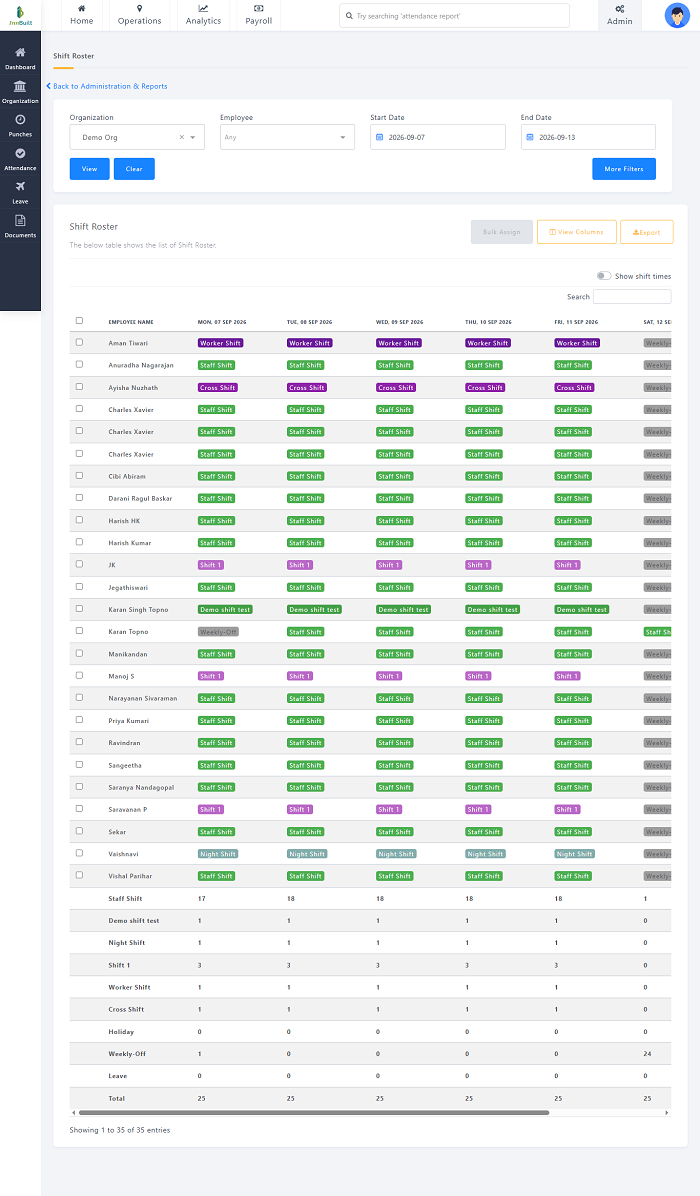
1. Establish a Written Shift-Swap Policy
The first step is to create a clear policy explaining when employees can exchange shifts and how approval must be obtained.
Without written rules, different supervisors may handle similar requests differently. One department may allow informal exchanges, while another may require advance approval. This inconsistency can lead to attendance disputes and payroll errors.
A shift-swap policy should explain:
- Which employees are eligible to request swaps.
- Which shifts can be exchanged.
- How far in advance requests should be submitted.
- Whether both employees must agree.
- Who reviews and approves the request.
- How emergency or last-minute swaps are handled.
- What happens if a requested swap creates overtime.
- How employees are notified of the decision.
- How approved changes are recorded.
- What happens if an employee does not follow the approved arrangement.
The policy should also explain that an informal agreement between employees does not automatically change the official roster.
For example, if an employee asks a colleague to cover a Saturday night shift, both employees should submit the request through the company's approved process. The supervisor should review the change before the employees treat it as confirmed, except where a documented emergency procedure applies.
Employers with ten or more employees should also check that their written work rules remain consistent with Section 108 of Thailand's Labour Protection Act. The section requires work rules in Thai covering matters such as working days, normal working hours, rest periods, holidays, overtime and holiday work.
2. Require Agreement From Both Employees
A shift swap usually involves two employees:
- Employee A: The employee originally assigned to the shift.
- Employee B: The employee who agrees to take over that shift.
Both employees should confirm that they understand and accept the proposed change.
For example, an employee scheduled to work Tuesday from 2:00 p.m. to 10:00 p.m. may ask a colleague to exchange shifts. The colleague may agree to work Tuesday's afternoon shift in return for taking the first employee's Thursday morning shift.
The request should identify:
- Both employees' names and employee IDs.
- Original shift dates and times.
- Proposed replacement shift dates and times.
- The reason for the exchange, if the company requires one.
- Confirmation from both employees.
- Date and time of the request.
The system should record each employee's confirmation separately. A supervisor should not assume that one employee's request proves that the other employee has agreed.
Employers should also avoid treating an employee's silence or failure to object as confirmation.
3. Use a Standard Shift-Swap Request Process
A standard request process helps employees submit complete information and makes it easier for supervisors to review changes.
A typical workflow can follow these steps:
- Employee A opens the attendance or employee self-service system.
- Employee A selects the shift to exchange.
- Employee A identifies Employee B.
- Employee A selects the replacement shift or proposes an alternative.
- Employee B receives a notification.
- Employee B accepts or declines the proposed exchange.
- The request moves to the supervisor for review.
- The supervisor approves or rejects it.
- Both employees receive the final decision.
- The official roster is updated after approval.
The system should clearly distinguish between a submitted request, an employee-confirmed request, a pending approval and an approved swap.
This prevents employees from assuming that a proposed exchange has been accepted before the authorised manager has completed the review.
4. Preserve the Original Shift Roster
One of the most important audit-trail requirements is retaining the original schedule.
When a shift swap is approved, employers should not simply overwrite the original roster and remove evidence of the earlier assignment.
Instead, the system should preserve both versions:
- Original employee and shift assignment.
- Revised employee and shift assignment.
- Date and time of the change.
- Person who submitted the request.
- Employee confirmations.
- Person who approved the change.
- Reason for the change, where required.
Example:
A factory originally assigns Employee A to work from 10:00 p.m. on Monday until 6:00 a.m. on Tuesday. Employee B agrees to take that shift, and the supervisor approves the exchange.
The revised roster should show Employee B as the assigned employee. However, the system should retain the original assignment to Employee A and link it to the approved swap request.
This allows HR to determine who was originally scheduled, who ultimately worked and why the schedule changed.
A good audit trail should be chronological, searchable and protected against unauthorised modification.
5. Check Working-Hour Limits Before Approving a Swap
A shift swap should not be approved solely because both employees agree.
The revised schedule must also be checked against applicable working-hour requirements.
Under Section 23 of Thailand's Labour Protection Act, normal working hours generally must not exceed eight hours per day and 48 hours per week. For work prescribed as potentially harmful to health and safety, the general limits are seven hours per day and 42 hours per week.
Certain arrangements allow working hours to be distributed differently across working days, subject to statutory conditions. Employers should therefore assess the employee's actual work arrangement rather than applying a single calculation to every role.
Consider this example:
| Detail | Employee A | Employee B |
|---|---|---|
| Original weekly hours | 32 hours | 40 hours |
| Proposed additional shift | No longer works it | Takes an 8-hour shift |
| Revised weekly hours | 32 hours | 48 hours |
Although the swap may appear straightforward, the supervisor should confirm that Employee B's revised schedule complies with the applicable working-hour limits and does not create other scheduling problems.
The review should include hours already worked, other scheduled shifts and any additional hours the employee is expected to perform.
6. Check Weekly Rest Days and Rest Periods
Shift swaps can unintentionally reduce the time employees have between shifts or affect their weekly rest arrangements.
For example, an employee may exchange a Sunday morning shift for a Saturday night shift. If the employee already worked late on Friday, the revised schedule may create an inadequate rest arrangement.
Thailand's Labour Protection Act includes requirements relating to daily rest periods under Section 27 and weekly holidays under Section 28.
In general:
- Employees must receive at least one hour of rest during a working day after no more than five consecutive hours of work, subject to the statutory arrangements and exceptions.
- A weekly holiday must generally be provided at least once every week.
- The interval between weekly holidays must generally not exceed six days.
- Specific arrangements apply to certain categories of work and must meet the relevant legal conditions.
Supervisors should review the complete schedule before approving a swap rather than examining only the two shifts being exchanged.
Attendance software can help by displaying the employee's preceding and following shifts, weekly hours and planned rest days alongside the proposed change.
7. Review Overtime Implications
A shift exchange may cause one employee to work more hours than originally planned.
For example, Employee B may already have completed five shifts during the week. Taking Employee A's additional shift could create overtime or exceed applicable working-hour limits.
Before approving the request, the supervisor should check:
- Employee B's total scheduled hours.
- Hours already worked during the relevant week.
- Whether the new shift creates overtime.
- Whether the employee's prior consent is required.
- Whether the applicable overtime limit would be exceeded.
- Whether payroll needs a separate overtime classification.
Under Section 24 of the Labour Protection Act, employers generally need the employee's prior consent on each occasion before requiring overtime on a normal working day, subject to specified exceptions for certain continuous or emergency work.
Sections 61–63 establish minimum payment rates for overtime and work on holidays.
An approved shift swap should not be used to avoid overtime obligations or disguise additional working hours. The attendance and payroll records should reflect the actual work performed and its correct classification.
8. Check Employee Skills and Role Eligibility
Not every employee can replace another employee in every shift.
Certain positions require specific qualifications, training, authorisation or familiarity with workplace procedures.
For example:
- A machine operator may need training for a particular production line.
- A hospital employee may need the appropriate professional qualification.
- A security employee may need site-specific authorisation.
- A warehouse employee may need equipment-operation certification.
- A supervisor may need authority to perform particular operational duties.
The shift-swap approval process should therefore include a role-eligibility check.
Supervisors should verify that the replacement employee is authorised and capable of performing the required duties. They should also check whether the change affects minimum staffing levels, safety coverage or customer-service requirements.
Attendance software can support this process by displaying employee roles, qualifications or eligibility indicators alongside the shift roster. Sensitive or detailed qualification records should only be accessible to authorised personnel.
9. Assign Clear Approval Responsibilities
A reliable shift-swap process should define who can approve different types of changes.
For example:
| Request type | Suggested reviewer |
|---|---|
| Standard swap within the same team | Team supervisor |
| Swap involving another department | Department manager |
| Swap creating potential overtime | Supervisor and HR/payroll reviewer |
| Swap affecting weekly rest arrangements | Supervisor and HR |
| Swap involving a restricted role | Department manager or authorised specialist |
| Emergency shift replacement | Designated duty manager |
The exact approval structure will depend on the size and operational requirements of the business.
Employers should also consider separating request submission from final approval. This reduces the risk of unauthorised changes and makes it easier to identify who was responsible for each decision.
For small businesses, a supervisor may perform more than one role, but the system should still record the actions separately wherever possible.
10. Record the Reason for the Shift Swap
A shift-swap request should contain enough information to explain why the schedule changed.
Employers may allow employees to choose from standard reasons, such as:
- Personal commitment.
- Family responsibility.
- Transport difficulty.
- Medical appointment.
- Shift-coverage requirement.
- Operational adjustment.
- Other approved reasons.
A detailed personal explanation should not be required unless it is genuinely necessary for the decision.
For example, an employee may select "personal commitment" without disclosing private family information.
Recording a reason helps managers identify recurring scheduling problems and understand why changes were made. It also provides context when HR reviews a disputed attendance record.
The reason should be stored with the request rather than added informally to a separate spreadsheet or messaging conversation.
11. Handle Emergency and Last-Minute Shift Swaps
Not every shift exchange can be planned several days in advance.
Employees may become unavailable because of unexpected illness, transport disruption or other urgent circumstances. Businesses operating continuously may need to arrange replacement coverage quickly.
Employers should create an emergency swap procedure that identifies:
- Who employees should contact.
- Who can authorise an urgent replacement.
- How both employees confirm the arrangement.
- How the revised roster is recorded.
- How attendance records are updated.
- How HR is notified after the immediate situation is resolved.
For example, a warehouse employee may be unable to attend a night shift because of an unexpected emergency. A colleague agrees to cover the shift, and the duty manager approves the replacement by phone.
The manager should ensure that the approval is entered into the official system as soon as practical, with the actual approval time, approving the person's identity and reason for using the emergency procedure.
A verbal approval should not become a permanent substitute for documented records.
12. Keep Messaging-App Agreements Separate From Official Approval
Employees often use LINE, WhatsApp, email or other messaging platforms to discuss shift changes.
These conversations can help employees coordinate, but they should not become the only record of an approved swap.
Messages may be deleted, lost, difficult to search or inaccessible to HR. They may also contain informal agreements that were never authorised by management.
A better approach is to use messaging platforms for notifications while keeping the official request and approval in the attendance system.
For example:
- Employees discuss a proposed swap through LINE.
- One employee submits the request through the attendance system.
- The other employee confirms the exchange.
- The supervisor approves it.
- The system updates the roster and notifies both employees.
If a business must approve an urgent swap through another channel, the approval should be transferred into the official record.
This creates one reliable source of information for HR, supervisors and payroll.
13. Use Attendance Software to Maintain an Audit Trail
Attendance software can reduce the administrative work involved in managing shift swaps.
Rather than updating multiple spreadsheets or communicating changes manually, employees and supervisors can use a central system to submit, review and approve requests.
Useful features include:
| Software feature | Business benefit |
|---|---|
| Employee self-service | Allows employees to submit swap requests |
| Mutual confirmation | Records agreement from both employees |
| Approval workflow | Routes requests to authorised managers |
| Original roster history | Preserves the initial shift assignment |
| Version history | Shows what changed and when |
| Automatic notifications | Keeps employees informed |
| Working-hour validation | Flags possible scheduling conflicts |
| Overtime alerts | Identifies additional-hour implications |
| Role eligibility checks | Helps prevent unsuitable replacements |
| Attendance integration | Updates the approved schedule |
| Payroll integration | Transfers revised working information |
| Audit reports | Supports HR reviews and investigations |
Employers should check whether the system records both successful and rejected requests. Rejected requests can also be useful when investigating scheduling disputes or reviewing recurring staffing problems.
14. Maintain Accurate Attendance After the Swap
Approving a shift swap is only one part of the process. The attendance system must also reflect who actually worked the revised shift.
For example, if Employee B takes Employee A's approved night shift, the clock-in and clock-out records should be associated with Employee B.
The system should not continue expecting Employee A to attend the original shift.
HR teams should verify that:
- The revised roster is visible to both employees.
- The correct employee is assigned to the shift.
- Attendance devices recognise the replacement employee.
- Clock-in and clock-out events are linked to the revised schedule.
- Missed-punch alerts go to the appropriate supervisor.
- Payroll receives the revised assignment and actual hours.
This is especially important for overnight shifts that cross midnight. The system should preserve the actual date and time of each attendance event while linking the record to the correct scheduled shift.
15. Reconcile Shift Swaps Before Payroll Processing
Payroll teams should review approved shift changes before finalising salary calculations.
An unrecorded swap can cause several problems:
- The original employee may be marked absent.
- The replacement employee may not receive credit for working.
- Overtime may be assigned to the wrong employee.
- Holiday-work payments may be miscalculated.
- Shift allowances may be assigned incorrectly.
- Payroll reports may not match the approved roster.
A payroll reconciliation process should compare:
- Original shift schedule.
- Approved swap request.
- Revised shift schedule.
- Actual attendance records.
- Overtime and holiday-work classifications.
- Applicable allowances and payments.
- Payroll export results.
For example, if Employee B covers a night shift originally assigned to Employee A, the actual attendance and any applicable shift-related payment should be reviewed against Employee B's employment terms and company policy.
The original employee should not automatically be treated as absent if the approved swap was recorded correctly.
16. Protect Employee Information Under Thailand's PDPA
Shift-swap records contain employee information, including names, schedules, attendance details and sometimes personal reasons for requesting changes.
Thailand's Personal Data Protection Act (PDPA) applies to personal data processed for workforce scheduling and attendance administration.
Employers should:
- Inform employees about how shift-swap information is used.
- Identify an appropriate legal basis for processing personal data.
- Limit access to authorised employees and managers.
- Avoid collecting unnecessary personal explanations.
- Protect records against unauthorised access or alteration.
- Define appropriate retention periods.
- Review data access by attendance-software vendors.
- Establish procedures for responding to employee data requests.
For example, a manager who only needs to approve shift coverage may not need access to an employee's detailed medical information.
Employers should collect only the information necessary to administer the request and maintain appropriate records.
17. Maintain Records for Audit and Labour Inspections
Shift-swap records can help employers explain how work schedules changed and how wages were calculated.
Thailand's Labour Protection Act includes specific recordkeeping requirements for employers with ten or more employees.
Sections 112–114 address employee registers and documents relating to wages, overtime pay, holiday pay and holiday overtime pay. Section 114 requires relevant wage-payment documents to include working days and working time, among other particulars.
Section 115 generally requires employee registers to be retained for at least two years after employment ends and relevant payment records for at least two years from payment. Where a relevant complaint, labour dispute or lawsuit arises, specified records must be retained until the matter is finally resolved.
Employers should distinguish these statutory requirements from their broader internal retention policy for shift-swap requests and approval histories.
A useful shift-swap audit record should contain:
- Unique request number.
- Original shift assignment.
- Proposed replacement assignment.
- Both employees' confirmations.
- Request submission date and time.
- Approval or rejection decision.
- Approving manager's identity.
- Reason for the decision.
- Revised roster details.
- Actual attendance records.
- Related payroll adjustments, if any.
The business should be able to retrieve these details without relying on individual managers' personal messages or spreadsheets.
18. Monitor Shift-Swap Trends and Operational Risks
Shift-swap reports can help HR and operations teams identify scheduling issues.
Useful reports include:
- Total swap requests by department.
- Approved and rejected requests.
- Last-minute swap frequency.
- Employees frequently requesting replacements.
- Employees regularly covering additional shifts.
- Swaps that create overtime.
- Swaps affecting weekly rest arrangements.
- Requests awaiting approval.
- Differences between approved swaps and actual attendance.
For example, if employees in one department frequently exchange weekend shifts, managers may need to review the existing rotation pattern or staffing levels.
If a small group of employees regularly covers additional shifts, the business should check workload distribution, working-hour limits and potential overtime obligations.
The purpose of reporting should be to improve workforce planning, not to penalise employees for making reasonable requests.
19. Test the Shift-Swap Workflow Before Implementation
Businesses introducing attendance software or changing their approval procedures should test different scenarios before going live.
| Test scenario | Expected result |
|---|---|
| Both employees agree to a standard swap | Request moves to manager approval |
| One employee declines | Request cannot proceed as a mutually agreed swap |
| Supervisor rejects the request | Original roster remains unchanged |
| Swap creates possible overtime | System flags the issue for review |
| Replacement employee lacks required authorisation | Request is flagged or blocked according to policy |
| Emergency swap is approved | Approval is documented and roster updated |
| Employee works a different shift from the approved one | Attendance exception is generated |
| Approved swap crosses midnight | Correct employee and shift are recorded |
| Approved swap overlaps a holiday | Relevant holiday hours are identified for review |
| Payroll cut-off approaches | Pending changes are highlighted for reconciliation |
The pilot should involve employees, supervisors, HR, payroll and IT teams.
Before implementation, verify that the original schedule remains accessible, approval histories are complete and payroll receives the correct employee and working-hour information.
Conclusion
Thailand employers can make shift swaps more flexible without sacrificing attendance accuracy or accountability. The key is to establish a consistent approval process that captures both employees' agreement, checks working-hour and rest-day requirements, assigns clear management responsibility and preserves the original shift roster.
A centralised attendance system can make this process easier by maintaining request histories, approval timestamps, roster revisions and payroll-ready attendance information. Employers should also ensure that emergency changes are documented and that informal messaging-app agreements are not treated as the only official record.
By combining clear policies, controlled approvals and reliable audit trails, Thailand businesses can support employee flexibility while maintaining accurate workforce records and more dependable payroll processing.
A swap is not complete until both the replacement and approval are recorded. InnBuilt Shift Management can help Thailand supervisors review requests, update the roster and retain the change history.