How Can Thailand Businesses Plan Staff Coverage During Songkran?
How Can Thailand Businesses Plan Staff Coverage During Songkran?
Introduction
Songkran is one of Thailand's most important traditional festivals and a major holiday period for employees, businesses and communities. Celebrated in April, it is widely associated with family gatherings, travel, religious activities and water festivals. Many employees take the opportunity to return to their hometowns or travel with their families.
For employers, this period creates an important workforce planning challenge. Some businesses temporarily close, while others must continue operating to serve customers, maintain production, deliver essential services or manage increased seasonal demand.
Hotels, restaurants, hospitals, transport companies, retail stores, logistics providers, factories and security services may need employees throughout the Songkran period. Without proper planning, businesses can experience understaffing, delayed customer service, missed deliveries, production interruptions and increased overtime costs.
Thailand employers should therefore prepare a staff coverage plan well before the festival. This involves reviewing business requirements, forecasting employee absences, collecting leave requests, arranging shift rotations, identifying backup employees and communicating holiday schedules clearly.
Employers must also consider the Labour Protection Act B.E. 2541 (1998), particularly the requirements relating to traditional holidays, annual leave, weekly rest days, overtime and holiday work.
This article explains how Thailand businesses can plan staff coverage during Songkran while balancing employee leave requests, operational continuity, labour compliance and customer service.
1. Understand Songkran Holiday Dates and Business Requirements
The first step is to confirm the Songkran holiday dates and determine which days the organisation will operate.
Songkran is traditionally observed from 13 to 15 April. However, employers should check the applicable official holiday announcements and their own published holiday schedules when planning each year's operations.
For example, the Stock Exchange of Thailand lists 13–15 April as Songkran holidays in 2027. Individual employers should still check their own announced traditional holidays, applicable substitute holidays and any additional company closure dates.
Under Section 29 of Thailand's Labour Protection Act, employers must announce at least 13 traditional holidays per year in advance, including National Labour Day. These holidays are selected with reference to official holidays, religious holidays or local traditional holidays.
If a traditional holiday falls on an employee's weekly holiday, the employee is generally entitled to a substitute holiday on the following working day. Specific arrangements apply to certain categories of work where a traditional holiday cannot be provided.
HR should prepare an annual holiday calendar that identifies:
- Official Songkran holiday dates.
- Company-announced traditional holidays.
- Substitute holidays, where applicable.
- Additional company closure dates.
- Normal working days before and after the festival.
- Departments that must remain operational.
- Employees assigned to holiday shifts.
Businesses should not assume that every company follows exactly the same closure schedule. Holiday arrangements should be based on the employer's published schedule and applicable legal requirements.
2. Identify Which Departments Must Remain Operational
Not every department needs to operate during Songkran.
Some teams may be able to close completely, while others need minimum staffing to maintain essential services.
HR should work with department heads to identify the functions that must continue operating during the holiday period.
For example:
| Department | Possible Songkran coverage requirement |
|---|---|
| Human Resources | Emergency employee support and essential administration |
| Finance | Critical payment processing and urgent financial approvals |
| Customer Support | Reduced or full service depending on customer demand |
| Manufacturing | Production continuity and essential equipment monitoring |
| Security | Continuous site protection |
| IT | System monitoring and emergency technical support |
| Logistics | Delivery operations based on customer requirements |
| Maintenance | Emergency repairs and equipment support |
| Retail | Store operations based on trading hours |
| Healthcare | Continuous patient and emergency services |
This review helps employers distinguish between essential roles and functions that can temporarily operate with reduced staffing.
For example, a manufacturing company may suspend normal production but retain a small maintenance and security team. A hotel may continue operating with full guest-facing coverage because customers are expected throughout the holiday.
The goal is to establish realistic staffing requirements before employees begin submitting leave applications.
3. Forecast Customer Demand During Songkran
Staffing requirements during Songkran may differ significantly from normal business periods.
Some businesses experience lower demand because customers and suppliers are closed. Others experience increased demand due to domestic travel, tourism, retail activity and seasonal services.
Employers should examine historical operational data to forecast the expected workload.
Useful information includes:
- Sales volumes during previous Songkran periods.
- Customer booking levels.
- Hotel and restaurant reservations.
- Delivery schedules.
- Production orders.
- Customer support volumes.
- Maintenance requirements.
- Store opening hours.
- Supplier availability.
- Planned customer projects.
For example, a hotel in Chiang Mai may need additional front-office and housekeeping staff during the festival because of increased tourist activity. A manufacturing facility serving industrial customers may reduce production but still need security and maintenance coverage.
Businesses should avoid applying the same staffing assumptions to every department.
A demand-based approach helps determine how many employees are required for each shift, location and operational function.
4. Collect Annual Leave Requests Early
Employees may want to travel home, attend family events or participate in Songkran celebrations.
If many employees request the same dates, managers may face difficulties arranging adequate coverage.
HR should therefore establish an early leave application period.
For example, a company planning for the April holiday period could ask employees to submit planned annual leave requests several weeks or months in advance, according to its internal policy.
The application process should explain:
- When employees can submit requests.
- Which dates are subject to staffing restrictions.
- Who approves leave.
- Whether certain roles require minimum coverage.
- When employees will receive approval decisions.
- How changes or cancellations are handled.
A leave management system can make this process easier by collecting applications centrally and displaying requests by department and date.
However, early planning should not be used to remove statutory leave rights or impose unreasonable restrictions. Employers should review requests consistently and in accordance with applicable law and company policies.
5. Review Leave Requests Against Minimum Staffing Levels
Once employees submit their requests, managers should compare them with the minimum staffing requirements for each department.
The organisation should identify how many employees must remain available to maintain essential operations.
For example, a customer service department may normally have 20 employees. During Songkran, management may determine that at least eight employees are needed each day.
An illustrative coverage calculation could be:
| Staffing information | Employees |
|---|---|
| Total department employees | 20 |
| Minimum required coverage | 8 |
| Employees available for leave or other approved absence | 12 |
| Employees requesting leave on the same date | 15 |
| Potential staffing shortage | 3 |
This example shows why managers should review leave requests before approving all applications.
HR should coordinate with department heads to consider alternative dates, shift swaps, temporary support and other reasonable arrangements.
A staffing threshold should support planning and transparent decisions, not automatically result in unfair treatment of employees.
6. Divide Employees Into Leave and Coverage Groups
One practical way to manage Songkran staffing is to divide employees into rotating groups.
Instead of allowing an entire department to take leave during the same period, the employer can arrange different holiday or coverage schedules.
For example:
| Employee group | Illustrative arrangement |
|---|---|
| Group A | Takes the main Songkran holiday period off |
| Group B | Works the first part of the holiday period |
| Group C | Works the later part of the holiday period |
| Group D | Provides backup or emergency coverage |
The actual arrangement will depend on the business's operating requirements and the employee's applicable holiday entitlement.
Rotation can be particularly useful for:
- Retail outlets.
- Hotels and restaurants.
- Hospitals and clinics.
- Security companies.
- Logistics operations.
- Manufacturing facilities.
- Customer service centres.
Employers should communicate the rotation plan early and ensure that employees understand their scheduled working days, rest days and applicable holiday arrangements.
A fair rotation policy should also consider employees who worked during previous holiday periods.
7. Prepare a Shift Schedule for the Songkran Period
A detailed shift schedule helps managers ensure that the right number of employees are available throughout the holiday.
The schedule should identify:
- Employee names.
- Departments.
- Assigned locations.
- Shift start and end times.
- Weekly rest days.
- Traditional holidays.
- Substitute holidays, where applicable.
- Approved annual leave.
- Backup employees.
- Supervisor responsibilities.
For example, a hotel may operate morning, evening and overnight shifts throughout Songkran.
A factory may suspend production while retaining maintenance staff on a limited standby schedule.
The shift plan should reflect actual operational needs rather than simply copying the normal monthly roster.
HR should also review the applicable working-hour and rest-period rules under the Labour Protection Act when designing holiday shifts.
Under Section 23, normal working hours generally must not exceed eight hours per day and 48 hours per week. Certain hazardous work is subject to lower limits. Section 27 provides general requirements for daily rest periods, while Section 28 addresses weekly rest days.
Employers should check the applicable exceptions and special rules for their industries before finalising the roster.
8. Plan Holiday Work and Compensation Correctly
Some employees may need to work on traditional holidays during Songkran.
Examples include:
- Hospital and emergency service employees.
- Hotel and restaurant employees.
- Security officers.
- Transport and logistics employees.
- Certain manufacturing employees.
- Essential maintenance teams.
- Retail employees.
Thailand's Labour Protection Act contains specific requirements concerning work on holidays and the associated payments.
Under Section 29, where an employer cannot provide a traditional holiday to employees performing work of a prescribed nature or under prescribed conditions, the employer must agree with employees either to provide another day off in substitution or to pay holiday work pay.
Sections 56 and 62 also address holiday pay and holiday work remuneration. The applicable payment depends on the employee's wage arrangement and whether the employee is entitled to holiday wages.
HR and payroll teams should therefore review:
- Whether the day is an announced traditional holiday for the employee.
- Whether the employee is required and legally permitted to work.
- Whether holiday work has been appropriately arranged.
- Whether the employee is entitled to holiday pay.
- Whether additional holiday work pay is payable.
- Whether overtime is also involved.
- Whether substitute holiday arrangements apply.
For employees entitled to holiday pay, Section 62 generally requires holiday work pay at not less than an additional amount equivalent to the hourly wage rate on a working day for the hours worked. Employees who are not entitled to holiday wages are subject to a higher statutory holiday work payment formula.
The calculation should be checked against the applicable statutory provisions and employee wage arrangements.
Employers should not treat working on a Songkran holiday as an ordinary working day without reviewing the relevant holiday and payment rules.
9. Maintain Adequate Coverage for Critical Roles
Some jobs require specific skills, authorisations or operational knowledge.
If the only employee capable of performing a critical task takes leave during Songkran, the business may experience serious disruption.
HR should work with department managers to identify critical roles before approving leave.
Examples include:
- Production supervisors.
- Qualified machine operators.
- Electrical and mechanical technicians.
- IT system administrators.
- Security supervisors.
- Payroll approvers.
- Warehouse controllers.
- Medical personnel.
- Emergency response coordinators.
For each critical role, employers should identify at least one trained backup where operationally feasible.
A useful backup planning table may look like this:
| Critical role | Primary employee | Backup employee | Coverage status |
|---|---|---|---|
| IT system administrator | Employee A | Employee B | Covered |
| Production supervisor | Employee C | Employee D | Covered |
| Maintenance technician | Employee E | Not assigned | Gap identified |
| Payroll approver | Employee F | Employee G | Covered |
The table helps managers identify gaps before the holiday begins.
Cross-training employees during normal business periods can make future holiday planning easier.
10. Arrange Temporary Staff or Additional Support Where Necessary
Businesses may need additional workers during Songkran because of increased customer demand or reduced employee availability.
Temporary staff, agency workers or approved contractors may help maintain operations.
However, employers should evaluate the requirements before engaging additional workers.
Important considerations include:
- The nature of the work.
- Required qualifications and training.
- Site access and security requirements.
- Working-hour arrangements.
- Applicable employment terms.
- Occupational safety requirements.
- Payroll and statutory obligations.
- Supervision and reporting responsibilities.
For example, a retail business may engage temporary staff to support customer service during the holiday period.
A logistics company may need additional delivery support because of increased seasonal demand.
Businesses should not assume that using temporary or outsourced personnel automatically removes their legal responsibilities. The applicable employment relationship, contractual arrangements and statutory obligations should be reviewed.
11. Plan Employee Travel and Return-to-Work Arrangements
Songkran is a major travel period in Thailand. Employees may travel long distances to visit family or participate in celebrations.
Travel congestion can affect employee availability before and after the official holiday dates.
HR should consider the possibility of delayed returns, especially for employees travelling between Bangkok and provincial locations.
Useful planning steps include:
- Publishing the holiday calendar early.
- Communicating the first working day after the festival.
- Reminding employees to plan their return journey.
- Confirming attendance expectations after the holiday.
- Identifying backup coverage for critical shifts.
- Establishing a procedure for reporting travel delays.
- Maintaining emergency contact channels.
For example, a company may send a reminder several days before the end of Songkran asking employees to confirm their availability for the next scheduled working day.
Employers should also consider whether flexible arrangements are feasible for roles that can be performed remotely.
However, travel delays should be assessed according to the facts and the company's applicable policies rather than automatically being treated as misconduct.
12. Use a Centralised Leave and Attendance System
Manual spreadsheets can become difficult to manage when many employees request leave during the same period.
A leave management system can give HR and managers a central view of applications, approvals and staffing availability.
Useful features include:
- Leave request management: Employees can submit annual leave applications through a self-service portal.
- Team leave calendars: Managers can see which employees are scheduled to be absent.
- Approval workflows: Requests can be routed to the appropriate supervisor or department head.
- Leave balance tracking: HR can check remaining annual leave entitlements before reviewing requests.
- Staff coverage dashboards: Managers can compare available employees against minimum staffing requirements.
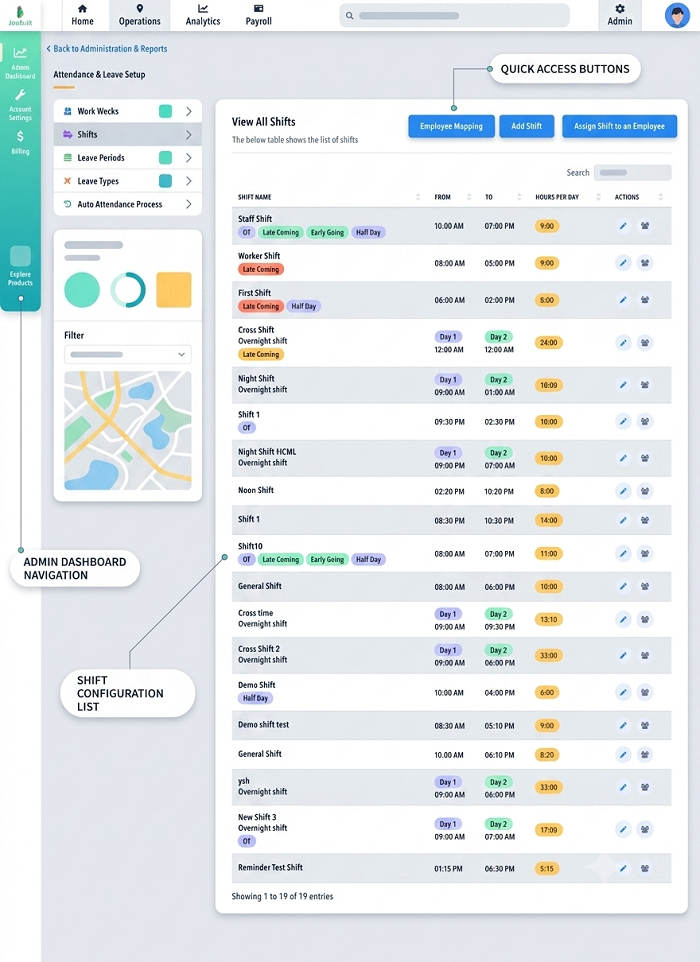
- Shift scheduling: Supervisors can assign employees to holiday and normal working shifts.
- Attendance monitoring: HR can compare scheduled shifts with actual attendance.
- Payroll integration: Approved holiday work, overtime and leave records can be transferred for payroll review.
For example, if 10 employees request leave for 13–15 April, a dashboard can help the manager identify whether approving all requests would leave the department below its minimum staffing requirement.
A centralised system reduces duplicate records and helps HR make decisions using consistent information.
13. Communicate the Songkran Staffing Plan Clearly
Even a well-designed coverage plan can fail if employees do not understand their schedules.
HR should publish the final holiday and staffing arrangements early enough for employees to plan their personal activities.
Communication should cover:
- Official company holiday dates.
- Departments operating during Songkran.
- Employee shift assignments.
- Approved and pending annual leave.
- Substitute holiday arrangements.
- Holiday work and payment procedures.
- Emergency contacts.
- First working day after the festival.
- Procedures for reporting absence or delays.
Businesses with employees who prefer Thai-language communication should provide the information in Thai.
Managers should also confirm that employees have received and understood their individual schedules.
For large organisations, a central holiday announcement combined with individual employee notifications can reduce confusion.
14. Establish Emergency and Escalation Coverage
Unexpected events may occur even after the staffing plan has been finalised.
Employees may become ill, transport disruptions may prevent staff from reporting to work, equipment may fail or customer demand may increase unexpectedly.
Businesses should therefore prepare an emergency coverage arrangement.
This may include:
- A list of backup employees.
- On-call technical personnel.
- Escalation contacts.
- Emergency replacement procedures.
- Supervisor contact information.
- Alternative service arrangements.
- Critical supplier contacts.
For example, a factory may keep an emergency maintenance contact available during a production shutdown. A hotel may identify additional housekeeping employees who can be called if occupancy increases unexpectedly.
Any on-call or standby arrangement should be clearly defined, including the employee's duties, working-time treatment and applicable compensation where required.
Employers should avoid informal expectations that employees remain available throughout the holiday without properly defining the arrangement.
15. Consider Employee Safety During Songkran
Employee safety should remain a priority during the festival period.
Songkran is associated with extensive domestic travel and public celebrations. The Thai government has historically established road-safety campaigns and emergency coordination arrangements during the festival.
Employees travelling for work may face additional road risks, while staff working in public-facing roles may encounter crowded environments and water-related hazards.
Employers should consider:
- Safe travel arrangements for employees working during the holiday.
- Suitable rest periods for drivers.
- Vehicle maintenance and safety checks.
- Clear rules against driving under the influence.
- Emergency contact procedures.
- Safe handling of equipment in wet environments.
- Protective equipment for outdoor workers.
- Incident reporting arrangements.
For example, a delivery company should avoid assigning excessive driving hours to employees during a period of heavy traffic.
A hotel or event organiser may need additional safety procedures for employees working in crowded public areas.
The government has emphasised road safety during Songkran, including sufficient rest, compliance with traffic laws and avoidance of drink-driving.
Businesses should incorporate appropriate safety reminders into their holiday workforce communications.
16. Monitor Attendance During the Holiday Period
Once the staffing plan is active, managers should monitor actual attendance against the published schedule.
A reliable attendance process helps identify shortages early and supports accurate payroll processing.
Useful monitoring activities include:
- Confirming employees have reported for assigned shifts.
- Recording late arrivals and absences.
- Monitoring shift changes.
- Recording approved overtime.
- Tracking substitute holiday arrangements.
- Reviewing emergency replacements.
- Reporting operational disruptions.
Mobile attendance applications can be useful for employees working at customer sites or multiple locations during Songkran.
However, employers should ensure that employees understand how to record attendance and how to report technical problems.
A missed punch should be reviewed rather than automatically treated as an absence. Managers should also preserve the approval history for any changes to the attendance record.
17. Reconcile Holiday Attendance With Payroll After Songkran
After the festival, HR and payroll teams should reconcile the actual working arrangements with the planned schedule.
This is particularly important when employees have worked on traditional holidays, taken substitute holidays or performed additional hours.
The review should cover:
- Employees who worked during the announced traditional holidays.
- Employees who received substitute holidays.
- Approved annual leave.
- Absences and attendance corrections.
- Overtime records.
- Holiday work payments.
- Additional allowances, if applicable.
- Temporary staffing costs.
For example, if an employee was scheduled to work on a traditional holiday and completed an approved shift, payroll should receive the correct holiday work information.
If an employee was assigned a substitute day off, the record should also be reflected accurately in the leave and attendance systems.
A post-holiday reconciliation helps identify errors before salary processing is completed.
18. Review the Effectiveness of the Coverage Plan
After Songkran, businesses should evaluate whether their staffing arrangements worked as intended.
The review should identify operational problems and opportunities to improve the following year's planning.
Useful performance indicators include:
| Performance measure | What it reveals |
|---|---|
| Approved leave requests | Employee demand for time off |
| Rejected or rescheduled requests | Potential staffing pressure |
| Shift coverage rate | Whether minimum staffing levels were maintained |
| Unplanned absences | Unexpected workforce shortages |
| Overtime hours | Additional staffing cost |
| Temporary staffing cost | Cost of external workforce support |
| Customer complaints | Impact of staffing on service quality |
| Delayed deliveries or projects | Operational disruption |
| Payroll corrections | Accuracy of holiday and attendance records |
| Safety incidents | Effectiveness of holiday safety arrangements |
Managers should collect feedback from employees and supervisors.
For example, if one department consistently experiences shortages during Songkran, the organisation may need to train backup employees or adjust its staffing model.
The findings can be used to improve the next annual holiday planning cycle.
Conclusion
Planning staff coverage during Songkran requires coordination between HR, operations, department managers and payroll teams. Businesses must balance employee holiday requests with the need to maintain essential operations and customer service.
A structured plan should begin with the holiday calendar and business demand forecast. Employers should then identify minimum staffing requirements, review annual leave applications, prepare shift rotations, assign backup employees and communicate the final schedule.
Thailand's Labour Protection Act provides important requirements concerning traditional holidays, annual leave, weekly rest days and holiday work payments. Employers should ensure that their schedules and payroll arrangements reflect these requirements.
Leave management and attendance software can make the process more efficient by providing centralised leave requests, team calendars, shift schedules, attendance records and payroll information.
Ultimately, effective Songkran planning allows employees to enjoy the festival while helping businesses maintain reliable operations, manage costs and protect workplace safety.
Songkran can concentrate leave requests while essential work continues. InnBuilt Shift Management can help Thailand managers compare approved time off with the people available to cover each shift.