How Can Thailand Warehouses Plan Shift Handoffs and Seasonal Staffing?
How Can Thailand Warehouses Plan Shift Handoffs and Seasonal Staffing?
Introduction
Warehouses in Thailand often operate beyond standard office hours to support manufacturing, retail distribution, e-commerce, import and export operations, and third-party logistics. Many facilities run two or three shifts, while others extend operating hours during high-demand periods such as year-end promotions, major online shopping campaigns, festive seasons, and changes in customer demand.
Managing these operations requires more than assigning employees to shifts. Warehouse managers must ensure that each shift receives accurate information about pending orders, inventory movements, equipment conditions, safety issues, staffing levels, and urgent tasks. At the same time, they need enough employees to manage seasonal increases in picking, packing, loading, receiving, and dispatch activities.
A structured approach to shift handoffs and seasonal staffing helps warehouses maintain operational continuity, reduce errors, control labour costs, and protect employee wellbeing. Workforce management and attendance software can further support this process by connecting shift schedules, attendance records, workload information, and payroll data.
1. Understand Warehouse Workload Before Planning Shifts
The first step is to understand how warehouse activity changes throughout the day, week, and year. Staffing decisions based only on total warehouse headcount may result in shortages in important operational areas.
Managers should review historical and expected workload across functions such as:
- Goods receiving and unloading
- Inventory inspection and put-away
- Order picking and replenishment
- Packing, labelling, and sorting
- Loading and dispatch
- Returns and damaged-goods processing
- Inventory counting and stock reconciliation
- Equipment operation and warehouse maintenance
For example, a distribution centre may receive most supplier deliveries in the morning but experience its highest order-picking and dispatch volumes in the afternoon and evening. Its shift plan should reflect these differences.
Useful information includes order volumes, inbound deliveries, average picking time, packing capacity, dispatch deadlines, absenteeism, and seasonal sales forecasts.
Managers should also identify bottlenecks. Increasing the number of pickers will not necessarily improve dispatch performance if packing stations, loading bays, or transport availability are already operating at full capacity.
2. Create a Clear Shift Structure
Warehouses should establish shift patterns that match operating requirements and employee availability.
Common arrangements include:
- Day shift: Handles receiving, supplier coordination, inventory checks, and routine warehouse activities.
- Evening shift: Supports order processing, picking, packing, and preparation for dispatch.
- Night shift: Handles overnight replenishment, bulk movements, sorting, and operations requiring extended facility coverage.
- Flexible or overlapping shifts: Provide additional coverage during peak receiving, picking, or dispatch periods.
An example of a three-shift structure is shown below. These are illustrative schedules rather than prescribed working hours.
| Shift | Example schedule | Main responsibilities |
|---|---|---|
| Day | 6:00 AM–2:00 PM | Receiving, inspection, put-away |
| Evening | 2:00 PM–10:00 PM | Picking, packing, dispatch preparation |
| Night | 10:00 PM–6:00 AM | Replenishment, sorting, overnight operations |
The schedule should include appropriate rest periods, weekly rest days, and time for shift handoffs. Managers should also check whether employees are being assigned consecutive shifts or excessive hours when schedules change.
3. Establish a Standard Shift Handoff Procedure
A shift handoff is the process through which outgoing employees communicate important operational information to incoming employees.
Without a consistent procedure, employees may repeat completed work, overlook pending orders, misplace inventory, or fail to report equipment problems.
A standard handoff should cover the following areas:
Pending orders and dispatches
- Orders awaiting picking or packing
- Orders approaching dispatch deadlines
- Delayed or incomplete shipments
- Priority customer orders
- Items awaiting quality inspection
Inventory and stock movements
- Goods received but not yet recorded
- Stock transfers between warehouse zones
- Inventory discrepancies
- Damaged, missing, or quarantined products
- Items requiring urgent replenishment
Equipment and facility conditions
- Forklift or pallet truck issues
- Conveyor and sorting-system faults
- Scanner or warehouse-system problems
- Loading-bay availability
- Safety hazards and maintenance requests
Staffing and operational coverage
- Employees absent or arriving late
- Temporary workers assigned to specific zones
- Employees transferred between warehouse functions
- Tasks requiring additional support
- Work requiring supervisor approval
A digital handoff checklist helps ensure that outgoing employees complete the required updates before the next shift takes responsibility.
4. Use Overlapping Shift Time for Critical Handoffs
A short overlap between shifts can make communication more effective, particularly in warehouses with high order volumes or continuous operations.
During the overlap, outgoing and incoming supervisors can review outstanding tasks, staffing shortages, safety concerns, equipment conditions, and dispatch priorities.
For example, a warehouse operating an evening shift and a night shift may schedule a brief handoff period around the shift change. The outgoing supervisor can explain which orders remain incomplete, which loading bays require attention, and whether any equipment has been taken out of service.
The overlap should be included in the workforce plan rather than added informally at the end of an employee's scheduled hours. If employees are required to work beyond their normal hours, the warehouse should review the applicable overtime rules and compensation requirements.
A structured handoff can reduce the need for repeated phone calls and help incoming employees begin productive work sooner.
5. Maintain a Digital Handoff Log
Paper registers and verbal instructions may be sufficient for small operations, but they become difficult to manage when warehouses have multiple shifts, departments, and locations.
A digital handoff log provides a central record of important operational updates.
It can include:
- Date and shift identification
- Outgoing and incoming supervisor details
- Pending orders and task status
- Inventory exceptions
- Equipment problems
- Safety incidents or hazards
- Employee attendance and staffing shortages
- Escalated issues and responsible persons
- Time of submission and acknowledgement
Each issue should have a clear status, such as Open, In Progress, Escalated, or Resolved.
For example, if a conveyor fault is reported by the evening shift, the night supervisor should be able to see the report, assign the maintenance follow-up, and update the issue status. This prevents the problem from disappearing between shifts.
Access permissions and audit trails should also be configured so that operational updates can be reviewed without allowing unauthorised changes.
6. Forecast Seasonal Staffing Requirements Early
Warehouse demand may increase significantly during certain periods. Thailand warehouses supporting e-commerce, retail, consumer goods, food distribution, and manufacturing may experience temporary workload increases around major shopping campaigns, Songkran-related demand changes, year-end promotions, and other business-specific peak periods.
Instead of waiting until order volumes rise, managers should forecast seasonal staffing requirements in advance.
Useful forecasting inputs include:
- Previous year's order and dispatch volumes
- Expected sales and customer promotions
- Supplier delivery schedules
- Customer service-level agreements
- Product launches and new contracts
- Planned inventory counts
- Returns and reverse-logistics volumes
- Employee leave and expected absenteeism
A simple approach is to compare expected workload with available productive capacity.
For example, if a warehouse normally processes 5,000 orders per day but expects 7,000 orders during a promotional period, managers should calculate the additional picking, packing, sorting, and dispatch capacity required.
The extra workload should not automatically be translated into an equal percentage increase in every department. Staffing should be allocated according to the actual bottleneck in each process.
7. Build a Flexible Seasonal Workforce Plan
Seasonal staffing can combine permanent employees, temporary workers, approved agency workers, and employees trained to support more than one warehouse function.
A practical staffing plan should identify which roles require additional capacity and how quickly those roles can be filled.
| Warehouse function | Seasonal staffing requirement | Planning consideration |
|---|---|---|
| Receiving | Additional unloading and inspection staff | Supplier delivery schedules |
| Picking | More pickers during high order volumes | Order lines and picking productivity |
| Packing | Additional packing operators | Packing-station capacity |
| Sorting | Temporary sorting support | Dispatch cut-off times |
| Loading | Additional loading personnel | Vehicle arrival schedules |
| Inventory control | Extra stock-count support | Accuracy and reconciliation |
| Returns | Dedicated returns-processing staff | Expected return volumes |
Temporary workers should receive appropriate onboarding before handling warehouse activities. They need to understand site procedures, emergency arrangements, equipment restrictions, inventory handling, and reporting responsibilities.
Managers should also distinguish between employees who can perform general warehouse tasks and those who require specific qualifications or authorisation, such as forklift operators.
8. Maintain a Skills Matrix for Seasonal Assignments
A skills matrix helps warehouse managers identify employees who can be moved between functions without compromising quality or safety.
For example, an employee trained in picking and packing may be able to support both departments during peak periods. However, the same employee should not be assigned to operate specialised equipment without the required training and authorisation.
A warehouse skills matrix may include:
- Employee name or ID
- Primary warehouse role
- Secondary trained roles
- Equipment operating authorisations
- Safety and compliance training
- Training completion dates
- Supervisor approval
- Training renewal requirements
Managers can use this information to identify internal staffing options before hiring additional workers.
Cross-training also helps warehouses manage unexpected absences. If a packing employee is unavailable, a trained employee from another area may be reassigned without disrupting the entire shift.
9. Manage Temporary Workers and Agency Staff Carefully
Seasonal workers can help warehouses respond to demand increases, but they need to be included in the same operational planning process as permanent staff.
Before assigning temporary workers, managers should verify the applicable employment arrangement, working conditions, role requirements, and any relevant agency responsibilities.
The onboarding process should explain:
- Work schedules and reporting procedures
- Attendance and time-recording methods
- Break and rest arrangements
- Warehouse safety rules
- Emergency exits and evacuation procedures
- Personal protective equipment requirements
- Inventory handling procedures
- Equipment-use restrictions
- Supervisor and escalation contacts
- Payroll and attendance correction procedures
Where workers are supplied through an agency, the warehouse should clarify the responsibilities of the agency and the receiving business. Contractual arrangements should not be treated as automatically removing statutory responsibilities.
Temporary employees should also receive clear shift assignments so that supervisors know who is working in each warehouse zone.
10. Coordinate Attendance With Shift Handoffs
Accurate attendance information is important for maintaining the right staffing levels across shifts.
If the scheduled number of employees differs from the actual number reporting for work, managers may need to reassign employees or activate backup staffing arrangements.
Attendance systems can help warehouses monitor:
- Scheduled versus actual employee attendance
- Late arrivals and early departures
- Absence and leave requests
- Missed clock-ins and clock-outs
- Shift swaps
- Overtime requests and approvals
- Employees assigned to different warehouse zones
- Temporary-worker attendance
For example, if three employees assigned to the evening packing shift are absent, the supervisor can identify the shortage before dispatch operations are affected.
Attendance data should be connected to shift rosters and employee assignments. A record showing that an employee entered the warehouse does not necessarily establish which department or task the employee was assigned to.
Managers should therefore maintain separate records for attendance and operational assignments where necessary.
11. Plan Shift Changes Without Disrupting Employee Rest
Frequent shift changes can create fatigue and reduce employee productivity, particularly when employees move between day, evening, and night shifts.
Warehouse managers should avoid making last-minute changes without reviewing the employee's previous and upcoming working hours.
Before approving a shift change, they should check:
- The employee's previous shift and actual finishing time
- The proposed shift start time
- Required rest periods
- Weekly rest-day arrangements
- Existing overtime hours
- Employee availability and agreement where required
- Skills and safety requirements for the new assignment
For example, an employee who completes a night shift should not be assigned to an early morning shift without checking the applicable working-time requirements and providing adequate recovery time.
Managers should also monitor repeated overtime and excessive workload during seasonal peaks. Additional staffing is often more sustainable than relying on the same employees to work extended hours throughout a busy period.
12. Monitor Warehouse Workload and Staffing in Real Time
A warehouse dashboard can help managers identify operational problems before they affect customer commitments.
Useful dashboard indicators include:
- Employees scheduled and employees present
- Staffing levels by warehouse zone
- Orders received and orders processed
- Pending picking and packing tasks
- Dispatch deadlines approaching
- Inventory exceptions
- Equipment downtime
- Temporary-worker assignments
- Overtime hours
- Open handoff issues
For example, a dashboard may show that the picking department has sufficient employees but the packing department is understaffed. Managers can then review available cross-trained employees and reassign suitable workers.
Real-time information should support supervisor decisions rather than automatically determine employee performance. Order complexity, equipment downtime, product availability, and other operational factors should be considered when interpreting productivity data.
13. Connect Shift Planning With Warehouse and Payroll Systems
Warehouse operations often use several systems to manage employees, inventory, orders, and dispatch activities. Connecting these systems can reduce duplicate data entry and improve coordination.
A workforce management or attendance platform can integrate with:
- Warehouse Management Systems (WMS)
- Enterprise Resource Planning (ERP) platforms
- Inventory management systems
- Order management systems
- Transport and dispatch software
- HR management systems
- Payroll applications
- Employee self-service platforms
For example, a WMS may show that order volumes are increasing in a particular picking zone. Managers can use this information to review staffing requirements and adjust upcoming shift assignments.
Attendance and approved overtime information can then be transferred to payroll for calculation and verification.
Integration should preserve clear data ownership. The WMS should remain the source of operational order and inventory information, while the HR or attendance system should maintain employee schedules and time records.
14. Understand Thailand Labour Requirements When Planning Shifts
Thailand warehouses must plan shift schedules and seasonal staffing in line with applicable employment requirements, particularly the Labour Protection Act B.E. 2541 (1998), as amended.
The following provisions are especially relevant:
Normal working hours – Section 23
For general work, normal working hours are generally limited to eight hours per day and 48 hours per week. Certain legally prescribed hazardous work is subject to a lower limit of seven hours per day and 42 hours per week. Warehouse employers should assess the actual nature of the work rather than assuming that every warehouse activity falls into the hazardous-work category.
Overtime – Section 24
Overtime on a normal working day generally requires the employee's prior consent on each occasion, subject to statutory exceptions. Seasonal increases in orders should not be treated as automatic permission to require unlimited overtime.
Holiday work – Section 25
The Act sets conditions under which employees may be required to work on holidays. For certain production, sale, and service activities, prior consent on each occasion is generally required where the statutory conditions apply. Warehouse operations should review the nature of their business and the applicable legal provisions before scheduling holiday work.
Combined overtime and holiday work – Section 26
The total hours of specified overtime and holiday work must remain within the limits prescribed by ministerial regulations. Managers should therefore monitor combined hours rather than reviewing normal-day overtime in isolation.
Daily rest periods – Section 27
Employees should generally receive at least one hour of rest during a working day after no more than five consecutive hours of work. The Act also provides for a rest period before overtime that continues for more than two hours, subject to statutory exceptions.
Weekly rest – Section 28
Employees are generally entitled to at least one weekly holiday, with no more than six days between weekly holidays. The Act provides specific arrangements for certain types of work, but warehouses should not assume that ordinary warehouse operations automatically qualify for those exceptions.
Traditional holidays – Section 29
Employers must provide the statutory minimum number of traditional holidays, including National Labour Day, subject to the Act's requirements. Holiday schedules should be considered when preparing seasonal rosters and dispatch coverage.
Work rules and employment records – Sections 108 and 112–115
Employers with ten or more employees are generally required to maintain work rules in Thai covering matters such as working days, normal working hours, rest periods, holidays, overtime, leave, and discipline. The Act also requires covered employers to maintain employee and wage-related records. Relevant working-time and wage records should be maintained and retained in accordance with the statutory requirements.
Warehouses should have HR or legal teams review current Thai-language legislation, applicable ministerial regulations, and the actual employment arrangements before implementing shift patterns or seasonal overtime policies.
15. Use Technology to Improve Shift Handoffs and Seasonal Staffing
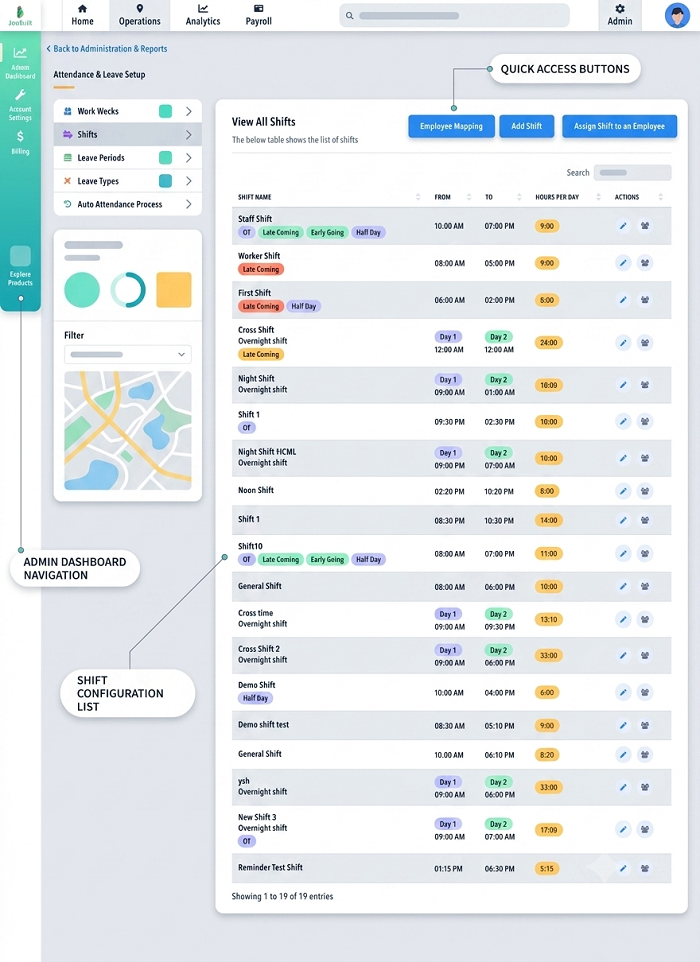
Workforce management software can help warehouse managers coordinate employee schedules and maintain reliable attendance information.
Useful features include:
- Shift scheduling: Create and publish schedules for day, evening, and night teams.
- Attendance tracking: Record actual clock-in and clock-out times.
- Shift handoff checklists: Provide standard fields for pending work, inventory issues, and equipment problems.
- Employee self-service: Allow employees to view schedules and submit availability or shift-change requests.
- Temporary-worker management: Record seasonal assignments and attendance.
- Overtime management: Route overtime requests through the appropriate approval process.
- Skills management: Identify employees qualified for different warehouse functions.
- Payroll integration: Transfer verified attendance and approved working-time data.
- Reporting: Compare planned staffing with actual attendance and workload.
The software should be easy for warehouse supervisors and frontline employees to use. Mobile access, shared terminals, clear approval workflows, and reliable offline procedures may be particularly important in large warehouses.
Technology should support documented procedures rather than replace supervisor verification.
16. Protect Employee and Operational Data
Warehouse workforce systems may contain employee contact details, attendance records, shift assignments, payroll information, and location data.
Businesses operating in Thailand should consider the Personal Data Protection Act (PDPA) when collecting and using this information.
Practical safeguards include:
- Explain why employee information is collected and how it is used.
- Collect only information needed for workforce and operational purposes.
- Restrict access to attendance and payroll records by job role.
- Apply appropriate security controls to mobile applications and shared devices.
- Establish retention and deletion procedures.
- Review third-party software providers and data-processing arrangements.
- Avoid unnecessary continuous employee-location monitoring.
- Provide appropriate privacy notices and handle employee rights requests.
If biometric attendance is used, employers should pay particular attention to the PDPA requirements for sensitive personal data. A suitable legal basis and appropriate safeguards must be established before collecting biometric information.
17. Measure the Effectiveness of Shift Handoffs and Seasonal Staffing
Warehouse managers should review operational and workforce indicators to determine whether their planning approach is working.
| KPI | What it measures |
|---|---|
| Shift handoff completion rate | Percentage of required handoffs completed |
| Open issues carried forward | Number of unresolved issues passed to the next shift |
| Order fulfilment rate | Percentage of orders completed within the required period |
| Dispatch delay rate | Frequency of shipments missing dispatch targets |
| Picking accuracy | Accuracy of items picked against customer orders |
| Inventory discrepancy rate | Frequency of differences between recorded and actual stock |
| Attendance coverage | Actual employees present compared with scheduled staffing |
| Seasonal vacancy rate | Unfilled temporary and permanent positions |
| Overtime hours | Additional working hours recorded |
| Equipment downtime | Time equipment is unavailable for operations |
These indicators should be reviewed together. For example, a warehouse may achieve higher order volumes during a seasonal campaign but also experience more picking errors and overtime. Managers should examine whether staffing levels, training, equipment capacity, or shift handoffs need improvement.
18. Common Mistakes to Avoid
Warehouses may face recurring problems when shift handoffs and seasonal staffing are managed informally.
- Relying only on verbal handoffs: Important information can be forgotten or misunderstood. Use a standard written or digital handoff record.
- Hiring temporary workers too late: Late recruitment leaves insufficient time for onboarding and training. Forecast demand and recruitment requirements early.
- Ignoring department-level workload: Additional employees in one area may not solve shortages elsewhere. Forecast staffing by operational function.
- Assigning untrained employees to specialised equipment: Verify training and authorisation before changing assignments.
- Using attendance as proof of task completion: Clock-in records show attendance events, not whether an employee completed an assigned warehouse task. Maintain separate task and operational records.
- Changing shifts without checking rest requirements: Review actual working hours, rest periods, weekly holidays, and overtime before approving changes.
- Failing to document unresolved issues: Open inventory, equipment, and dispatch problems should have a named owner and a clear follow-up status.
- Relying excessively on overtime: Extended hours may create fatigue and operational errors. Consider additional seasonal workers and better workload distribution.
Conclusion
Effective shift handoffs and seasonal staffing are essential for Thailand warehouses that need to maintain reliable operations during normal periods and sudden demand increases. A structured handoff process ensures that incoming employees understand pending orders, inventory conditions, equipment issues, and staffing requirements. Early seasonal forecasting helps managers recruit, train, and assign the right number of employees to each warehouse function.
By combining clear shift schedules, documented handoff procedures, skills-based staffing, accurate attendance records, and appropriate workforce technology, warehouses can reduce operational disruption and improve labour planning. Regular reviews of workload, employee wellbeing, and Thailand labour requirements help ensure that increased demand does not come at the expense of safety, accuracy, or compliance.
Warehouse seasonality makes clear handovers and flexible rosters essential. InnBuilt Shift Management can help Thailand supervisors plan temporary coverage and review who actually attended each shift.