What Is the Best Way to Plan 24/7 Customer Support Shifts in the UAE?
What Is the Best Way to Plan 24/7 Customer Support Shifts in the UAE?
Introduction
Providing 24/7 customer support helps UAE businesses serve customers at any time, resolve urgent issues, and maintain service quality across different time zones. However, round-the-clock operations can be challenging for HR teams and support managers. Poor shift planning may result in understaffing, excessive overtime, employee fatigue, missed service-level agreements (SLAs), and payroll errors.
The best way to plan 24/7 customer support shifts in the UAE is to combine demand forecasting, structured shift rotations, appropriate staffing levels, employee availability, labour-law compliance, and automated workforce management. A well-designed roster ensures that every shift has sufficient coverage without placing an unreasonable burden on individual employees.
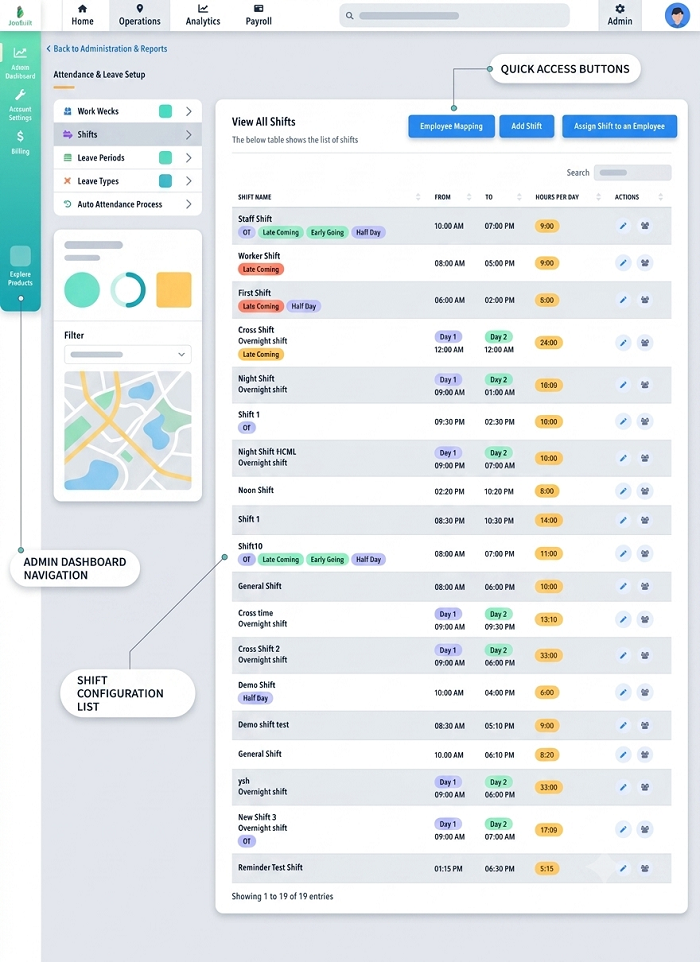
1. Analyse Customer Support Demand Before Creating Shifts
The first step is to understand when customers need assistance. Customer support demand rarely remains constant throughout the day. A business may receive more calls during UAE business hours, while technical support requests may increase at night or during weekends.
Review historical data from call centre systems, email queues, live chat platforms, and ticketing software.
Analyse:
- Average calls, chats, and tickets received each hour.
- Peak periods during weekdays, weekends, and public holidays.
- Average handling time for each customer query.
- Number of urgent or high-priority requests.
- Expected response and resolution times under SLAs.
- Seasonal demand, product launches, and promotional periods.
For example, an e-commerce business may need more agents during evening shopping hours, while a technology company may require overnight technical support for international customers.
Practical tip: Forecast staffing requirements for each time interval rather than assigning the same number of agents to every shift.
2. Choose a Shift Structure That Supports Continuous Coverage
A 24/7 operation must cover 168 hours every week. Businesses can use different shift structures depending on their service requirements, team size, and employee contracts.
| Shift structure | Example timing | Best suited for |
|---|---|---|
| Three-shift model | 6 AM–2 PM, 2 PM–10 PM, 10 PM–6 AM | Teams requiring continuous daily coverage |
| Four-shift rotation | Four staggered shifts with overlapping handovers | Larger support centres with variable demand |
| Fixed shifts | Employees consistently work assigned time slots | Stable demand and employees who prefer predictable hours |
| Rotating shifts | Employees move between day, evening, and night shifts according to a roster | Businesses sharing less popular working hours |
| Split-team model | Core daytime team plus evening and overnight teams | Businesses with significantly different demand levels |
These are illustrative scheduling patterns, not automatic legal entitlements or a substitute for calculating actual working hours.
For many UAE businesses, a three-shift model is a practical starting point. However, managers must account for breaks, weekly rest days, leave, training, and absence cover. A team cannot maintain continuous coverage simply by assigning three shifts without calculating the total staffing required.
3. Calculate the Number of Employees Needed for Each Shift
One of the most common scheduling mistakes is planning only for the employees who are present on a normal working day. A sustainable roster must also cover weekly rest days, annual leave, sick leave, training, and unexpected absences.
A simple starting calculation is:
Weekly coverage hours = Required agents per shift × Coverage hours per week
For example, if a business needs four agents continuously available, the operation requires:
4 agents × 168 hours = 672 agent-hours per week.
If each employee is scheduled for 40 working hours per week, the basic calculation is:
672 ÷ 40 = 16.8, or approximately 17 full-time employees.
This is only a baseline illustration. It does not include additional staffing for leave, breaks, training, absence, demand spikes, or other operational requirements. The actual headcount may need to be higher.
Managers should also distinguish between employees scheduled to work and agents actively available to handle customers. If employees take breaks or perform administrative duties, sufficient overlap or relief coverage may be necessary to maintain the target number of available agents.
4. Design Fair and Predictable Shift Rotations
Night shifts, weekend shifts, and public-holiday coverage can become a source of dissatisfaction if the same employees repeatedly receive inconvenient schedules.
Create a transparent rotation policy that explains how shifts are assigned, how changes are approved, and how employee preferences are considered.
A good rotation policy should:
- Publish schedules sufficiently in advance.
- Distribute night and weekend assignments fairly where operationally practical.
- Provide adequate recovery time between shifts.
- Avoid unnecessary last-minute changes.
- Consider approved leave and documented availability.
- Establish clear procedures for shift swaps.
- Allow employees to raise scheduling concerns through HR or their manager.
For example, a business could use a planned rotation in which employees move between day, evening, and night assignments over defined roster periods. The precise sequence should be based on operational needs, contractual arrangements, and appropriate rest intervals.
Avoid automatically moving an employee from a night shift to an early-morning shift with little recovery time. Predictability and sufficient rest can improve alertness, reduce fatigue, and support better customer interactions.
5. Follow UAE Working-Hour and Rest Requirements
Shift planning must reflect the employment rules applicable to the business. For most UAE private-sector employees covered by Federal Decree-Law No. 33 of 2021, normal working hours are generally eight hours per day or 48 hours per week, subject to applicable exceptions and special rules. The law also addresses breaks, overtime, and weekly rest. Employers should verify the rules that apply to their particular shift arrangements.
Official reference: UAE Government working-hours guidance and the UAE Labour Law.
The following areas require particular attention:
Working hours: Confirm each employee’s normal hours, contractual schedule, and any applicable sector-specific provisions.
Rest breaks: Plan breaks into the roster so customer queues remain covered. The general rule restricts working more than five consecutive hours without rest periods totalling at least one hour, subject to the legal provisions governing shift systems and relevant categories of work.
Weekly rest: Ensure employees receive the required weekly rest period and that work on rest days is handled according to applicable rules.
Overtime: Monitor additional hours, obtain required approvals, and calculate compensation correctly. Do not rely on overtime as a permanent solution to a staffing shortage.
Night work and shift-worker rules: Do not assume that every night shift automatically attracts the same overtime treatment. Applicable rules distinguish certain shift workers from other employees in specific circumstances.
Ramadan and public holidays: Review official announcements and applicable working-hour and holiday requirements when preparing the roster.
The general private-sector framework does not apply identically to every worker or establishment. Government entities, domestic workers, and certain special employment regimes may be governed by different rules. Businesses should confirm the correct legal framework before implementing a schedule.
6. Build Breaks and Handover Time Into Every Shift
Customer support teams need more than a start time and an end time. Employees must be able to take appropriate breaks, document unresolved cases, and transfer urgent issues to the incoming team.
Include planned handover periods where operationally necessary. The outgoing employee should communicate:
- Open customer tickets and pending callbacks.
- Escalated complaints and priority cases.
- Technical incidents or service disruptions.
- Promised response times and outstanding SLAs.
- Any temporary changes to support procedures.
Use a shared ticketing or customer relationship management (CRM) system to keep records accessible to authorised employees across shifts.
Avoid relying entirely on verbal handovers or informal messaging. A consistent digital handover process reduces the risk of missed cases and conflicting customer responses.
7. Use Workforce Management Software to Automate Rostering
Spreadsheets may work for a small team, but they become difficult to maintain as the number of employees, shifts, locations, and leave requests increases.
Workforce management software can help HR and support managers:
- Create recurring shift patterns.
- Forecast staffing demand.
- Track employee availability and approved leave.
- Identify overlapping or uncovered shifts.
- Manage shift swaps and approval workflows.
- Record attendance and actual working hours.
- Flag potential overtime and scheduling conflicts.
- Integrate attendance records with payroll processing.
- Produce reports on staffing, adherence, and service performance.
For example, if an employee requests leave during a night shift, the system can help the manager identify available replacement employees and assess whether the change creates an uncovered period.
Automation should support managerial decisions rather than replace them. HR must still review exceptions, validate attendance records, and ensure that the final schedule follows the applicable employment requirements.
8. Prepare a Backup Plan for Absences and Demand Spikes
Even a carefully planned roster can be disrupted by sickness, emergencies, unexpected customer demand, or system outages. A 24/7 support operation needs a documented contingency plan.
Useful measures include:
Cross-training: Train selected employees to handle more than one type of customer query, allowing managers to reallocate work when necessary.
Relief coverage: Maintain an appropriate reserve of trained employees or approved backup arrangements.
Escalation procedures: Identify who is responsible for urgent customer issues during each shift.
On-call arrangements: Where appropriate, define on-call responsibilities, response expectations, compensation, and approval procedures in line with applicable rules and contracts.
Overflow support: Establish a process for redirecting calls or prioritising urgent tickets during exceptionally busy periods.
Absence reporting: Give employees a clear process for notifying managers when they cannot attend a scheduled shift.
A backup plan should not depend on repeatedly asking the same employees to work beyond their scheduled hours. Consistent understaffing is a signal to review headcount, forecasts, and shift design.
9. Track the Right Metrics to Improve Shift Planning
Shift planning should be reviewed regularly using operational and employee-related data.
| Metric | What it helps managers understand |
|---|---|
| Average response time | How quickly customers receive an initial response |
| Average handling time | How long agents spend resolving each interaction |
| SLA achievement | Whether agreed service targets are being met |
| Queue abandonment rate | How often customers leave before receiving assistance |
| Schedule adherence | Whether staffing aligns with the planned roster |
| Overtime hours | Whether the team is regularly exceeding scheduled hours |
| Absence rate | How frequently unplanned absences affect coverage |
| Employee turnover | Whether workload or scheduling practices may be contributing to attrition |
Use these metrics together. For instance, low response times do not necessarily indicate a healthy operation if employees are experiencing excessive overtime or consistently missing breaks.
Review performance by shift, weekday, and demand period. This helps managers identify where additional staffing, different start times, or better training would make the biggest difference.
10. Example of a 24/7 Customer Support Planning Process
Consider a UAE business that operates a customer support centre for customers in the UAE and overseas.
The HR and operations teams could follow this process:
- Analyse customer demand by hour and day.
- Define the minimum number of agents required for each period.
- Select suitable shift patterns and calculate total staffing requirements.
- Build rest days, breaks, leave cover, and handovers into the roster.
- Validate the schedule against employment contracts and applicable labour rules.
- Publish the roster and allow employees to submit availability or swap requests.
- Monitor attendance, queues, overtime, and service levels.
- Review staffing assumptions monthly and adjust the plan as demand changes.
This process creates a repeatable approach instead of rebuilding the roster every week.
Frequently Asked Questions
1. What is the best shift pattern for 24/7 customer support in the UAE?
A three-shift pattern is a common starting point because it divides the day into manageable coverage periods. However, the best pattern depends on customer demand, team size, required overlap, employee contracts, and applicable working-hour rules.
2. How many employees are required for 24/7 customer support?
The answer depends on how many agents must be available at any time and the number of working hours each employee can be scheduled for. Calculate the total weekly coverage hours, divide by available working hours per employee, and then add sufficient capacity for breaks, leave, training, and absence cover.
3. Can UAE businesses schedule employees for night shifts?
Night shifts can be part of a 24/7 operating model, subject to the applicable employment rules, contracts, and health and safety considerations. Employers should review the specific rules for working hours, overtime, rest periods, and shift workers before finalising schedules.
4. How can HR prevent gaps in customer support coverage?
Use demand forecasting, a centralised roster, planned handovers, leave tracking, relief coverage, and automated alerts for uncovered shifts. Review the roster whenever an absence or shift change affects minimum staffing levels.
5. Can shift management software integrate with payroll?
Yes. Depending on the product, workforce management software can connect scheduled shifts and actual attendance records with payroll systems. HR should validate exceptions, overtime calculations, leave entries, and applicable compensation rules before processing salaries.
6. How often should a 24/7 shift roster be reviewed?
Managers should monitor coverage daily and review demand, service levels, overtime, and absence trends regularly. A monthly review is a useful starting point, with additional reviews after major changes in customer demand or operating hours.
Conclusion
Planning 24/7 customer support shifts in the UAE requires a balance between continuous service availability, realistic staffing, fair employee schedules, and labour compliance. Businesses should begin with demand forecasting, select an appropriate shift structure, calculate headcount accurately, and plan for breaks, rest days, leave, and unexpected absences.
Workforce management software can make the process more consistent by automating rosters, approvals, attendance tracking, and reporting. By reviewing operational metrics and employee feedback regularly, UAE businesses can maintain reliable customer support while reducing scheduling conflicts, avoidable overtime, and employee fatigue.
Around-the-clock support needs predictable coverage. InnBuilt Shift Management can help UAE teams distribute shifts, track rest assignments and identify gaps across day and night rosters.