How Can UAE Data Centres Schedule Technicians for 24/7 Incident Coverage?
How Can UAE Data Centres Schedule Technicians for 24/7 Incident Coverage?
Data centres in the UAE support essential digital services for businesses, financial institutions, government organisations, cloud providers, and technology companies. These facilities require continuous monitoring and rapid incident response to maintain infrastructure availability. When a server, cooling system, power supply, network connection, or security component develops a fault, qualified technicians must be available to investigate and resolve the issue.
Maintaining 24/7 incident coverage requires more than creating a rotating shift roster. Data centre operators must ensure that the right technical skills are available at every hour, handovers are completed properly, on-call engineers can be contacted, and working hours are recorded accurately.
A digital workforce management system can help UAE data centres coordinate technician schedules, track attendance, manage incident assignments, and maintain reliable timesheets while supporting continuous operations.
Why Is 24/7 Technician Scheduling Important for UAE Data Centres?
Data centre infrastructure operates continuously, even when administrative offices are closed. A technical issue arising overnight, on a weekend, or during a public holiday may require immediate investigation by a qualified engineer.
Scheduling gaps can create several operational risks:
- Insufficient shift coverage: A shift may lack technicians with the skills needed for a particular system.
- Delayed incident response: Managers may struggle to locate an available engineer during an urgent fault.
- Incomplete handovers: Incoming staff may not receive important information about unresolved incidents.
- Unplanned overtime: Repeated shift extensions can increase fatigue and complicate payroll.
- Unclear on-call responsibilities: Engineers may be unsure who is responsible for responding outside normal working hours.
- Attendance discrepancies: Managers may not know whether the scheduled technician reported for duty.
- Limited staffing visibility: Operations teams may find it difficult to coordinate employees across multiple facilities.
A structured scheduling process connects each shift with its required staffing levels, technical skills, incident responsibilities, and attendance records.
1. Identify Staffing Requirements for Every Shift
The first step is to define the staffing requirements for each operating period. A data centre may require different combinations of facilities engineers, electrical technicians, cooling specialists, network engineers, security personnel, and incident coordinators.
The required team depends on the facility's infrastructure, service commitments, incident procedures, and internal operating policies.
For example, a shift may need an electrical technician capable of investigating power distribution issues and a facilities engineer responsible for cooling infrastructure. Scheduling two employees without the required combination of skills may leave an important coverage gap.
Managers should establish:
- Minimum staffing levels for each shift.
- Required technical skills and certifications.
- Critical systems that need specialist coverage.
- Escalation contacts for complex incidents.
- Backup resources for simultaneous incidents.
- Planned leave and training requirements.
This approach ensures that the roster reflects operational requirements rather than simply filling a fixed number of employee slots.
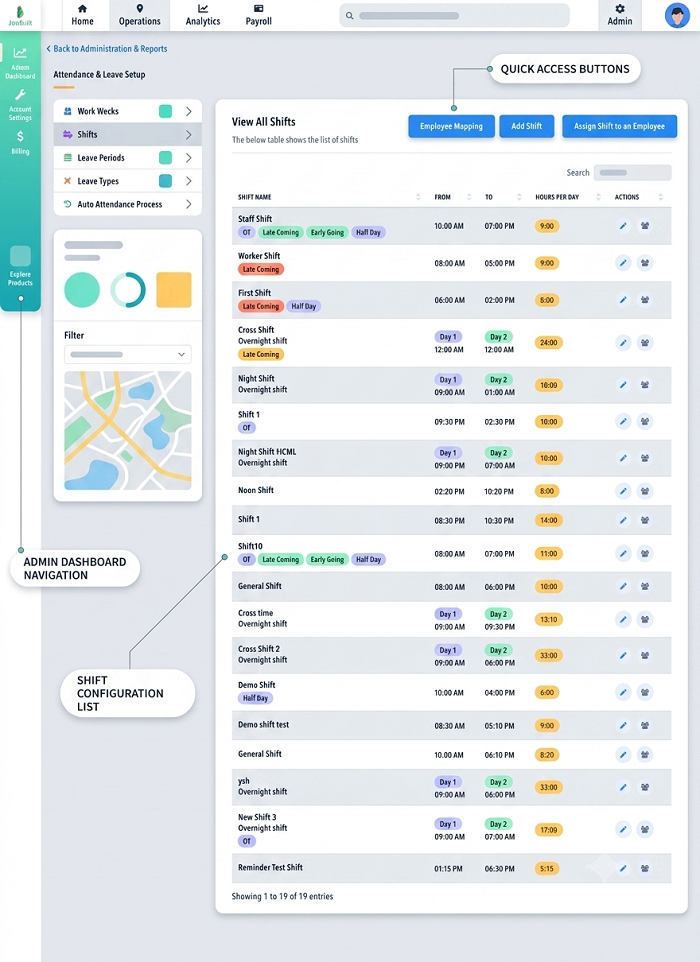
2. Build a Rotating 24/7 Shift Schedule
A 24-hour operation can be divided into day, evening, and night shifts or another suitable pattern based on operational needs. The schedule should provide continuous coverage while giving employees predictable working hours and rest periods.
A sample coverage pattern could look like this:
| Shift | Illustrative coverage window | Primary responsibility |
|---|---|---|
| Day | 6:00 AM–2:00 PM | Routine maintenance and incident response |
| Evening | 2:00 PM–10:00 PM | Infrastructure monitoring and fault resolution |
| Night | 10:00 PM–6:00 AM | Overnight monitoring and urgent incident handling |
These are illustrative eight-hour windows, not a prescribed UAE shift arrangement. Actual schedules should account for staffing requirements, handover time, breaks, employee contracts, and applicable employment rules.
Workforce scheduling software can generate recurring rosters, flag overlapping assignments, and identify shifts with insufficient coverage. Managers can also plan rotations in advance instead of relying on last-minute messages.
3. Match Technicians to Skills and Infrastructure Responsibilities
Not every technician can resolve every data centre incident. Scheduling should take account of the equipment and systems each employee is qualified and authorised to handle.
For example, an electrical technician may be responsible for investigating a power-related fault, while a cooling specialist handles a temperature-control issue. A network engineer may need to investigate connectivity problems or coordinate with another technical team.
A skills-based scheduling system can maintain employee profiles containing relevant competencies, certifications, assigned responsibilities, and approved access levels.
Before publishing a roster, managers should verify that:
- Each shift has the required technical skills.
- Critical infrastructure responsibilities are assigned.
- Authorised personnel are available for restricted tasks.
- Backup specialists can be contacted when needed.
- Expiring certifications or training requirements are addressed.
This reduces the risk of a shift being technically staffed but unable to respond effectively to a particular incident.
4. Manage On-Call Engineers and Escalation Rotations
Some incidents require specialist expertise that does not need to be physically present at the facility throughout every shift. Data centres may therefore use an on-call arrangement for designated engineers or senior specialists.
An on-call schedule should identify the primary contact, backup contact, escalation manager, and applicable response procedure.
For example, if an overnight technician cannot resolve a cooling-system fault, the incident process may require escalation to a facilities specialist. If that person is unavailable, the backup contact should be clear.
Effective on-call management includes:
- Publishing the current on-call roster.
- Maintaining accurate contact details.
- Defining escalation levels and notification procedures.
- Recording when an on-call engineer is contacted.
- Logging acknowledgement and response timestamps.
- Documenting any required call-out attendance.
- Reviewing missed or delayed acknowledgements.
On-call availability and actual work performed should be recorded separately where appropriate. Employers should apply the relevant contractual and legal rules when determining compensation for on-call duties, call-outs, and additional working hours.
5. Track Technician Attendance at Every Shift
A published roster does not confirm that the assigned technician actually reported for duty. Data centre operators need a reliable process for recording shift attendance.
A digital attendance system can capture employee check-in and check-out timestamps, scheduled shifts, late arrivals, and approved attendance corrections.
Depending on the facility's requirements, attendance may be recorded through an access-controlled terminal, an authorised workstation, or another approved method.
The system should help supervisors identify:
- Employees who have not checked in.
- Late arrivals that may affect coverage.
- Missing check-out records.
- Unapproved shift changes.
- Employees who have been reassigned to another facility.
- Attendance exceptions requiring approval.
Attendance records should complement, rather than replace, the facility's physical access-control and security systems. A door-access event does not necessarily prove that an employee began a scheduled shift or completed a particular task.
6. Plan Shift Handover for Unresolved Incidents
A shift handover is a critical part of continuous data centre operations. Incoming technicians need enough information to continue monitoring active issues without losing time repeating previous investigations.
The handover process should identify:
- Open incidents and their current status.
- Systems affected and observed symptoms.
- Troubleshooting already completed.
- Pending maintenance or change activities.
- Temporary workarounds and associated risks.
- Escalations awaiting a response.
- Next actions and responsible personnel.
A digital shift log can link these details to incident tickets and the incoming shift's assigned staff.
For example, if a cooling alert remains under investigation at the end of the evening shift, the outgoing technician can document the readings, actions taken, and next escalation step. The night technician can then continue from the recorded position.
Handover time should be included in workforce planning rather than treated as an informal activity outside the roster.
7. Connect Incident Tickets With Technician Assignments
When an incident occurs, operations managers need to know which technician is responsible, whether additional expertise is required, and whether the issue has been acknowledged.
Integrating incident-management workflows with staff scheduling can help assign work to available technicians based on their shift, skills, location, and current workload.
A practical workflow may include:
- An incident is logged and assigned a priority.
- The system identifies the responsible on-duty team.
- A qualified technician acknowledges the assignment.
- The technician records investigation and resolution updates.
- Additional specialists are contacted if escalation is required.
- The incident record is updated with resolution details and relevant timestamps.
The scheduling system should support the incident process rather than attempt to replace specialist monitoring, ticketing, or infrastructure-management tools.
Linking the incident ticket to the assigned shift also helps managers review staffing adequacy and identify recurring periods when additional technical coverage may be necessary.
8. Manage Absences, Shift Swaps, and Emergency Replacements
Unexpected leave, illness, transport delays, and urgent operational demands can create coverage gaps. Data centre managers need a controlled process for finding replacements without creating conflicting assignments.
A digital roster can highlight the affected shift and identify available employees with the required skills. Managers can then approve a replacement and update the official schedule.
Useful controls include:
- Shift-swap requests with approval history.
- Leave and absence visibility.
- Notifications for uncovered shifts.
- A list of qualified backup technicians.
- Alerts for overlapping assignments.
- Escalation when no suitable replacement is available.
A shift change should update the roster, attendance expectations, and relevant handover responsibilities. Informal swaps that are not recorded can leave managers uncertain about who is responsible during an incident.
Replacement planning should also account for employee rest requirements and applicable working-hour restrictions.
9. Prevent Fatigue Through Responsible Shift Planning
Continuous operations can put pressure on technicians when incidents extend beyond a scheduled shift. Repeated night work, frequent call-outs, and insufficient rest can affect concentration and operational performance.
Workforce planning should aim to distribute night shifts and emergency duties fairly while providing appropriate rest between assignments.
Practical measures include:
- Rotating shifts through a planned schedule.
- Avoiding unnecessary consecutive shift extensions.
- Tracking repeated call-outs and overtime.
- Maintaining backup coverage for extended incidents.
- Ensuring employees have the required breaks and rest.
- Reviewing staffing levels after repeated high-demand periods.
Managers should not automatically extend an employee's shift whenever an incident remains open. Where possible, responsibility should be transferred to another qualified technician using a documented handover.
10. Maintain Accurate Timesheets and Payroll Records
Data centre technicians may work night shifts, weekends, public holidays, or approved overtime. Workforce management software can connect the published roster with actual attendance, approved call-outs, and timesheet entries.
This helps payroll teams compare scheduled hours with recorded work and investigate exceptions before processing salaries.
Useful records include:
- Scheduled and actual shift times.
- Approved overtime and shift extensions.
- Call-out start and end times.
- Attendance adjustments and approvals.
- Leave and absence records.
- Relevant shift allowances under company policy.
- Public-holiday work and applicable compensation.
The UAE Government's guidance on private-sector working hours explains general rules on working hours, breaks, and overtime. However, specific provisions and exceptions can depend on the employee category and work arrangement. Employers should confirm the rules applicable to their workforce, including shift-worker provisions, rather than applying a generic overtime calculation to every technician.
11. Monitor Coverage and Response Performance With Reports
Scheduling data can help managers identify whether the current roster is providing adequate coverage.
Useful operational reports include:
| Report | How it helps |
|---|---|
| Shift coverage report | Identifies understaffed and uncovered shifts. |
| Skills coverage report | Highlights shifts missing required technical expertise. |
| Attendance exception report | Flags late arrivals and missing check-ins. |
| On-call response report | Tracks acknowledgement and escalation events. |
| Overtime report | Shows repeated extensions and additional work. |
| Handover report | Identifies incomplete shift transitions. |
| Incident workload report | Shows demand by shift, team, and incident category. |
| Leave and absence report | Supports replacement planning. |
These reports should be interpreted alongside incident severity, resolution complexity, maintenance schedules, and service-level commitments. A short response time alone does not prove that an incident was resolved correctly.
By analysing recurring patterns, managers can adjust shift overlaps, add specialist backup, or revise on-call arrangements where the evidence indicates a coverage gap.
12. Protect Employee and Data Centre Operational Information
Data centre scheduling systems may contain employee records, shift assignments, incident details, and sensitive information about facility operations. Access should be controlled according to each user's responsibilities.
Recommended practices include:
- Restricting roster and attendance access to authorised personnel.
- Maintaining audit logs for changes to schedules and timesheets.
- Protecting employee records and contact information.
- Limiting incident details to users with an operational need.
- Using approved authentication and access controls.
- Establishing suitable retention and deletion policies.
- Reviewing integrations before sharing workforce data between systems.
The UAE's Personal Data Protection Law provides a framework for handling personal data, subject to its scope and applicable exceptions. Data centre operators should also assess their contractual, sector-specific, and facility-security requirements before selecting or configuring workforce software.
13. Choose Workforce Scheduling Software for 24/7 Operations
A basic attendance register may not provide enough functionality for data centres that require continuous technical coverage. The selected system should support recurring shifts, skills-based assignments, incident escalation, and reliable time records.
Important features include:
- Rotating shift scheduling.
- Skills and certification profiles.
- Real-time attendance status.
- On-call and backup rosters.
- Shift-swap approvals.
- Incident and handover records.
- Overtime and call-out timesheets.
- Coverage and exception reports.
- Payroll integration.
- Role-based access and audit trails.
Ideally, workforce scheduling should integrate with existing incident-management and access-control systems where technically appropriate. This reduces duplicate entry while preserving each system's specific purpose.
Frequently Asked Questions
1. How can UAE data centres maintain 24/7 technician coverage?
They can use rotating shift schedules, minimum staffing rules, skills-based assignments, on-call engineers, and approved backup arrangements. Digital scheduling helps managers identify uncovered shifts before they affect operations.
2. How should data centres schedule technicians for night shifts?
Managers should consider technical skills, operational demand, employee availability, handover requirements, and appropriate rest periods. The schedule should also account for applicable employment rules and approved working-hour arrangements.
3. Can workforce software help manage on-call engineers?
Yes. Suitable software can publish primary and backup contacts, record on-call assignments, send notifications, and capture call-out timestamps. Compensation and working-time treatment should follow applicable contracts and legal requirements.
4. How can data centres improve shift handovers?
They can use standardised digital handover checklists linked to open incident tickets. Outgoing technicians should document unresolved faults, actions taken, pending escalations, and the next required steps.
5. Can attendance software track incident response times?
Attendance software can record shift attendance and may capture work-related timestamps when integrated with incident-management tools. Incident acknowledgement and resolution times should be taken from the relevant incident records rather than inferred from attendance alone.
6. How can accurate shift records improve payroll?
Linking the roster with actual attendance, approved overtime, and call-out records helps payroll teams identify discrepancies and process timesheets more consistently.
Conclusion
UAE data centres can strengthen 24/7 incident coverage by combining rotating shift schedules, skills-based assignments, on-call rotations, digital attendance, and structured handovers. These processes help ensure that qualified technicians are available, incident responsibilities are clear, and unresolved issues are transferred properly between shifts.
An integrated workforce management system also helps operators identify staffing gaps, control unplanned overtime, and maintain accurate attendance and payroll records. By coordinating people, schedules, and incident workflows, data centres can support more reliable operations while maintaining appropriate employee rest, data protection, and compliance controls.
Round-the-clock incident support depends on knowing who is available. InnBuilt Shift Management can help UAE data centres organise technician coverage, on-call changes and actual attendance.