How Can Face Attendance Prevent Buddy Punching in UAE Offices?
How Can Face Attendance Prevent Buddy Punching in UAE Offices?
Buddy punching occurs when one employee records attendance on behalf of another employee. For example, an employee may use a colleague's attendance card, PIN, or other credentials to register a clock-in or clock-out that does not represent the employee's actual presence.
For UAE employers, face attendance can help reduce this problem by linking an attendance event to the physical identity of the employee. However, organizations should also consider privacy, security, and applicable UAE requirements when implementing biometric attendance.
What Is Buddy Punching?
Buddy punching is a form of attendance fraud in which an employee asks a colleague to record attendance for them.
It can happen when organizations use:
- Manual attendance registers
- ID cards
- Swipe cards
- PIN-based terminals
- Shared login credentials
For example, an employee who is absent could give their access card to a colleague and ask them to clock in. The attendance system may record the transaction as valid even though the employee is not actually present.
How Does Face Attendance Prevent It?
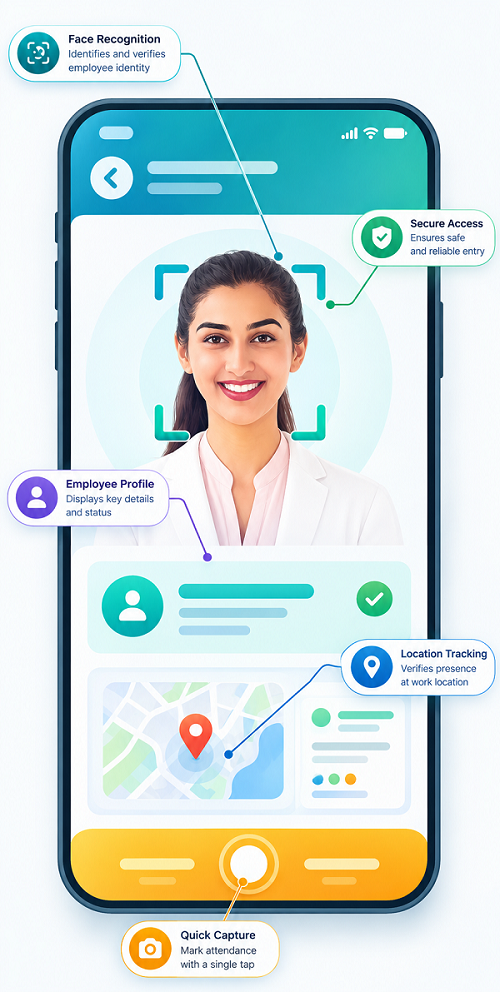
Face attendance uses facial recognition to verify the person attempting to record attendance.
Instead of asking employees to enter a PIN or present a card, the system captures their face and compares it with the employee's registered biometric profile.
The process is generally:
Employee approaches terminal → Face is detected → Identity is verified → Attendance is recorded
Because the attendance event is linked to the person being physically verified, another employee cannot normally clock in simply by using their card or PIN.
1. Attendance Is Linked to Employee Identity
Traditional attendance methods often depend on something an employee has or knows, such as an access card or PIN.
Face attendance uses biometric verification, which links the attendance event to the individual.
This makes it substantially more difficult for employees to exchange credentials for attendance purposes.
2. Reduces Shared Credentials
With card- or PIN-based attendance, employees may share their credentials with colleagues.
Face attendance reduces dependence on shared credentials because the employee's physical presence is required for verification.
This can help HR establish a more reliable record of who actually attended the workplace.
3. Creates More Reliable Attendance Records
A face-recognition system can automatically record:
- Employee identity
- Date
- Clock-in time
- Clock-out time
- Attendance location or device
- Attendance status
HR can then compare these records against schedules, leave applications, and payroll information.
4. Helps HR Identify Attendance Exceptions
Face attendance does not eliminate all attendance fraud, but it can help HR identify unusual patterns.
For example, HR may investigate:
- Repeated late arrivals
- Unusual clock-in patterns
- Missing clock-outs
- Attendance outside scheduled hours
- Unexpected attendance at a particular location
- Repeated manual corrections
Exception reports can help managers review questionable records before payroll is finalized.
5. Supports Multi-Location Attendance
UAE organizations may operate across offices, branches, warehouses, and project locations.
A centralized face-attendance platform can allow HR to monitor attendance across multiple locations while maintaining separate employee schedules.
For example, an organization could configure different attendance devices for:
- Dubai office
- Abu Dhabi branch
- Sharjah facility
- Warehouse
- Project site
This can provide HR with a centralized attendance record while maintaining location-specific controls.
6. Connects Attendance With Payroll
Preventing buddy punching is particularly important when attendance affects payroll.
If employees are paid based partly on attendance, working hours, overtime, or approved absences, inaccurate attendance records can result in incorrect payroll calculations.
An integrated system can transfer approved attendance information to payroll:
Face Verification → Attendance → Working Hours → Approved Adjustments → Payroll
This reduces the need for manual attendance entry and helps payroll teams identify discrepancies.
7. Anti-Spoofing Features Matter
Employers should not assume that every facial-recognition system provides the same level of security.
When selecting a system, HR and IT teams should evaluate whether it includes appropriate liveness detection or anti-spoofing technology.
These features are designed to help distinguish a real person from attempts to use photographs, videos, or other presentation methods.
The effectiveness of such technology depends on the particular system and its implementation.
8. Maintain a Manual Exception Process
Face recognition can occasionally fail because of technical issues, lighting, camera positioning, network problems, or other circumstances.
Employees should therefore have an approved process for reporting failed attendance.
For example:
Recognition failure → Employee reports issue → HR verifies circumstances → Attendance is corrected → Correction is logged
This prevents legitimate technical problems from being incorrectly treated as absenteeism.
9. Protect Employee Biometric Information
Face attendance involves biometric information, so employers should implement appropriate privacy and security controls.
HR should establish policies covering:
- Purpose of biometric data collection
- Access restrictions
- Data security
- Retention periods
- Data processing
- Vendor responsibilities
- Employee questions and complaints
Employers should also review applicable UAE data-protection requirements before implementing the technology.
10. Combine Technology With HR Controls
Face attendance should be part of a broader attendance-management process rather than the only anti-fraud measure.
Employers should also use:
- Clear attendance policies
- Manager approvals
- Regular attendance audits
- Exception reports
- Shift scheduling
- Leave management
- Payroll reconciliation
Combining technology with effective HR procedures provides stronger control than relying on facial recognition alone.
Conclusion
Face attendance can significantly reduce buddy punching in UAE offices because employees cannot normally record attendance simply by sharing a card or PIN with a colleague. By verifying the employee's physical identity, facial recognition creates a stronger connection between the attendance record and the person actually present.
For UAE employers, the best approach is to combine face recognition, anti-spoofing technology, clear attendance policies, exception management, data-security controls, and payroll integration. This can help improve attendance accuracy while supporting a more reliable and transparent payroll process.
Buddy punching is harder when a check-in is linked to the employee's face rather than a transferable badge. InnBuilt Face Attendance Software can give UAE offices clearer punch accountability.