What Is the Difference Between Face Recognition and Fingerprint Attendance in the UAE?
What Is the Difference Between Face Recognition and Fingerprint Attendance in the UAE?
Biometric attendance systems are increasingly used by organizations to improve attendance accuracy and reduce proxy attendance. Two common options are face recognition and fingerprint attendance.
Both methods identify employees using biometric characteristics, but they differ in how employees are authenticated, where the technology works best, and what employers should consider when implementing them in UAE workplaces.
What Is Face Recognition Attendance?
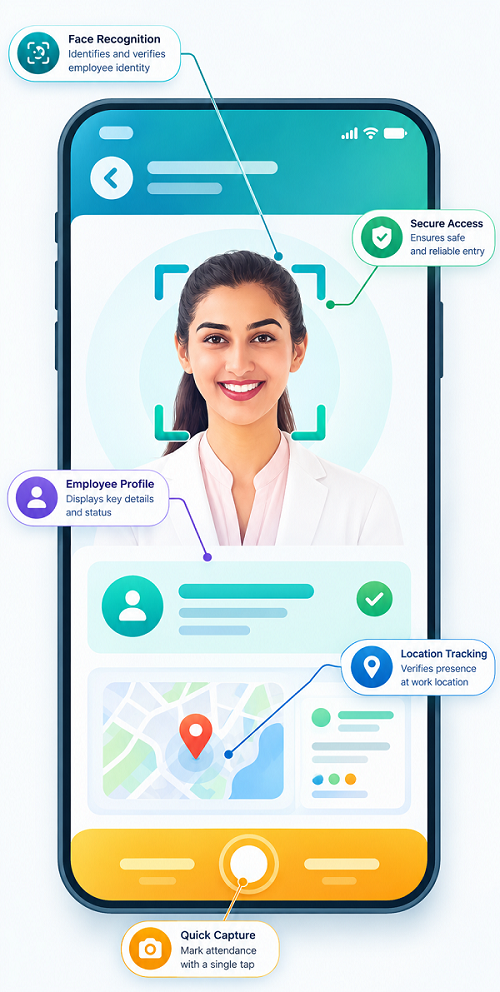
Face recognition attendance uses a camera to identify an employee based on facial characteristics.
The employee typically looks at an attendance terminal or camera, which captures their face and compares it with their registered biometric profile.
The basic process is:
Employee approaches device → Face is detected → Identity is verified → Attendance is recorded
Employees generally do not need to touch the attendance device.
What Is Fingerprint Attendance?
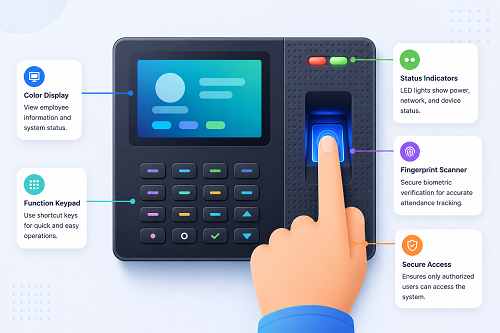
Fingerprint attendance uses the unique patterns in an employee's fingerprint to verify identity.
The employee places a registered finger on a biometric scanner, which compares the fingerprint with the employee's stored biometric template.
The process is:
Employee places finger on scanner → Fingerprint is captured → Identity is verified → Attendance is recorded
Fingerprint systems have been widely used for workplace attendance because they can provide reliable identity verification in suitable environments.
Face Recognition vs. Fingerprint Attendance
| Feature | Face Recognition | Fingerprint |
|---|---|---|
| Authentication method | Facial features | Fingerprint patterns |
| Physical contact | Usually contactless | Requires contact with scanner |
| Attendance speed | Generally quick | Can be quick |
| Proxy attendance | Helps reduce it | Helps reduce it |
| Hygiene | Contactless | Shared contact surface |
| Gloves | Generally compatible | May interfere with scanning |
| Lighting | Can affect performance | Generally less dependent on lighting |
| Finger condition | Not relevant | Dirt, moisture, injuries may affect scanning |
| Camera requirement | Yes | No camera required |
| Privacy considerations | Biometric data | Biometric data |
| Multiple locations | Can be supported | Can be supported |
The exact performance depends on the hardware, software, environment, and configuration.
1. Contactless vs. Contact-Based Attendance
One of the most noticeable differences is physical contact.
Face recognition normally allows employees to authenticate without touching the attendance terminal. This can be convenient in offices with high employee traffic.
Fingerprint attendance requires the employee to touch the scanner. Organizations should consider this when selecting a system for workplaces with large numbers of employees or specific hygiene requirements.
2. Workplace Environment Matters
Face recognition can work well in office environments, but factors such as lighting, camera positioning, and device placement can influence recognition.
Fingerprint systems can be affected by conditions such as:
- Wet fingers
- Dirty fingers
- Cuts or injuries
- Worn fingerprints
- Gloves
For employees working in construction, manufacturing, logistics, or outdoor environments, employers should test the chosen technology under actual working conditions.
3. Attendance for Employees Wearing Protective Equipment
Some employees may wear helmets, masks, safety glasses, or other protective equipment.
Depending on the facial-recognition technology, certain protective equipment may affect recognition performance. Employers should test the system with the equipment employees actually use.
Fingerprint attendance can also present challenges where employees routinely wear gloves.
Therefore, neither technology should be selected solely based on its theoretical capabilities.
4. Proxy Attendance Prevention
Both systems can help reduce buddy punching compared with card- or PIN-based attendance.
With face recognition, the employee's face must be verified.
With fingerprint attendance, the employee's fingerprint must be verified.
However, employers should select systems with appropriate security features and configure them correctly. Biometric attendance should also be supported by clear attendance policies and HR controls.
5. Privacy and Data Protection
Both face recognition and fingerprint systems involve biometric information. UAE employers should therefore consider applicable data-protection and privacy requirements before collecting employee biometric information.
HR should determine:
- Why biometric information is collected
- How it will be processed
- Who can access it
- How it will be protected
- How long it will be retained
- Whether third-party providers process the information
- What happens when an employee leaves
The organization should establish appropriate policies and safeguards before implementation.
6. Integration With Payroll
Both technologies can be connected to attendance and payroll software.
For example:
Biometric Verification → Attendance Record → Working Hours → Leave/Overtime → Payroll
This can help HR reduce manual data entry and improve the accuracy of payroll inputs.
The biometric device itself does not calculate every payroll entitlement. Employers should ensure that payroll rules and attendance adjustments are configured according to applicable UAE requirements and company policies.
7. Which Is Better for UAE Employers?
There is no single answer for every UAE organization.
Face recognition may be suitable when:
- Contactless attendance is preferred.
- Employees work mainly in offices or controlled environments.
- The organization wants fast identification.
- Employees frequently move between authorized locations.
- The company wants camera-based verification.
Fingerprint may be suitable when:
- Employees work in a controlled indoor environment.
- Reliable fingerprint scanning is practical.
- The organization prefers a simpler biometric terminal.
- Camera-based recognition is difficult in the workplace.
For some organizations, a combination of biometric and alternative attendance methods may be more practical.
8. Consider a Backup Attendance Method
Regardless of the technology selected, employers should plan for system failures.
Problems may occur because of:
- Network outages
- Device failures
- Power interruptions
- Recognition errors
- Employee injuries
- Poor environmental conditions
An approved manual or alternative attendance process can prevent legitimate attendance from being incorrectly recorded as absence.
Conclusion
The main difference between face recognition and fingerprint attendance is the biometric method used to verify employees. Face recognition is generally contactless and camera-based, while fingerprint attendance requires employees to place a finger on a scanner.
For UAE employers, the best choice depends on the workplace environment, employee population, security requirements, privacy considerations, and integration needs. Before implementation, organizations should test the technology in real working conditions and establish appropriate policies for biometric-data protection, attendance corrections, and system failures.
When integrated with HR and payroll software, either method can help employers create a more accurate and efficient attendance-to-payroll process.
Face and fingerprint systems offer different check-in experiences. InnBuilt Face Attendance Software can help UAE employers assess a contactless workflow while comparing deployment, usability and privacy needs.