What Should UAE Employers Consider Before Introducing Face Attendance?
What Should UAE Employers Consider Before Introducing Face Attendance?
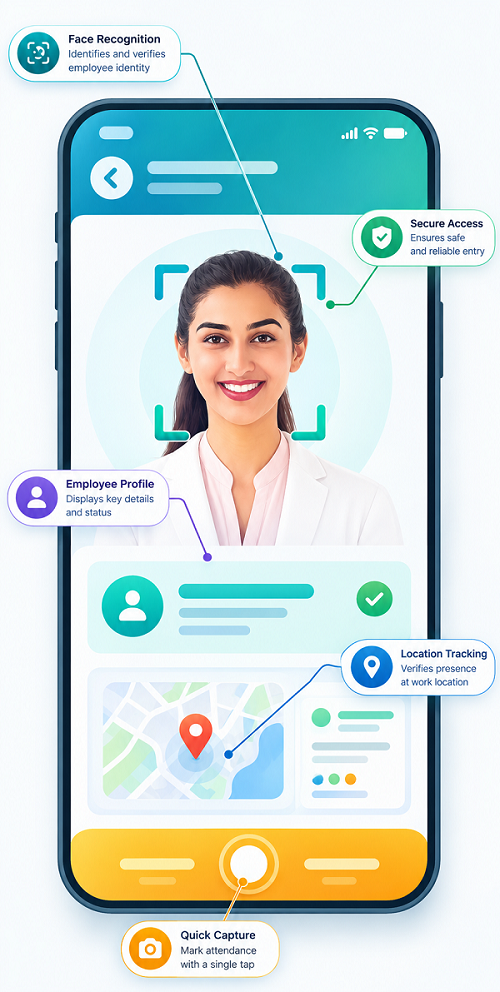
Face attendance can help UAE employers automate time tracking, reduce proxy attendance, and connect employee attendance with payroll. However, facial recognition involves biometric information, so employers should consider privacy, security, compliance, employee communication, and operational requirements before introducing it.
A successful implementation should balance attendance-management benefits with employees' rights and the organization's legal and security responsibilities.
1. Understand UAE Data Protection Requirements
Before collecting facial biometric information, employers should assess the applicable UAE data-protection requirements. Biometric information can require additional safeguards because it can be used to identify an individual.
HR and legal teams should determine:
- What information will be collected
- Why it is required
- How it will be processed
- Who can access it
- Where it will be stored
- How long it will be retained
- When it will be deleted
Employers should obtain appropriate legal advice where necessary, particularly for organizations operating across different UAE jurisdictions or with cross-border data processing.
2. Define a Clear Business Purpose
Employers should have a specific reason for introducing face attendance. For example, the objective may be to improve attendance accuracy, reduce proxy attendance, simplify payroll processing, or manage employees across multiple locations.
HR should avoid collecting biometric information simply because the technology is available.
A documented purpose helps determine what information should be collected and how the system should be configured.
3. Evaluate the Attendance Technology
Not all facial-recognition systems provide the same level of accuracy or security.
Before selecting a system, employers should evaluate:
- Recognition accuracy
- Anti-spoofing capabilities
- Speed of verification
- Offline functionality
- Cloud availability
- Integration with payroll
- Integration with HR software
- Reporting capabilities
- Multi-location support
- Data encryption
- Access controls
The system should be tested in the actual workplace environment before full deployment.
4. Consider Employee Privacy
Employees should understand how face attendance works and why the organization is introducing it.
HR should provide a clear policy explaining:
- What biometric information is collected
- The purpose of collection
- How attendance is recorded
- Who can access the information
- How the information is protected
- How long it will be retained
- What happens if recognition fails
- How employees can raise concerns
Clear communication can help employees understand that the system is intended for attendance management rather than unnecessary monitoring.
5. Establish Data Security Controls
Facial biometric information requires strong security controls because biometric identifiers cannot simply be replaced like a password.
Employers should consider:
- Encryption
- Role-based access
- Secure authentication
- Audit logs
- Vendor security practices
- Data backup procedures
- Breach-response procedures
- Data-retention controls
HR should work with IT and security teams to establish appropriate safeguards before the system goes live.
6. Check Where the Data Is Stored
Employers should understand whether biometric information is stored on local devices, company servers, or a third-party cloud platform.
If the technology provider stores or processes information outside the UAE, the employer should assess the applicable requirements governing data transfers and processing.
Vendor contracts should clearly identify responsibilities for data protection and security.
7. Provide an Alternative for Failed Recognition
Face recognition is not perfect. Employees may occasionally be unable to authenticate because of poor lighting, camera problems, network issues, or changes in appearance.
Employers should create a clear exception process.
For example:
Face recognition fails → Employee reports issue → HR verifies attendance → Approved correction is recorded
An alternative authentication or attendance procedure can prevent technical problems from becoming unfair attendance penalties.
8. Consider Different Work Environments
The system should work effectively in the organization's actual operating conditions.
For example, employers should test face attendance for:
- Office employees
- Factory workers
- Retail employees
- Construction teams
- Warehouse staff
- Field employees
- Multiple shifts
- Multiple locations
Lighting, camera positioning, protective equipment, and network availability may affect performance.
9. Integrate Face Attendance With Payroll
One of the major advantages of automated attendance is the ability to connect attendance data with payroll.
The system should ideally support the flow:
Face Verification → Attendance → Working Hours → Leave/Overtime → Payroll
This can reduce manual data entry and help HR identify discrepancies before payroll is processed.
However, payroll calculations should use approved attendance information and applicable UAE employment rules rather than automatically treating every recorded event as a payroll adjustment.
10. Review Vendor Responsibilities
If a third-party provider manages the facial-recognition platform, employers should carefully review the vendor agreement.
HR, IT, and legal teams should examine:
- Data ownership
- Data-processing responsibilities
- Security standards
- Data storage location
- Subcontractors
- Data retention
- Data deletion
- Incident notification
- System availability
- Employee support
- Contract termination procedures
The employer should understand what happens to employee biometric information if the contract ends.
11. Train HR and Managers
Technology alone does not guarantee successful attendance management. HR and managers should understand how to use the system correctly.
Training should cover:
- Attendance corrections
- Failed recognition
- Employee queries
- Privacy procedures
- Access permissions
- Attendance reports
- Payroll integration
- System outages
Managers should also understand that biometric attendance records should be handled responsibly and confidentially.
12. Run a Pilot Before Full Deployment
A pilot program can identify technical and operational problems before the system is introduced across the organization.
During the pilot, HR can evaluate:
- Recognition accuracy
- Employee experience
- Device performance
- Attendance synchronization
- Payroll integration
- Exception handling
- Reporting
- System reliability
Feedback from the pilot can then be used to improve the final implementation.
Conclusion
Face attendance can be an effective tool for UAE employers, but it should not be treated as simply another attendance device. Because facial recognition involves biometric information, organizations should consider privacy, data security, legal requirements, employee communication, vendor controls, system reliability, and payroll integration before implementation.
A well-designed approach can allow employers to benefit from automated attendance tracking while maintaining appropriate safeguards for employee information.
Before rollout, UAE employers should consider enrollment, employee communication and access controls. InnBuilt Face Attendance Software can support a defined check-in workflow with authorised administrative review.