How Can UAE Payroll Teams Calculate Salary for Employees Leaving Mid-Month?
How Can UAE Payroll Teams Calculate Salary for Employees Leaving Mid-Month?
Introduction
When an employee resigns or their employment ends in the middle of a month, UAE payroll teams must calculate the salary payable up to the final employment date and prepare the employee's final settlement. This involves more than simply dividing the monthly salary by the number of days worked.
Payroll administrators may need to account for basic salary, fixed allowances, approved overtime, unpaid absences, unused annual leave, notice-period payments, and end-of-service benefits. The final calculation also depends on the employee's contract, applicable employment rules, and the company's approved payroll procedures.
A structured payroll process helps UAE businesses calculate final payments accurately, explain settlement figures to departing employees, and meet applicable payment deadlines.
1. Confirm the Employee's Final Employment Date
Before calculating the final salary, HR should verify the employee's official last employment date. This may differ from the date the employee submitted a resignation letter, stopped attending the office, or completed a handover.
The final date should be checked against the resignation or termination notice, employment contract, approved leave records, and any written agreement concerning an earlier or later departure.
Payroll should collect the following information:
- Employee's contractual monthly salary and salary components.
- Official final employment date.
- Applicable notice period and notice served.
- Attendance records up to the final date.
- Approved overtime and outstanding incentives.
- Unused annual leave balance.
- Outstanding expenses or reimbursements.
- Applicable end-of-service benefit details.
- Any proposed deductions requiring legal and policy review.
The UAE private-sector framework generally requires notice under the applicable contract and law, with statutory provisions governing notice periods and compensation where notice is not served. The employment relationship ordinarily continues during the notice period unless a lawful arrangement provides otherwise.
2. Calculate Salary for the Partial Month
The first calculation is the salary payable for the eligible portion of the final payroll month.
Employers should use a documented calculation method consistent with applicable legal requirements, contractual terms, and company policy. Payroll teams should not assume that one proration formula applies universally to every UAE employee.
3. Separate Basic Salary and Allowances
A UAE employee's salary package may contain basic salary, housing allowance, transport allowance, and other fixed or variable components.
Payroll should calculate each component according to its applicable contractual and legal treatment rather than assuming that all payments must always be prorated identically.
Consider this example:
| Salary component | Monthly amount |
|---|---|
| Basic salary | AED 7,000 |
| Housing allowance | AED 3,000 |
| Transport allowance | AED 1,000 |
| Other fixed allowance | AED 1,000 |
| Total monthly package | AED 12,000 |
If the applicable policy requires all components to be prorated using the same calendar-day ratio, the payroll system can calculate each separately and reconcile the total.
Maintaining component-level records is particularly important because certain entitlements, including statutory end-of-service gratuity for eligible expatriate employees under the general private-sector regime, are calculated using basic salary rather than the full package.
4. Reconcile Attendance, Leave, and Unpaid Absences
Before finalising the partial-month salary, payroll teams should reconcile attendance records with the employee's approved schedule.
The review should identify:
- Days worked up to the final employment date.
- Approved paid leave.
- Unpaid leave or other eligible unpaid absences.
- Approved overtime and additional shifts.
- Missing clock-ins or clock-outs.
- Attendance corrections awaiting approval.
- Any leave taken during the notice period.
An approved paid leave day should not automatically be treated as an unpaid day. Likewise, a missing attendance record should be investigated before any deduction is applied.
Integrated attendance and payroll software can help identify discrepancies and provide a clear record of the final salary calculation.
5. Calculate Payment for Unused Annual Leave
Unused annual leave is a separate component of the final settlement. HR should confirm the employee's accrued entitlement, leave already taken, and any applicable carryover or adjustment.
Under the general UAE private-sector framework, eligible employees are entitled to annual leave under the applicable rules. When employment ends, employees are entitled to payment for unused annual leave, including eligible leave accrued for a fraction of the final year. The general government guidance states that this payment is calculated on the basis of basic salary.
For an illustrative calculation, assume an employee has:
- Basic monthly salary: AED 7,000.
- Confirmed unused annual leave balance: 8 days.
- An applicable payroll calculation basis of 30 days per month.
Payroll teams should verify the applicable calculation method, leave balance, and rounding rules before processing the payment. They should also ensure that leave days are not counted twice or deducted without a valid basis.
6. Determine Whether End-of-Service Benefits Are Payable
For eligible expatriate employees covered by the general UAE private-sector gratuity regime, statutory end-of-service gratuity is generally payable after at least one year of continuous service. The calculation is based on the last basic salary, subject to statutory conditions and limits.
Under the general framework for eligible full-time expatriate employees:
- Employees with less than one year of continuous service are generally not entitled to statutory gratuity.
- Employees with more than one year but fewer than five years of service generally receive 21 days of basic salary for each year of service.
- Employees with more than five years generally receive 21 days of basic salary for each of the first five years and 30 days for each additional year.
- Eligible fractions of a year are calculated proportionately after the minimum service requirement is met.
- The total gratuity is subject to the applicable statutory cap.
The exact calculation must account for the employee's service period, unpaid absences where relevant, contract type, and applicable legal framework.
UAE nationals may be covered by pension and social security arrangements rather than the same expatriate gratuity calculation. Employees covered by an approved alternative end-of-service savings scheme may also have a different settlement process. Certain free-zone employment regimes have their own rules.
Payroll teams should therefore verify the employee category and scheme before calculating this component.
7. Review Notice Pay and Other Outstanding Amounts
The final settlement may include amounts beyond salary for the partial month.
Depending on the circumstances, payroll may need to review:
- Compensation for an unserved notice period, where legally due.
- Outstanding approved overtime.
- Earned commissions or incentives.
- Approved expense reimbursements.
- Other contractual benefits.
- Any lawful, documented deductions.
The UAE's general private-sector framework provides rules for notice periods and compensation where a party fails to serve the required notice. Notice compensation is calculated according to the applicable legal provisions and the employee's last wage.
Employers should not automatically deduct a full notice-period amount merely because an employee leaves before an anticipated date. HR should verify the applicable contract, whether notice was waived or shortened by agreement, the circumstances of termination, and the correct legal treatment.
Similarly, outstanding loans, advances, or other amounts should not be deducted from final salary without confirming that the deduction is permitted and properly documented.
8. Prepare a Transparent Final Settlement Statement
A clear settlement statement helps employees understand how their final payment was calculated and allows HR and finance teams to review the figures.
A typical statement may include:
| Final settlement component | Illustrative amount |
|---|---|
| Partial-month salary | AED 5,806.45 |
| Unused annual leave payment | AED 1,866.67 |
| Approved overtime | AED 300.00 |
| Illustrative gross subtotal | AED 7,973.12 |
| Lawful deductions, if applicable | Subject to verification |
| End-of-service benefits | Calculated separately if eligible |
| Net settlement | Final approved amount |
The figures above are illustrative and do not represent a complete settlement for a particular employee. Actual entitlements depend on the employee's contract, applicable law, service period, and payroll records.
A good statement should show the calculation period, salary basis, leave balance, additional payments, deductions, and net amount payable. Payroll should also retain supporting calculations and approval records.
9. Meet the Final Settlement Payment Deadline
Under the general UAE private-sector labour framework, employers must pay the employee's wages and other applicable entitlements within 14 days from the end of the employment contract.
Payroll teams should plan the settlement timetable before the employee's final day. A structured process can include:
- HR confirms the final employment date.
- The line manager verifies attendance and handover information.
- Payroll calculates the partial-month salary and other applicable payments.
- HR verifies annual leave, notice-related items, and end-of-service benefits.
- Finance reviews the settlement and approved adjustments.
- The company processes payment within the applicable deadline.
- The employee receives a clear breakdown and the company retains proof of payment.
Internal payroll cut-off dates should not be treated as a reason to delay legally due final payments.
10. Automate Final Salary Calculations With Payroll Software
Manual calculations can become difficult when employees leave at different points in the month or have complex salary packages and benefit entitlements.
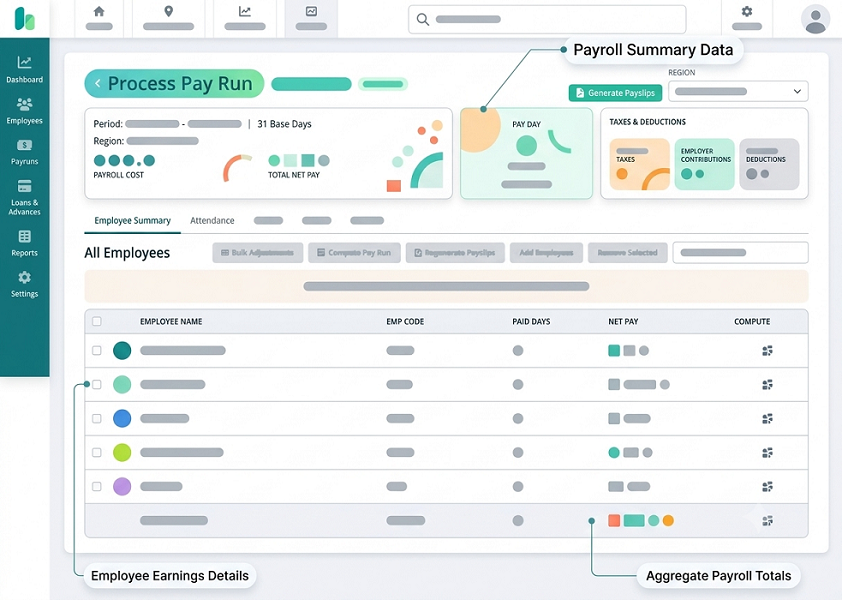
Payroll software can help by connecting employee records, attendance, leave balances, compensation structures, and final settlement calculations.
Useful capabilities include:
- Automatic calculation of salary through the final employment date.
- Configurable proration rules.
- Basic salary and allowance breakdowns.
- Leave balance reconciliation.
- End-of-service benefit calculations.
- Notice-period and approved overtime processing.
- Validation of proposed deductions.
- Settlement approval workflows.
- Final payslip and payment records.
- Alerts for approaching settlement deadlines.
Automation reduces repetitive work, but it does not replace legal review or HR approval. Payroll teams should validate the rules configured for each employee category and investigate unusual cases before releasing payment.
11. Maintain Records for Audits and Employee Queries
Final salary records should explain how the employer arrived at the settlement amount.
Maintain the relevant documentation, including:
- Resignation or termination confirmation.
- Employment contract and salary history.
- Confirmed final employment date.
- Attendance and approved absence records.
- Leave accrual and utilisation history.
- Salary proration calculations.
- Gratuity or alternative scheme calculations, where applicable.
- Notice-period arrangements.
- Approved deductions and supporting records.
- Final settlement statement and payment confirmation.
An audit trail helps HR respond to employee queries, resolve discrepancies, and demonstrate that the company followed its approved process.
Retention periods should be based on applicable legal requirements, contractual obligations, and legitimate business needs.
Frequently Asked Questions
1. How do UAE employers calculate salary when an employee leaves mid-month?
Employers calculate the salary payable through the final employment date using the applicable contract, approved payroll method, and relevant legal requirements. The calculation should reflect the eligible period and salary components.
2. Is the salary always divided by 30 when an employee leaves mid-month?
Not necessarily. Employers should verify the appropriate calculation method for their circumstances and apply it consistently. A 30-day divisor should not be assumed to be universally mandatory.
3. Is unused annual leave included in the final settlement?
Eligible unused annual leave is generally payable when employment ends under the UAE private-sector framework. Payroll should verify the accrued balance and calculate the payment according to the applicable rules.
4. Does every departing employee receive end-of-service gratuity?
No. Eligibility depends on the employee's category, length of service, contract, and applicable benefits regime. For example, the general private-sector gratuity rules for eligible expatriate employees normally require at least one year of continuous service.
5. When must UAE employers pay the final settlement?
Under the general private-sector framework, wages and other applicable entitlements must generally be paid within 14 days of the employment contract ending. Employers should verify the rules applicable to their establishment and employee category.
6. Can employers deduct outstanding loans from the final salary?
A deduction should not be made automatically. The employer should verify the legal basis, applicable restrictions, and supporting documentation before making any deduction from final wages or other entitlements.
7. Can payroll software calculate the entire final settlement automatically?
Software can automate many calculations and combine salary, leave, attendance, and benefit data. However, the final result should be reviewed for legal eligibility, contractual terms, approved deductions, and exceptions before payment.
Conclusion
Calculating salary for employees leaving mid-month requires accurate employment dates, a consistent salary proration method, reconciled attendance, correct unused-leave calculations, and a review of applicable end-of-service benefits and notice-related payments.
For UAE employers, the process should also include a clear settlement statement, appropriate approval controls, and timely payment under the applicable rules.
Payroll software can reduce manual calculations and improve recordkeeping, but accurate settlements depend on verified employee data and correctly configured policies. By standardising the final payroll process, UAE businesses can reduce disputes, improve employee confidence, and manage employee exits more efficiently.
When an employee leaves mid-month, InnBuilt Payroll Software can bring together final working dates, approved attendance, leave and deductions so UAE HR can review the last payslip.