When Should UAE Employers Choose Mobile Face Attendance Over Kiosks?
When Should UAE Employers Choose Mobile Face Attendance Over Kiosks?
UAE employers have several options for recording employee attendance, including biometric kiosks, desktop terminals, and mobile face attendance. The right option depends largely on where employees work and how frequently they move between locations.
A fixed kiosk can work well for employees who report to the same workplace every day. Mobile face attendance can be more practical for field employees, remote teams, contractors, and workers who move between different sites.
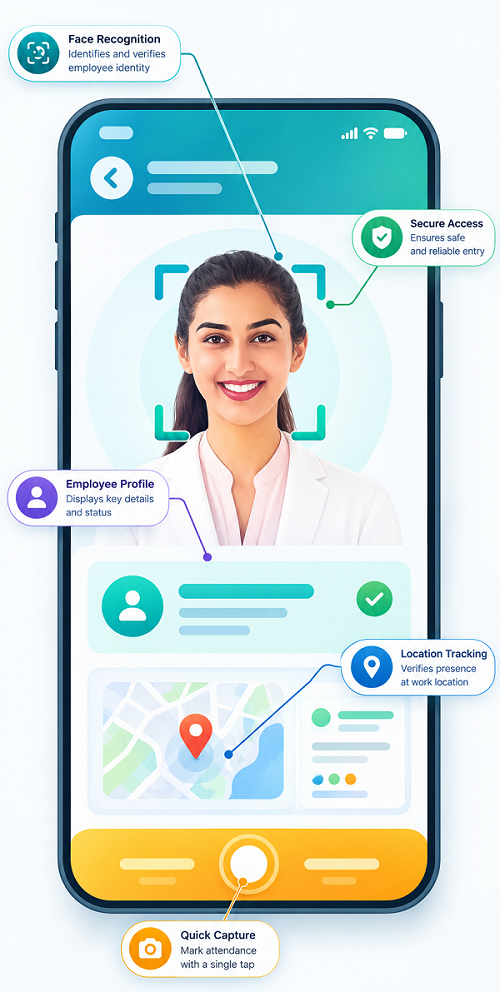
What Is Mobile Face Attendance?
Mobile face attendance uses a smartphone or tablet camera to verify an employee's identity and record attendance.
Instead of employees visiting a fixed biometric terminal, they can use an approved mobile application to record their attendance from an authorized location.
A typical process is:
Employee opens attendance app → Face is verified → Location or attendance conditions are checked → Attendance is recorded
The exact verification features depend on the software and employer's configuration.
When Is Mobile Face Attendance Better Than a Kiosk?
1. Employees Work Across Multiple Locations
Mobile attendance can be useful when employees do not report to the same office every day.
Examples include:
- Sales representatives
- Field technicians
- Maintenance teams
- Delivery personnel
- Construction supervisors
- Project employees
- Service engineers
Employees can potentially record attendance from authorized work locations without requiring a separate kiosk at every site.
2. Employees Work at Temporary Project Sites
Construction and infrastructure companies frequently establish temporary worksites.
Installing a permanent kiosk at every short-term location may not be practical.
A mobile solution can allow authorized employees to record attendance using a company-approved device or mobile application, subject to the organization's location and security controls.
This can reduce hardware requirements when employees move between projects.
3. Remote Employees Need Attendance Tracking
For employees working remotely, a kiosk is obviously impractical.
Mobile attendance can allow organizations to implement an attendance process for approved remote-working arrangements.
HR can configure:
- Working schedules
- Remote-working days
- Attendance windows
- Approval requirements
- Location restrictions, where appropriate
The employer should clearly communicate what information is collected and why.
4. Contractors Move Between Sites
Contractors and outsourced workers may work at different UAE locations during a project.
Mobile attendance can help authorized contractors record attendance without requiring the employer to install permanent hardware at every location.
However, employers should carefully define who is authorized to use the system and how contractor information is handled.
5. The Workforce Is Highly Mobile
Mobile face attendance may be particularly useful when employees spend much of their working day away from a central office.
For example, a service technician may visit several customer locations during the day. A fixed kiosk would only capture attendance at the company's office.
A mobile system can provide a more practical way to record attendance at approved work locations.
6. The Company Operates Many Small Branches
Installing and maintaining a biometric kiosk at every small branch can increase hardware and maintenance costs.
For organizations with many smaller locations, mobile attendance can reduce the need for physical attendance terminals.
However, employers should compare the total cost of mobile devices, software subscriptions, security controls, and administration before making a decision.
When Is a Kiosk Better?
Mobile attendance is not always the best solution.
A fixed kiosk may be more appropriate when:
- Employees work at one location.
- Large numbers of employees arrive at the same time.
- The organization wants a controlled entry point.
- Employees have limited access to smartphones.
- The workplace has strict device policies.
- A dedicated attendance terminal is easier to manage.
Factories, warehouses, offices, and large construction-site entrances may benefit from fixed attendance terminals.
Mobile Face Attendance vs. Kiosk
| Factor | Mobile Face Attendance | Fixed Kiosk |
|---|---|---|
| Location | Flexible | Fixed |
| Hardware | Smartphone/tablet | Dedicated terminal |
| Field employees | Highly suitable | Less suitable |
| Office employees | Suitable | Highly suitable |
| Temporary worksites | Suitable | May require installation |
| Remote employees | Suitable | Not practical |
| Large employee groups | Depends on device/network capacity | Suitable |
| Multiple locations | Easy to deploy | Requires multiple devices |
| Internet dependency | Usually important | Depends on device |
| Site control | Requires configuration | Strong physical control |
Consider Security and Privacy
Face attendance involves biometric information, so UAE employers should consider applicable privacy and data-protection requirements before implementing mobile facial recognition.
Organizations should evaluate:
- What facial information is collected
- Where it is stored
- Who can access it
- How it is secured
- Whether a third-party provider processes it
- How long it is retained
- What happens when an employee leaves
Mobile attendance should also include appropriate controls to reduce unauthorized attendance from outside approved locations.
Use Location Controls Carefully
Depending on the system, employers may use GPS, geofencing, or other location-verification features alongside face recognition.
For example, an organization may configure attendance so that employees can only record attendance within an approved project area.
However, location tracking raises additional privacy considerations. Employers should clearly define the purpose and scope of any location data collection and comply with applicable requirements.
Consider a Hybrid Approach
Many UAE organizations do not need to choose only one technology.
A hybrid model can be more practical:
- Office employees → Face kiosk
- Field employees → Mobile face attendance
- Construction sites → Site kiosk or approved mobile attendance
- Remote employees → Approved mobile attendance
This allows HR to use the appropriate attendance method for different employee groups while managing the information through one centralized system.
Connect Mobile Attendance With Payroll
Mobile attendance becomes more useful when connected with HR and payroll software.
The process can be:
Mobile Face Verification → Attendance → Working Hours → Leave/Ongoing Approval → Payroll
HR can review attendance exceptions before approved data is transferred into payroll.
This can reduce manual timesheet entry and help improve payroll accuracy.
Conclusion
UAE employers should consider mobile face attendance when employees work across multiple locations, temporary project sites, customer locations, or approved remote environments. It provides greater flexibility than a fixed kiosk and can be easier to deploy across a distributed workforce.
Kiosks remain useful for offices, factories, warehouses, and other locations where employees enter through a controlled, fixed point.
For many organizations, the most practical solution is a hybrid attendance strategy, combining fixed face-recognition kiosks for permanent workplaces with mobile face attendance for field and mobile employees. Whatever approach is selected, employers should also address biometric privacy, security, location controls, and applicable UAE requirements.
A moving workforce may need a different check-in method from a fixed branch. InnBuilt Face Attendance Software can help UAE employers compare mobile and kiosk setups by location and supervision needs.