How to Compare Payroll Software Vendors for UAE Businesses: A Buyer’s Checklist
How to Compare Payroll Software Vendors for UAE Businesses: A Buyer’s Checklist
Introduction
Choosing payroll software is an important decision for businesses operating in the United Arab Emirates (UAE). The right solution can simplify salary processing, reduce administrative work, improve payroll accuracy, and help organisations manage applicable employment and payment requirements. However, selecting the right software also means selecting a reliable vendor that understands the UAE payroll environment and can support the organisation as it grows.
Payroll software vendors may offer similar features but differ significantly in their UAE compliance capabilities, Wage Protection System (WPS) support, implementation services, integration options, data security, pricing, and customer support.
For example, one vendor may provide strong salary calculation features but require additional customisation for WPS file generation. Another may offer WPS support but lack flexible end-of-service benefit calculations or integration with the company's existing attendance system.
Comparing vendors based only on price or product demonstrations can therefore lead to an unsuitable purchasing decision.
UAE businesses should follow a structured evaluation process that examines both the software and the vendor behind it. This buyer's checklist explains how to compare payroll software vendors, what questions to ask, which features to test, and how to make a final selection.
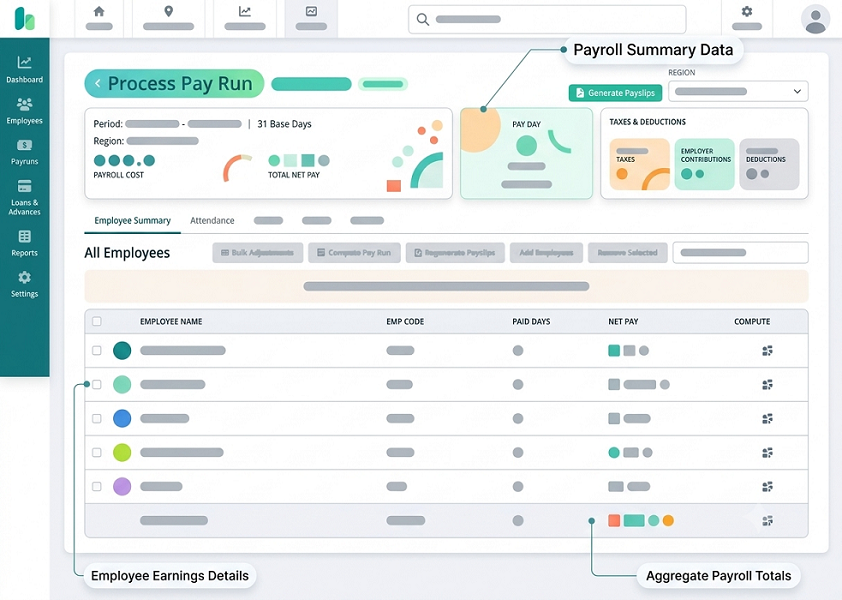
1. Define Your Business Payroll Requirements Before Comparing Vendors
Before contacting payroll software vendors, identify the organisation's payroll requirements. Without a clear understanding of internal needs, it can be difficult to determine whether a vendor's solution is suitable.
Start by reviewing the organisation's current payroll process and identifying operational challenges.
Consider the following areas:
- Number of employees currently on the payroll.
- Number of legal entities and business locations.
- Mainland or free-zone establishment requirements.
- Employee categories and contract arrangements.
- Monthly, hourly, daily, and variable salary structures.
- Allowances, incentives, commissions, and deductions.
- Overtime and attendance-related adjustments.
- Leave and absence management.
- WPS processing requirements.
- End-of-service benefits and final settlements.
- Payroll reporting and accounting requirements.
- Existing HRMS, attendance, and ERP applications.
For example, a small UAE business with 20 employees may need basic salary calculations, payslip generation, and WPS file preparation. A large organisation with 1,000 employees across several locations may require multi-entity payroll, advanced approval workflows, accounting integration, and detailed reporting.
The requirements should be documented before requesting vendor quotations.
Buyer's checklist:
- Have we identified our current employee count?
- Have we documented all salary components?
- Have we identified our applicable payroll and WPS requirements?
- Have we listed the systems that must integrate with payroll?
- Have we identified our reporting and approval requirements?
- Have we considered future workforce growth?
A clear requirements document helps vendors provide comparable proposals and prevents businesses from purchasing unnecessary features.
2. Compare UAE Payroll Compliance Capabilities
UAE payroll requirements should be a major part of the vendor evaluation process. Employers need software that supports their applicable payroll calculations and employment administration requirements.
When comparing vendors, check whether their platforms support:
- UAE employment-related payroll rules.
- Basic salary and allowance management.
- Overtime calculations.
- Paid and unpaid leave adjustments.
- Salary revisions and arrears.
- Employee joining and termination calculations.
- End-of-service benefit calculations.
- Final settlement processing.
- Payroll record maintenance.
- Configurable approval procedures.
Do not rely on general statements such as "UAE compliant" or "supports local payroll." Ask the vendor to explain precisely which requirements are covered and which need manual intervention or custom development.
For example, request a demonstration of how the software calculates an employee's final settlement. The vendor should explain which employee details, salary information, service dates, and applicable rules are used.
Also check how the vendor handles regulatory changes. Payroll calculations may need updates when applicable employment rules or administrative requirements change.
Questions to ask vendors:
- Which UAE payroll requirements does your software support?
- How are regulatory updates incorporated into the platform?
- Can payroll rules be configured for different employee categories?
- Does the software maintain historical salary information?
- Can it generate detailed calculation records for review?
- Which calculations require manual intervention?
Important: Payroll software can support compliance, but it does not automatically guarantee legal compliance. Employers should verify the applicable rules and review the vendor's calculation methodology.
3. Evaluate WPS File Generation and Salary Payment Support
The Wage Protection System is an important consideration for many UAE employers. Businesses should verify whether the payroll platform can support the relevant WPS processes for their establishment and payment arrangements.
A suitable system should help prepare salary information, validate employee payment details, and generate the required files in the supported format.
Compare vendors based on the following capabilities:
| WPS feature | What to evaluate |
|---|---|
| Salary file generation | Can the system prepare the required WPS file? |
| File format | Does it support the applicable format and requirements? |
| Employee bank details | Can payment information be maintained and validated? |
| Salary validation | Can missing or incorrect information be identified? |
| Payroll reconciliation | Can salary totals be checked against payroll records? |
| Error handling | Can users identify and correct file-generation issues? |
| File history | Are previously generated files stored securely? |
| Payment tracking | Can payment status be recorded or reconciled? |
Ask vendors to demonstrate the complete process, from payroll approval to WPS file generation.
For example, ask the vendor to create a sample payroll for 50 employees, generate the relevant salary file, and demonstrate how the system identifies an employee with incomplete bank details.
Also confirm whether the vendor provides support when files are rejected or require correction.
Questions to ask vendors:
- Does your software support WPS file generation?
- Which UAE authorities, banks, and payment channels are supported?
- Can the system validate employee payment details?
- Does it identify discrepancies before file generation?
- Are WPS-related product updates included in the subscription?
- Is technical assistance available for rejected files?
Businesses should verify that the solution supports their particular establishment and applicable WPS arrangements rather than assuming that one configuration works for every organisation.
4. Compare Salary Structure and Payroll Calculation Flexibility
Different UAE businesses use different salary structures. A payroll platform should be flexible enough to handle employee-specific salary arrangements without requiring repeated manual adjustments.
Compare how each vendor handles:
Salary components
- Basic salary.
- Housing allowance.
- Transport allowance.
- Communication allowance.
- Other fixed allowances.
- Variable allowances.
- Commissions and incentives.
Payroll calculations
- Monthly and hourly salaries.
- Daily wage calculations.
- Mid-month joining and exit calculations.
- Unpaid leave adjustments.
- Overtime payments.
- Salary revisions.
- Retroactive adjustments.
- Recurring and one-time deductions.
For example, a sales employee may receive a fixed monthly salary and a performance-based commission, while an office employee may receive a fixed salary with housing and transport allowances.
The payroll software should calculate both arrangements using configurable rules.
It should also maintain salary history so authorised users can identify previous salary components and effective dates.
Vendor comparison checklist:
- Supports multiple salary structures.
- Allows employee-specific allowances.
- Supports fixed and variable payments.
- Calculates overtime using configurable rules.
- Handles unpaid leave and attendance adjustments.
- Supports salary revisions with effective dates.
- Maintains historical payroll information.
- Provides a detailed gross-to-net salary breakdown.
During the demonstration, ask vendors to configure two employees with different salary structures and process a sample payroll for both.
5. Assess End-of-Service Benefits and Final Settlement Features
Employee exit processing is an important part of payroll administration. Employers may need to calculate outstanding salary, eligible leave encashment, applicable end-of-service benefits, and other settlement amounts.
A payroll vendor should demonstrate how its software manages the employee exit process.
Look for features such as:
- Employee joining and termination date records.
- Salary history.
- Service period calculations.
- Applicable end-of-service benefit calculations.
- Leave balance and encashment.
- Notice-period adjustments.
- Approved deductions.
- Final settlement statements.
- Settlement approval workflows.
- Historical settlement records.
For example, when an employee resigns, the HR team should be able to initiate an exit process and review the employee's outstanding payroll components.
The system should display the calculations clearly so authorised users can verify the settlement before approval.
Do not assume that every employee follows the same benefit arrangement. Applicable calculations may depend on employment terms, service period, termination circumstances, and the relevant legal or alternative savings framework.
Questions to ask vendors:
- Does the software support UAE end-of-service benefit calculations?
- Can different employment and benefit arrangements be configured?
- Does it use historical salary information where required?
- Can HR review the calculation before final approval?
- Can the system generate a detailed final settlement statement?
- Does it retain completed employee exit records?
A vendor that can demonstrate the complete final settlement process is generally better positioned to support businesses with regular employee movements.
6. Check Integration with HRMS, Attendance, Accounting, and ERP Systems
Payroll depends on information from several business functions. If employee information, attendance records, and financial entries are maintained in separate applications, manual data transfer can increase administrative work and the risk of errors.
Compare the integration capabilities of each payroll vendor.
| Integration | Information exchanged | Business benefit |
|---|---|---|
| HRMS | Employee details, joining dates, salary revisions, and termination records | Reduces duplicate employee data entry |
| Attendance software | Working hours, overtime, absence, and leave adjustments | Improves payroll input accuracy |
| Accounting software | Salary expenses, liabilities, and payroll journal entries | Simplifies financial reconciliation |
| ERP systems | Cost centres, departments, projects, and financial information | Supports organisation-wide reporting |
| Banking and payment systems | Salary payment information and transaction records | Streamlines supported payment processes |
| Expense management | Approved reimbursements and employee claims | Reduces manual payment adjustments |
Ask whether the integration is available through a standard connector, API, file import, or custom development.
For example, a company may use a separate attendance application to track employee working hours. The payroll software should be able to receive approved attendance information and apply the appropriate payroll adjustments.
Questions to ask vendors:
- Which HRMS and attendance systems do you integrate with?
- Are standard APIs available?
- Can employee records synchronise automatically?
- How frequently does data synchronisation occur?
- How are duplicate or incorrect records handled?
- Are integration costs included in the quotation?
- Can the system maintain a record of failed synchronisations?
Do not evaluate integration based only on whether a vendor claims to offer an API. Ask for a demonstration using the applications your business actually uses.
7. Evaluate Employee Self-Service and Mobile Features
Employee self-service capabilities can reduce routine requests to HR and improve employee access to payroll information.
When comparing vendors, check whether employees can securely access:
- Monthly payslips.
- Salary breakdowns.
- Previous payroll statements.
- Leave balances.
- Salary certificates.
- Payroll-related documents.
- Personal information.
- Bank account details.
- Payroll query or correction requests.
The system should also support mobile access, particularly for businesses with employees working across multiple offices, retail outlets, project locations, and field operations.
For example, an employee working outside the head office may need to download a payslip or review salary payment details. A mobile-friendly portal makes it possible to access the information without contacting HR.
Check whether the platform provides separate access permissions for employees, managers, HR administrators, and finance teams.
Questions to ask vendors:
- Does the software include an employee self-service portal?
- Can employees access payslips through mobile devices?
- Can employees submit personal information updates?
- Are payroll queries managed through the portal?
- Can managers approve employee requests?
- Does the platform support multiple languages?
- Can access be restricted according to user roles?
During the demonstration, ask the vendor to show both the employee and administrator experiences.
8. Compare Payroll Reporting, Analytics, and Audit Trails
Payroll reporting helps businesses monitor salary expenses, identify unusual changes, and maintain financial records.
A good payroll platform should offer standard reports as well as configurable reporting options.
Compare vendors based on the availability of:
| Report | What it helps businesses monitor |
|---|---|
| Payroll summary | Total salary expenses for each payroll period |
| Employee salary register | Employee-wise salary details |
| Payslip report | Individual salary breakdowns |
| Allowance report | Fixed and variable salary components |
| Deduction report | Payroll deductions and adjustments |
| Overtime report | Approved overtime hours and payments |
| Leave adjustment report | Payroll impact of employee leave |
| WPS report | Salary payment information and file records |
| End-of-service report | Applicable employee benefit calculations |
| Payroll variance report | Changes between payroll periods |
| Department-wise report | Salary expenses across departments |
Audit trails are equally important. A payroll system should record changes to salary information, employee records, and payroll transactions.
For example, if an administrator modifies an employee's salary, the system should record the change, the effective date, and the user responsible for the modification.
Questions to ask vendors:
- Can payroll reports be filtered by department and location?
- Does the platform provide month-to-month payroll comparisons?
- Can reports be exported to Excel or PDF?
- Does it maintain user activity logs?
- Can historical payroll data be retrieved?
- Can reporting access be restricted by user role?
A vendor with strong reporting and audit functionality can help HR and finance teams improve payroll visibility and internal controls.
9. Review Data Security, Privacy, and Hosting Arrangements
Payroll systems store confidential information such as employee salaries, bank account details, identification records, and employment information.
Businesses should therefore assess the vendor's data protection and security arrangements before signing a contract.
Important features to compare include:
- Role-based access controls.
- Multi-factor authentication.
- Encryption during transmission and storage.
- Secure employee login.
- User activity logs.
- Regular backups.
- Disaster recovery arrangements.
- Data retention and deletion controls.
- Secure document storage.
- Incident response procedures.
Employers should also ask where the payroll data is hosted and whether it is transferred or accessed from other countries.
The UAE Personal Data Protection Law (Federal Decree-Law No. 45 of 2021) is relevant to many organisations processing personal data in the UAE, subject to its scope and exclusions. Businesses operating in the DIFC and ADGM should also consider their respective data protection frameworks.
Request relevant security documentation and review contractual provisions covering confidentiality, data processing, subcontractors, international data transfers, and security incidents.
Questions to ask vendors:
- Where is employee payroll data hosted?
- Is data encrypted during transmission and storage?
- Does the platform support multi-factor authentication?
- Can access be restricted according to job responsibilities?
- How frequently are backups performed?
- What disaster recovery arrangements are available?
- How does the vendor handle security incidents?
- Can the organisation retrieve or securely delete its data when the contract ends?
Do not rely only on general claims such as "enterprise-grade security." Ask for documentation that explains the actual controls.
10. Compare Vendor Experience, Implementation, and Customer Support
The software itself is only one part of the purchasing decision. The vendor's experience, implementation approach, and ongoing support can significantly affect the success of a payroll project.
A suitable vendor should understand the organisation's payroll requirements and provide assistance throughout the implementation process.
Evaluate the following areas.
Vendor experience
- Experience supporting UAE businesses.
- Knowledge of relevant payroll and WPS processes.
- Experience with similar employee counts and industries.
- Availability of customer references.
- Track record of product updates.
Implementation services
- Initial system configuration.
- Employee data migration.
- Salary structure setup.
- Payroll rule configuration.
- Integration with existing systems.
- User acceptance testing.
- Payroll administrator training.
- Go-live support.
Customer support
- Support availability and operating hours.
- Response and resolution targets.
- Dedicated account management.
- Technical troubleshooting.
- Payroll processing support.
- Product documentation.
- Regular training and updates.
For example, a business migrating from spreadsheets to payroll software may need help transferring employee information, configuring salary structures, validating opening leave balances, and testing the first payroll cycle.
Ask the vendor to provide a realistic implementation plan with responsibilities, timelines, deliverables, and charges.
Questions to ask vendors:
- How many UAE businesses currently use your payroll platform?
- Have you implemented the software for organisations similar to ours?
- Do you provide dedicated implementation support?
- How long does a typical implementation take?
- What training is included?
- What are your support response and resolution targets?
- Is ongoing regulatory and product support included?
A reliable vendor should be able to explain the complete customer journey, from initial configuration to ongoing payroll operations.
11. Compare Pricing and Total Cost of Ownership
Payroll software quotations can differ considerably. One vendor may offer a low monthly subscription but charge separately for implementation, integration, support, and additional modules.
Another vendor may offer a higher subscription that includes several of these services.
Businesses should therefore compare the total cost of ownership rather than focusing only on the advertised licence price.
Common pricing models include:
- Per-employee monthly subscription.
- Per-employee annual subscription.
- Fixed monthly or annual packages.
- Custom enterprise pricing.
- One-time software licence with maintenance fees.
Evaluate these cost components:
| Cost component | What to verify |
|---|---|
| Subscription | Monthly or annual software charges |
| Employee licences | Whether inactive or temporary employees are chargeable |
| Implementation | Initial configuration and setup costs |
| Data migration | Employee and historical payroll data transfer charges |
| Integrations | HRMS, attendance, accounting, and ERP connection fees |
| Training | Administrator and employee training costs |
| Support | Included support and premium service charges |
| Customisation | Additional payroll rules and report development |
| Hosting | Additional hosting or storage fees |
| Upgrades | Whether updates are included |
| Contract renewal | Price increases and renewal conditions |
Request a quotation for the same employee count, feature set, implementation scope, and support requirements from every vendor.
Example: Comparing total payroll software costs
Assume a business with 100 employees receives the following hypothetical annual quotations:
| Cost component | Vendor A | Vendor B |
|---|---|---|
| Annual subscription | AED 12,000 | AED 15,000 |
| Implementation | AED 3,000 | Included |
| Data migration | AED 1,500 | AED 1,000 |
| Integration | AED 2,000 | AED 1,000 |
| Training | AED 1,000 | Included |
| First-year total | AED 19,500 | AED 17,000 |
In this example, Vendor A has a lower subscription price, but Vendor B has a lower first-year total cost.
These figures are illustrative only and do not represent actual UAE market quotations. VAT and any other applicable charges should be checked separately.
Questions to ask vendors:
- What is included in the subscription?
- Are implementation and migration charged separately?
- Are integrations included?
- Are there additional employee licence charges?
- What happens when the employee count increases?
- Are annual price increases specified in the contract?
- What are the renewal and cancellation terms?
- Can payroll data be exported when the contract ends?
12. Conduct a Payroll Software Pilot Before Making a Decision
A product demonstration shows what the system can do, but a pilot helps determine whether it works with the organisation's actual payroll data and processes.
Before signing a long-term agreement, request a trial or controlled pilot where possible.
The pilot should involve representative employees, salary structures, attendance information, and payroll scenarios.
Recommended pilot tests:
- Add employees with different salary structures.
- Import employee information from the existing HR system.
- Process a sample monthly payroll.
- Test salary revisions and allowances.
- Enter approved overtime and unpaid leave.
- Generate sample payslips.
- Prepare a WPS file where applicable.
- Test an employee final settlement.
- Generate payroll and accounting reports.
- Review user permissions and audit trails.
Compare the software's output with verified calculations from the organisation's existing payroll process.
Also ask the HR and finance teams to provide feedback on usability, processing time, error handling, and report quality.
A pilot can reveal practical limitations before the organisation commits to implementation.
UAE Payroll Software Vendor Comparison Scorecard
A structured scorecard helps businesses compare multiple vendors using the same criteria. Assign a score from 1 to 5 for each category.
- 1: Poor – Does not meet the requirement.
- 2: Below expectations – Significant limitations.
- 3: Acceptable – Meets basic requirements.
- 4: Good – Meets most requirements.
- 5: Excellent – Fully meets requirements with strong supporting capabilities.
The following scorecard uses suggested evaluation weights. Businesses can adjust the weights according to their priorities.
| Evaluation category | Suggested weight | Vendor A | Vendor B | Vendor C |
|---|---|---|---|---|
| UAE payroll compliance | 15% | |||
| WPS support | 15% | |||
| Salary and overtime calculations | 10% | |||
| End-of-service benefits | 10% | |||
| HRMS and accounting integration | 10% | |||
| Employee self-service | 5% | |||
| Reporting and audit trails | 10% | |||
| Data security and privacy | 10% | |||
| Implementation and support | 10% | |||
| Total cost of ownership | 5% | |||
| Total | 100% |
How to Calculate the Weighted Score
Multiply each category's weight by the vendor's score and divide by 5.
For example, if a vendor scores 4 out of 5 for WPS support and the category weight is 15%, its weighted contribution is:
4 ÷ 5 × 15 = 12 points.
Add the weighted contributions from all categories to obtain the vendor's final score out of 100.
A higher score can help identify the stronger overall proposal, but businesses should also review critical requirements individually. A vendor with a high overall score should not be selected if it fails a mandatory WPS, security, or payroll calculation requirement.
Conclusion
Comparing payroll software vendors for UAE businesses requires more than reviewing product features and subscription prices. Employers should evaluate each vendor's understanding of UAE payroll requirements, WPS capabilities, salary calculation flexibility, end-of-service benefit support, integration options, reporting, data security, implementation services, and customer support.
The most effective approach is to prepare a requirements document, shortlist suitable vendors, request structured demonstrations, test real payroll scenarios, and compare quotations using a weighted scorecard.
Businesses should also assess the vendor's ability to support future growth, additional legal entities, changing payroll requirements, and new integrations.
By following a consistent buyer's checklist, UAE organisations can select a payroll software vendor that offers reliable technology, practical implementation support, transparent pricing, and long-term value.
Build a scorecard covering pay-run controls, employee self-service, data access and total cost. Ask InnBuilt and other UAE payroll vendors to prove each priority with sample records.