How Accurate Is Real-Time GPS Tracking in UAE Cities, Buildings, and Remote Sites?
How Accurate Is Real-Time GPS Tracking in UAE Cities, Buildings, and Remote Sites?
Real-time GPS tracking has become an important technology for UAE businesses that manage field employees, delivery drivers, technicians, construction workers, sales representatives, and mobile service teams. It allows managers to monitor employee locations, coordinate field activities, verify site visits, and improve workforce visibility.
However, GPS tracking accuracy is not the same in every environment. A tracking application may show an employee's location with reasonable precision on an open road but provide less accurate information inside a high-rise building, underground parking area, warehouse, or remote worksite.
In the UAE, businesses operate across different environments, including densely developed cities such as Dubai and Abu Dhabi, industrial areas, large construction projects, highways, desert locations, and remote infrastructure sites. Each environment can affect GPS signals and the frequency of location updates.
Understanding these differences is essential when selecting live employee tracking software. Businesses should know what level of accuracy to expect, which factors influence location information, and how to evaluate a vendor's tracking capabilities before implementation.
This article explains how accurate real-time GPS tracking can be in UAE cities, buildings, and remote sites, what limitations businesses should consider, and how to improve tracking reliability.
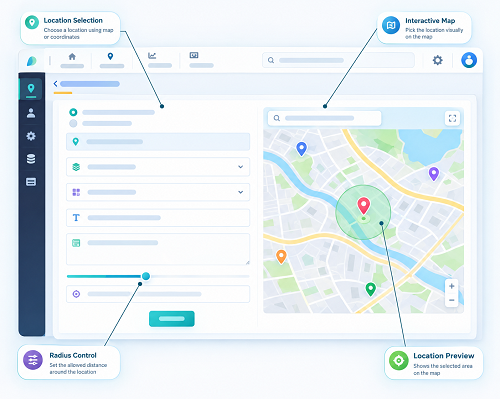
1. Understanding Real-Time GPS Tracking Accuracy
GPS tracking uses signals from satellites to estimate the location of a mobile device. Employee tracking applications generally use a smartphone's location services, which may combine information from several sources, including:
- Global Navigation Satellite Systems (GNSS), including GPS.
- Wi-Fi positioning.
- Mobile network and cell tower information.
- Device sensors and movement data.
- Assisted GPS (A-GPS) technologies.
The application uses the available location information to display an employee's approximate position on a digital map.
GPS accuracy is commonly discussed in terms of the distance between the reported location and the device's actual position. For example, if a device reports a location within 5 metres of its actual position, the location error is approximately 5 metres.
However, businesses should not assume that every location update will have the same accuracy. Actual performance depends on satellite visibility, device hardware, network availability, surrounding structures, software configuration, and environmental conditions.
It is also important to distinguish between two concepts:
Location accuracy: How close the reported position is to the employee's actual location.
Location update frequency: How often the application sends or refreshes the employee's location on the manager's dashboard.
A system may provide reasonably accurate location information but update it less frequently. Another platform may refresh locations frequently but display inaccurate positions in areas with poor signal conditions.
Both factors should be evaluated when choosing employee tracking software.
2. How Accurate Is GPS Tracking in UAE Cities?
GPS tracking generally performs better in open outdoor environments where mobile devices have a clear view of the sky. In UAE cities, however, surrounding buildings and infrastructure can influence signal reception.
Dubai
Dubai has a combination of high-rise commercial buildings, residential towers, highways, shopping centres, industrial zones, and densely developed neighbourhoods.
GPS tracking can work effectively on open roads and outdoor locations, but tall buildings may obstruct or reflect satellite signals. This can cause location errors known as multipath effects, where signals reach the device after reflecting off nearby surfaces.
Businesses using tracking software in Dubai should test:
- Employee location updates along major roads.
- Tracking around high-rise commercial buildings.
- Location consistency near shopping malls.
- GPS performance in parking areas.
- Geofence accuracy around office and customer locations.
For example, a delivery driver travelling along an open road may appear accurately on the map, while the same device may show a less reliable position when entering a densely developed commercial area.
Abu Dhabi
Abu Dhabi includes business districts, residential areas, industrial locations, large infrastructure projects, and extensive road networks.
GPS performance may vary depending on the surrounding structures and whether employees are working outdoors or inside buildings.
Companies managing technicians, inspection teams, and field service employees should test location accuracy across different types of work locations rather than relying on a single demonstration site.
Sharjah and Other Emirates
Businesses operating in Sharjah, Ajman, Ras Al Khaimah, Fujairah, and Umm Al Quwain may manage employees across urban areas, industrial zones, coastal locations, and less densely developed areas.
GPS tracking can perform well in open outdoor locations, but industrial structures, covered facilities, and indoor work environments can affect location precision.
For organisations operating across multiple emirates, the tracking platform should provide consistent location records, clear timestamps, and reliable reporting regardless of the employee's assigned location.
3. GPS Accuracy Inside High-Rise Buildings
GPS tracking is generally less reliable inside buildings because walls, roofs, concrete structures, metal surfaces, and other materials can weaken or obstruct satellite signals.
This is particularly relevant in the UAE, where employees may work inside high-rise offices, hotels, shopping centres, residential towers, and commercial complexes.
Common challenges include:
- Weak or unavailable satellite signals.
- Reflected signals from nearby buildings.
- Location updates that become delayed.
- Incorrect positioning on the outdoor map.
- Devices showing their last known outdoor location.
- Differences in accuracy between floors.
For example, a technician working on the 15th floor of a commercial building may not have a reliable GPS position inside the office. The tracking application might display an approximate position near the building entrance or the last location recorded outdoors.
Businesses should understand that standard GPS tracking does not automatically identify an employee's exact floor or room.
What Should Businesses Test?
During a software demonstration, ask the vendor to test the application in:
- An outdoor area near the building.
- The building entrance.
- An indoor office.
- A basement or underground parking area.
- Different floors, if indoor positioning features are available.
If precise indoor positioning is important, ask whether the platform supports additional technologies such as Wi-Fi positioning, Bluetooth beacons, or indoor positioning infrastructure.
4. GPS Tracking Accuracy in Warehouses and Industrial Facilities
Warehouses and industrial facilities can create challenges for standard GPS tracking because of enclosed spaces, metal structures, storage racks, machinery, and large roofs.
Employees working in logistics centres, manufacturing facilities, distribution warehouses, and industrial sites may experience inconsistent GPS updates.
For example, a warehouse supervisor may need to monitor employees moving between loading bays, storage areas, and dispatch sections. Standard outdoor GPS tracking may not provide the level of indoor precision required to identify their exact positions within the facility.
Businesses should evaluate whether they need:
- General outdoor location visibility.
- Entry and exit verification.
- Location-based attendance.
- Indoor positioning.
- Movement tracking within specific facility zones.
These requirements are different. GPS may be sufficient for verifying whether an employee arrived at a warehouse, but more specialised indoor positioning technology may be required to identify movement between internal sections.
5. GPS Tracking Accuracy at Construction Sites
Construction sites in the UAE often cover large areas and may contain cranes, temporary structures, metal equipment, unfinished buildings, machinery, and partially enclosed workspaces.
These conditions can influence GPS signal reception and create location inconsistencies.
Construction companies may use live tracking software to:
- Monitor employees arriving at project sites.
- Verify attendance at approved locations.
- Track supervisors and mobile teams.
- Monitor movement between project locations.
- Record site entry and exit events.
- Coordinate equipment and workforce deployment.
However, businesses should distinguish between site-level tracking and precise positioning within a construction site.
For example, GPS may be suitable for confirming that a worker is within a project site's general geographical boundary. It may not reliably identify whether the worker is standing near a particular crane, building entrance, or internal work zone.
Geofencing should therefore be configured with realistic boundaries that account for GPS variation.
6. GPS Accuracy at Remote and Desert Worksites
Remote locations and desert worksites can offer relatively open views of the sky, which may support good satellite signal reception. However, location accuracy is not guaranteed simply because an area has fewer buildings.
Remote tracking performance can also be affected by:
- Mobile network coverage.
- Smartphone GPS hardware.
- Device battery and power-saving settings.
- Environmental obstructions.
- Application background restrictions.
- Satellite availability and signal conditions.
- Frequency of location synchronisation.
A device may determine its position using satellite signals even when mobile internet connectivity is weak. However, the application may not be able to transmit that location to the manager's dashboard until a data connection becomes available.
This distinction is important for businesses operating in remote construction, oil and gas support, utilities, infrastructure maintenance, and field inspection activities.
During vendor evaluation, ask whether the application can temporarily store location records and synchronise them when connectivity returns.
7. Factors That Affect GPS Tracking Accuracy in the UAE
Several technical and environmental factors determine how accurately live tracking software can identify an employee's location.
7.1 Satellite Signal Visibility
GPS-enabled devices need signals from multiple satellites to calculate their position. When buildings, roofs, or other obstacles block these signals, the device may struggle to determine its exact location. Open outdoor environments generally provide better satellite visibility than enclosed spaces.
7.2 Tall Buildings and Signal Reflection
In densely developed areas, satellite signals may reflect off glass, concrete, and metal surfaces before reaching a smartphone. This can result in multipath errors, where the device calculates a position that differs from its actual location. This issue can be particularly relevant around high-rise buildings and commercial districts in Dubai and Abu Dhabi.
7.3 Smartphone Hardware
Not all smartphones have the same location capabilities. Differences in GNSS chipsets, antennas, supported satellite systems, and device design can affect tracking performance. Businesses should test the software on the actual devices employees use rather than relying exclusively on high-end smartphones supplied by the vendor.
7.4 Mobile Network Connectivity
GPS positioning and mobile internet connectivity perform different functions. Satellite signals help determine the device's location, while internet connectivity allows the application to transmit that information to the tracking dashboard. If mobile data connectivity is interrupted, the manager may not receive the latest location immediately, even if the device can still determine its position.
7.5 Background Application Restrictions
Smartphone operating systems may restrict background application activity to reduce battery consumption. If location permissions or background settings are configured incorrectly, tracking updates may become less frequent or stop when the application is not actively open. Businesses should check whether employees need to enable specific location permissions and background settings for reliable operation.
7.6 Battery-Saving Settings
Battery optimisation features can reduce the frequency of location updates or limit background processing. This may affect tracking consistency during long working shifts. Ask the vendor how the application manages battery consumption and whether administrators can configure tracking intervals according to operational requirements.
8. Typical GPS Accuracy Expectations by Environment
The following table provides a practical comparison of how GPS tracking may perform across different UAE working environments. These are general expectations, not guaranteed accuracy specifications for every device or software platform.
| Environment | Expected GPS performance | Common limitations |
|---|---|---|
| Open roads and highways | Generally good | Device quality and signal conditions |
| Open outdoor areas | Generally good | Satellite visibility and device capability |
| Densely built city areas | Variable | Signal reflection and tall buildings |
| High-rise buildings | Often limited indoors | Roofs, walls, and blocked signals |
| Shopping centres | Often limited indoors | Enclosed structures and signal reflection |
| Underground parking | Usually poor with standard GPS | Limited satellite visibility |
| Large warehouses | Often limited indoors | Metal structures and enclosed spaces |
| Construction sites | Variable | Temporary structures and equipment |
| Remote desert locations | Potentially good outdoors | Network coverage and device conditions |
A tracking vendor should explain the expected performance for each environment and demonstrate it under realistic conditions.
9. Difference Between GPS Accuracy and Geofencing Accuracy
GPS accuracy and geofencing performance are closely related, but they are not identical.
GPS accuracy describes how closely a device's reported position matches its actual position. Geofencing uses location information to determine whether the device is inside or outside a predefined geographical boundary.
For example, a company may create a geofence around a construction site in Abu Dhabi. When an employee enters the area, the system may record an entry event. However, if the GPS position fluctuates near the boundary, the system may incorrectly identify the employee as entering or leaving the site.
To reduce such problems, businesses should:
- Use geofence boundaries appropriate to the size of the worksite.
- Avoid excessively small geofences when using standard smartphone GPS.
- Test geofences at different points around the boundary.
- Check whether the system supports location accuracy thresholds.
- Review entry and exit event timestamps.
- Use administrator approval for disputed attendance records.
For large project sites, a broader geofence may be more practical than attempting to identify an employee's exact position within a small internal area.
10. Can GPS Tracking Identify an Employee's Exact Location?
Standard smartphone GPS tracking generally provides an estimated geographical position rather than guaranteed centimetre-level precision.
In favourable outdoor conditions, some devices may provide location estimates within a few metres. However, accuracy can become significantly worse in urban canyons, indoor spaces, underground parking areas, and other environments where satellite signals are obstructed or reflected.
Businesses should understand what their tracking software can and cannot verify.
| Business requirement | Is standard GPS usually sufficient? |
|---|---|
| Confirming an employee is near a worksite | Often, with an appropriately sized geofence |
| Monitoring movement along an outdoor route | Generally suitable |
| Checking arrival at a customer location | Often, subject to location accuracy |
| Identifying an exact office floor | No |
| Identifying a specific room inside a building | No |
| Tracking movement between warehouse shelves | Usually not |
| Verifying presence within a large construction site | Often, with suitable geofence settings |
| Identifying a precise indoor work zone | May require additional positioning technology |
If a business needs highly precise indoor positioning, it should consider specialised technologies rather than expecting standard GPS tracking to meet that requirement.
11. How to Improve GPS Tracking Accuracy for UAE Field Teams
Businesses can improve tracking reliability through appropriate device settings, software configuration, employee training, and regular system testing.
Use Compatible Smartphones
Choose devices with reliable location hardware and support for the satellite systems used by the tracking application. Test the software across the smartphone models deployed to employees.
Configure Location Permissions Correctly
Ensure that employees provide the location permissions required for the application to function during authorised working periods. Review background location settings and operating system restrictions.
Set Suitable Tracking Intervals
Location updates that are too frequent may increase battery consumption, while very long intervals may reduce operational visibility. Choose update frequencies based on job requirements. For example, a delivery operation may need more frequent updates than a field sales team that visits a small number of customer locations each day.
Use Appropriate Geofence Sizes
Geofences should reflect the actual dimensions of offices, warehouses, customer properties, and construction sites. Avoid boundaries that are too small for the expected GPS accuracy.
Enable Offline Data Storage Where Available
If the application supports offline tracking, configure it to retain permitted location records temporarily and synchronise them when connectivity returns.
Train Employees
Employees should understand how to use the tracking application, enable the required permissions, record attendance correctly, and report device or connectivity issues.
Monitor Tracking Exceptions
Managers should review missing updates, unusual location jumps, inaccurate geofence events, and delayed synchronisation. This helps identify whether the problem is related to the device, network, application, or configuration.
12. What Should UAE Businesses Test Before Purchasing GPS Tracking Software?
A vendor demonstration should include practical tests across different environments. A single outdoor demonstration is not enough to establish whether a platform will meet the organisation's requirements.
The following tests can help businesses evaluate the software.
| Test scenario | What to evaluate |
|---|---|
| Open outdoor location | GPS accuracy and update frequency |
| Busy urban area | Performance around tall buildings |
| Inside an office | Availability of indoor location information |
| Underground parking | Behaviour when GPS signals are unavailable |
| Warehouse | Location consistency in enclosed spaces |
| Construction site | Geofence accuracy and site-level tracking |
| Remote location | GPS positioning and data synchronisation |
| Weak network area | Handling of delayed location transmission |
| Long working shift | Battery consumption and background tracking |
| Multiple employees | Dashboard performance and location visibility |
Businesses should record the results of each test and compare them across shortlisted vendors.
A proof of concept involving a small group of actual field employees is particularly useful. It allows the company to assess how tracking performs during normal working activities rather than relying on controlled demonstrations.
Conclusion
Real-time GPS tracking can provide useful and reasonably accurate location information for UAE field teams, particularly when employees work outdoors with good satellite visibility. However, accuracy can vary significantly between open roads, densely developed city areas, high-rise buildings, warehouses, construction sites, and remote locations.
Dubai and Abu Dhabi's high-rise environments may create signal reflection and obstruction, while indoor facilities and underground parking areas can limit standard GPS performance. Remote outdoor locations may offer better satellite visibility, but mobile network availability can affect how quickly location records reach the tracking dashboard.
Businesses should distinguish between GPS positioning accuracy and location update frequency. They should also understand that standard GPS is generally more suitable for outdoor tracking and site-level verification than identifying an employee's exact indoor position.
Before purchasing live tracking software, UAE organisations should conduct practical tests using their employees' actual devices and working environments. They should evaluate location accuracy, geofencing, mobile connectivity, offline synchronisation, battery consumption, reporting, and data privacy.
Ultimately, the right tracking solution is one that provides reliable location information for the organisation's operational needs while clearly communicating its limitations and protecting employee information.
Check location accuracy around high-rises, indoor sites and low-signal areas before making performance promises. Pilot InnBuilt or a competing tracking app with representative UAE routes.