How Do Shift Scheduling Rules Affect Working Hours in the UAE?
How Do Shift Scheduling Rules Affect Working Hours in the UAE?
Shift scheduling plays an important role in managing working hours for UAE private-sector employees. Companies operating hospitals, hotels, security services, logistics, retail, manufacturing, customer support, and other 24/7 operations often use rotating, split, night, or flexible shifts.
Under the UAE Labour Law, employers must organize working hours and rest periods while complying with statutory limits. Federal Decree-Law No. 33 of 2021 generally establishes an ordinary working-hour limit of 8 hours per day or 48 hours per week, subject to the exceptions and rules provided by the legislation.
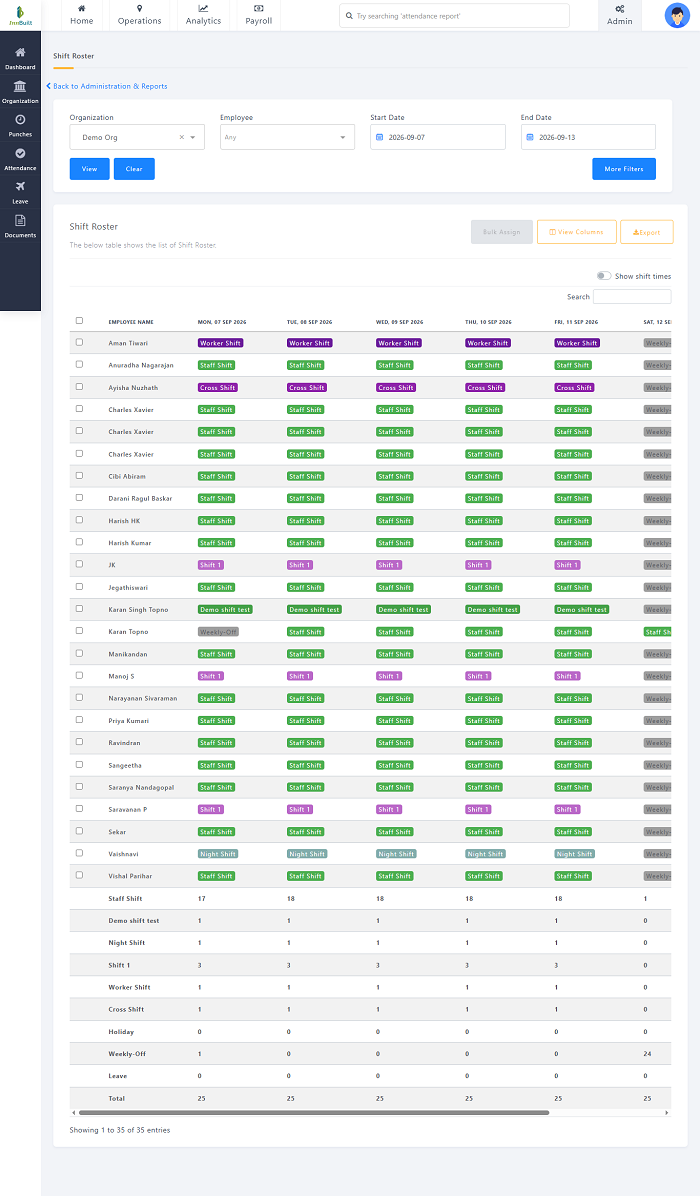
1. Shift Schedules Must Respect Working-Hour Limits
Employers should design rosters so that employees do not routinely exceed the applicable normal working-hour limits.
For example:
- Morning shift: 8:00 AM–4:00 PM
- Evening shift: 4:00 PM–12:00 AM
- Night shift: 12:00 AM–8:00 AM
A scheduling system can calculate the employee's total working hours across the week and highlight potential violations before the roster is published.
2. Breaks Should Be Included in Shift Planning
Employees generally cannot be required to work continuously for more than five consecutive hours without a break or breaks for rest, meals, or prayer, with the total break periods generally being at least one hour. The break periods are not ordinarily counted as working hours.
For example:
- Shift: 8:00 AM–5:00 PM
- Break: 1 hour
- Working time: 8 hours
Employers should configure attendance systems to distinguish paid working time from applicable break periods.
3. Weekly Working Hours Need to Be Monitored
A shift may appear compliant when viewed on its own but result in excessive weekly working hours when combined with other shifts.
For example:
- Monday: 8 hours
- Tuesday: 8 hours
- Wednesday: 8 hours
- Thursday: 8 hours
- Friday: 8 hours
- Saturday: 8 hours
Total: 48 hours
HR systems should therefore calculate both daily and weekly working hours.
4. Weekly Rest Days Must Be Included in the Roster
Employers should provide employees with a weekly rest day in accordance with the applicable UAE Labour Law and employment arrangements.
A roster might show:
| Day | Schedule |
|---|---|
| Monday | 8 hours |
| Tuesday | 8 hours |
| Wednesday | 8 hours |
| Thursday | 8 hours |
| Friday | 8 hours |
| Saturday | 8 hours |
| Sunday | Weekly rest |
For businesses operating seven days a week, weekly rest days can be rotated among employees.
5. Rotating Shifts Need Careful Planning
Rotating shifts can create problems if employees move frequently between morning, evening, and night schedules.
For example:
- Week 1: Morning
- Week 2: Evening
- Week 3: Night
Employers should consider adequate rest and operational requirements when designing these rotations.
A workforce-management system can automatically identify employees whose schedules change frequently.
6. Night Shifts Require Additional Attention
Night-shift employees may work across two calendar dates.
For example:
10:00 PM Monday → 6:00 AM Tuesday
The attendance system should treat this as one shift rather than incorrectly splitting the employee's attendance into two unrelated workdays.
The system should capture:
- Shift start
- Shift end
- Breaks
- Total hours
- Overtime
- Location
- Shift type
7. Overtime Should Be Tracked Separately
When an employee works beyond the applicable normal working hours, the additional time may qualify as overtime subject to UAE Labour Law and applicable exceptions.
For example:
- Scheduled: 8 hours
- Actual: 10 hours
- Additional time: 2 hours
Payroll should determine the appropriate treatment based on the employee's circumstances and applicable statutory rules.
8. Shift Changes Should Be Documented
Last-minute roster changes can create attendance and payroll errors.
For example:
- Original: 8 AM–4 PM
- Updated: 4 PM–12 AM
The system should record:
- Original shift
- New shift
- Reason for change
- Approving manager
- Date of change
This creates an audit trail and prevents employees from being incorrectly marked late or absent.
9. Shift Scheduling and Attendance Should Be Integrated
A shift-based attendance system should compare actual attendance with the employee's scheduled shift.
For example:
- Scheduled: 9:00 AM
- Clock-in: 9:05 AM
The system can apply the organization's attendance rules to determine whether the employee is late.
Without an accurate roster, the system may incorrectly classify employees as late or absent.
10. Mobile Attendance Helps Field-Based Shift Teams
Employees who work away from a fixed office may need mobile attendance.
Examples include:
- Delivery drivers
- Maintenance technicians
- Security personnel
- Construction workers
- Service engineers
- Field sales teams
Mobile attendance can record clock-in and clock-out information against the employee's assigned shift.
11. Shift Scheduling Affects Public-Holiday Work
Employees working on official UAE public holidays require special payroll and attendance treatment.
The employer should record:
Public holiday → Scheduled to work → Actual hours → Applicable compensation
Article 28 provides specific compensation arrangements for employees required to work during public holidays.
This information should flow from attendance into payroll.
12. Shift Scheduling Affects Annual Leave
The leave system should use the employee's actual roster when processing leave.
For shift-based employees, HR should avoid relying solely on a standard Monday-to-Friday calendar.
For example:
- Employee A: Works Sunday–Thursday
- Employee B: Works Tuesday–Saturday
Their leave and attendance records should reflect their individual schedules.
13. Manage Shift Swaps Through Approval
Employees may need to exchange shifts.
A controlled workflow can be:
Employee requests swap → Colleague accepts → Manager approves → Roster updated → Attendance updated
This prevents an approved shift swap from appearing as an absence or late arrival.
14. Avoid Excessive Consecutive Shifts
Managers should monitor consecutive working days and shift patterns, particularly in safety-sensitive industries.
Examples include:
- Oil and gas
- Manufacturing
- Transportation
- Healthcare
- Security
- Construction
Workforce software can flag employees approaching excessive scheduled hours or repeated shifts so managers can review the roster.
15. Consider Special Working-Hour Rules
Certain categories of work may be subject to specific working-hour provisions or exemptions.
For example, UAE regulations contain special rules concerning certain industries, job categories, and working conditions. Employers should therefore avoid applying one generic shift rule to every employee.
HR should review the employee's role, applicable regulations, employment contract, and company policies before finalizing schedules.
16. Account for Ramadan Working Hours
The UAE Labour Law provides special working-hour provisions during Ramadan. Employers should adjust employee schedules according to the applicable statutory requirements.
HR systems should allow companies to create a temporary Ramadan schedule rather than manually changing every employee's attendance record.
17. Use Automated Working-Hour Calculations
An integrated system can calculate:
Scheduled hours + Actual hours + Breaks + Overtime + Weekly totals
This helps HR identify:
- Excess working hours
- Missing attendance
- Unapproved overtime
- Insufficient rest
- Shift conflicts
- Incorrect schedules
18. Maintain an Audit Trail
Employers should retain records of:
- Published rosters
- Shift changes
- Clock-in/out records
- Breaks
- Overtime approvals
- Leave
- Public-holiday work
- Manager approvals
This creates reliable documentation for payroll processing and compliance reviews.
19. Use Employee Self-Service
Employees can access their schedules through an HR self-service portal.
They can view:
- Upcoming shifts
- Working hours
- Rest days
- Leave
- Shift changes
- Overtime
- Attendance records
This reduces confusion and gives employees greater visibility over their working schedules.
20. Connect Scheduling With Payroll
The strongest approach is to integrate:
Shift schedule → Attendance → Overtime → Leave → Payroll
When the employee's actual working hours are captured automatically, payroll teams can calculate applicable earnings and overtime with less manual intervention.
Example of Shift Scheduling
A logistics company operates 24 hours a day using three shifts:
| Shift | Time | Scheduled Hours |
|---|---|---|
| Morning | 6:00 AM–2:00 PM | 8 |
| Evening | 2:00 PM–10:00 PM | 8 |
| Night | 10:00 PM–6:00 AM | 8 |
HR should then review:
- Weekly working hours
- Breaks
- Weekly rest days
- Overtime
- Shift changes
- Public-holiday work
- Annual and sick leave
The objective is to ensure that the roster and actual attendance remain consistent with UAE working-hour requirements.
Conclusion
Shift scheduling directly affects how UAE employers manage daily working hours, weekly hours, breaks, rest days, overtime, public-holiday work, leave, and payroll. A well-designed roster should consider the employee's actual working pattern rather than treating every employee as a standard office worker.
For businesses with rotating or 24/7 teams, integrating shift scheduling, attendance, leave, overtime, and payroll can help HR teams identify excessive hours, manage shift changes, maintain accurate records, and improve workforce planning while supporting compliance with UAE Labour Law.
Shift plans and actual punch times should match. InnBuilt Shift Management can compare UAE rosters with attendance, highlight exceptions and help managers review hours against their work rules.