How Can UAE Warehouses Track Overtime and Shift Handovers?
How Can UAE Warehouses Track Overtime and Shift Handovers?
UAE warehouses often operate extended hours or multiple shifts to support receiving, storage, picking, packing, inventory management, and dispatch operations. When shifts overlap or employees work beyond scheduled hours, warehouses need accurate systems to track overtime and ensure effective shift handovers.
Manual registers and spreadsheets can make it difficult to determine when employees actually started and finished work, whether overtime was approved, and whether important operational information was transferred to the next team. A digital attendance and workforce management system can connect shift schedules, attendance, overtime, and handover records in one workflow.
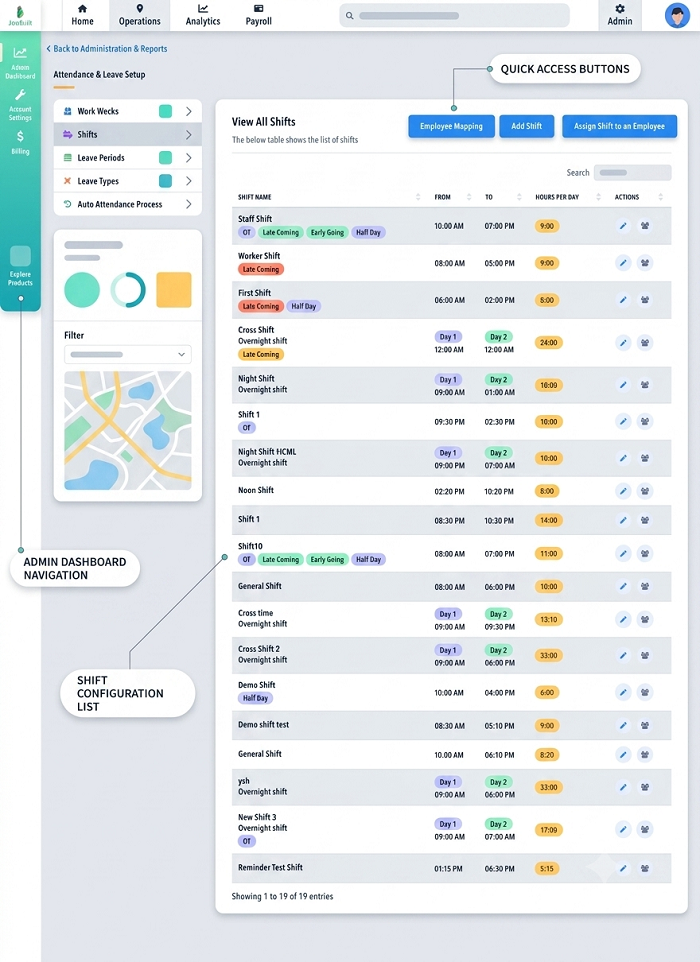
1. Create Clear Warehouse Shift Schedules
The first step is to establish structured shifts based on warehouse operating hours.
For example:
| Shift | Example Timing |
|---|---|
| Morning | 6:00 AM – 2:00 PM |
| Evening | 2:00 PM – 10:00 PM |
| Night | 10:00 PM – 6:00 AM |
Actual schedules should be configured according to the warehouse's operating requirements, employment arrangements, and applicable UAE rules.
Each employee should have a clearly defined shift, department, location, and supervisor.
2. Record Actual Check-In and Check-Out Times
Scheduled hours alone are not enough to calculate overtime.
The system should capture actual:
- Check-in time
- Check-out time
- Breaks, where applicable
- Shift start and end
- Late arrival
- Early departure
- Additional working time
For example, if a warehouse employee is scheduled to finish at 6:00 PM but checks out at 8:00 PM, the additional two hours can be flagged for overtime review.
This provides a clearer record than relying on handwritten timesheets.
3. Separate Scheduled Hours From Overtime
Warehouses should distinguish between normal working hours and additional working time.
A useful workflow is:
Shift Schedule → Employee Check-In → Actual Working Hours → Overtime Detection → Approval → Payroll
This allows HR and supervisors to see whether additional hours were:
- Planned
- Approved
- Automatically detected
- Caused by operational delays
- Caused by employee-specific circumstances
- Still awaiting approval
Separating these records reduces confusion during payroll processing.
4. Use Approval Rules for Overtime
Not every additional attendance period should automatically become approved overtime.
For example, an employee may remain inside the warehouse after a shift because they are waiting for transport rather than performing work.
A controlled overtime process can therefore be:
Overtime Detected → Supervisor Review → Reason Verified → Approval/Rejection → Payroll
Warehouses can define approval rules based on department, shift, supervisor, or business policy.
This creates a clear audit trail for overtime decisions.
5. Track Overtime by Department
Warehouse operations often involve different teams with different workloads.
Overtime can be tracked separately for:
- Receiving
- Put-away
- Inventory
- Picking
- Packing
- Dispatch
- Loading and unloading
- Quality control
- Maintenance
- Security
- Warehouse administration
Department-level reporting helps managers identify where overtime is increasing and whether additional staffing may be required.
6. Monitor Shift Handover Times
Shift handover is the point at which responsibility moves from one warehouse team to another.
A handover may include information about:
- Pending orders
- Receiving activities
- Dispatch status
- Inventory discrepancies
- Damaged goods
- Equipment issues
- Safety incidents
- Urgent shipments
- Pending loading or unloading
- Maintenance problems
The attendance system can record when the outgoing and incoming teams are present, while a separate digital handover checklist can record operational information.
7. Use Digital Handover Checklists
A digital checklist helps ensure that important tasks are not forgotten during shift changes.
For example:
Outgoing Shift → Complete Checklist → Record Pending Work → Report Issues → Incoming Shift Reviews → Accept Handover
A checklist could include:
| Handover Item | Status |
|---|---|
| Pending orders | Completed / Pending |
| Loading bays | Clear / Active |
| Inventory issues | Reviewed / Pending |
| Equipment status | Normal / Issue |
| Safety incidents | None / Reported |
| Urgent shipments | Completed / Pending |
This creates a standardized handover process across shifts.
8. Link Handover Records to Employees and Shifts
Each handover should ideally be connected to the relevant shift and responsible employees.
This can show:
- Outgoing team
- Incoming team
- Handover time
- Supervisor
- Pending tasks
- Exceptions
- Confirmation status
This is particularly useful when a problem is discovered shortly after a shift change and managers need to understand what was handed over.
9. Handle Shift Overlap Properly
Some warehouses intentionally schedule a short overlap between shifts.
For example:
- Outgoing shift: 6:00 AM – 2:00 PM
- Incoming shift: 1:30 PM – 9:30 PM
The overlap gives employees time to exchange information about pending work and operational issues.
A digital scheduling system can identify the overlap and help managers determine whether employees are working beyond their assigned hours.
If the outgoing employee remains after the scheduled end time, the additional period can be flagged for review rather than automatically treated as approved overtime.
10. Manage Overnight and Cross-Day Shifts
Warehouse night shifts often cross midnight.
For example, a shift may begin at 10:00 PM and end at 6:00 AM the following day.
Attendance software should correctly associate both timestamps with the same shift.
The system should distinguish:
- Shift date
- Actual start
- Actual end
- Late arrival
- Early departure
- Overtime
- Shift handover
Accurate cross-day records are important for attendance reporting and payroll calculations.
11. Track Overtime During Peak Periods
Warehouse workloads can increase during seasonal sales, promotional campaigns, major deliveries, or other periods of high demand.
Managers can compare overtime across periods to determine whether additional temporary or permanent staffing is needed.
Useful indicators include:
- Overtime hours per employee
- Overtime by department
- Overtime by shift
- Number of employees working overtime
- Repeated overtime occurrences
- Peak-day overtime
- Approved versus rejected overtime
This allows workforce planning to become more data-driven.
12. Connect Attendance With Payroll
Overtime tracking becomes more valuable when attendance data flows directly into payroll.
A typical workflow is:
Employee Schedule → Attendance → Working Hours → Overtime → Approval → Payroll
HR can then reconcile the payroll inputs with attendance records before processing salaries.
This reduces manual calculations and helps identify discrepancies between approved overtime and recorded attendance.
Employers should configure overtime calculations according to applicable UAE requirements, employment contracts, approved company policies, and any relevant sector-specific rules.
13. Give Supervisors Real-Time Visibility
Warehouse supervisors need a quick view of current staffing conditions.
A workforce dashboard can show:
- Employees currently on duty
- Employees who have checked out
- Late arrivals
- Missing attendance
- Overtime employees
- Open shifts
- Handover status
- Pending operational tasks
This allows supervisors to react quickly when staffing gaps or operational issues occur.
14. Create Exception Alerts
Instead of requiring managers to review every attendance record manually, the system can highlight exceptions.
Examples include:
- Employee worked beyond scheduled hours
- Missing check-out
- Unexpected overtime
- Employee absent from scheduled shift
- Shift handover not completed
- Excessive consecutive working days
- Unapproved additional hours
- Repeated late arrivals
Managers can focus their attention on records that require action.
15. Maintain an Audit Trail
Overtime and handover information should be traceable.
A good system can maintain records of:
- Original schedule
- Actual attendance
- Overtime request
- Approval or rejection
- Handover checklist
- Supervisor comments
- Schedule changes
- Attendance corrections
- Payroll adjustment
This provides a reliable history when HR needs to investigate a payroll or attendance discrepancy.
Best Practices for UAE Warehouses
UAE warehouses can improve overtime and shift handover management by following these practices:
- Maintain clear shift schedules.
- Record actual check-in and check-out times.
- Separate scheduled hours from overtime.
- Use supervisor approval for overtime where appropriate.
- Track overtime by warehouse department.
- Standardize shift handover checklists.
- Record pending work and operational issues.
- Use controlled shift overlap when required.
- Handle overnight shifts correctly.
- Connect attendance and overtime records with payroll.
- Use exception alerts instead of reviewing every record manually.
- Maintain an audit trail for changes and approvals.
- Review overtime trends to improve workforce planning.
- Configure systems according to applicable UAE requirements and company policies.
How Attendance Software Helps UAE Warehouses
A modern attendance and workforce management platform can combine scheduling, attendance, overtime, and handover workflows.
For example:
Schedule Shift → Employee Checks In → Track Working Hours → Detect Overtime → Supervisor Approves → Complete Handover → Payroll
For warehouses operating multiple facilities, centralized dashboards can also provide location- and department-level visibility while allowing authorized managers to access the information relevant to their responsibilities.
Conclusion
Tracking overtime and shift handovers is essential for UAE warehouses that operate multiple shifts or extended working hours. Accurate attendance records help establish when employees actually worked, while standardized handover workflows ensure that important operational information reaches the next team.
By connecting shift scheduling, attendance, overtime approval, handover checklists, and payroll, warehouses can reduce manual work, improve accountability, and gain better visibility into workforce costs and operational continuity.
InnBuilt Shift Management can record UAE warehouse shift boundaries, handovers and approved extra hours, helping supervisors reconcile actual coverage with planned staffing.